2-1 Buydown vs Price Reduction: Which Saves You More?
Discover whether a 2-1 buydown or price reduction is more beneficial. Learn how each option affects your payments and long-term costs.
2-1 Buydown vs Price Reduction: Which Saves You More?

A seller-funded 2-1 buydown almost always beats a price reduction for near-term monthly relief, dollar for dollar. A price reduction almost always wins if you plan to keep the loan for the long haul. That’s the trade: cash flow now versus total cost later.
The exceptions matter more than the rule. If you’re planning to refinance within two or three years, or you’re stretching to make year-one payments work, the buydown usually wins outright. If you want day-one equity, need to avoid mortgage insurance, or plan to hold this loan for decades, the price cut usually wins. Lender concession caps can also shrink or kill the buydown option entirely on some loan programs.
- Short hold or refinance plan: buydown typically wins
- Long-term hold, want equity now: price reduction typically wins
- Tight seller concession limits: may force the choice for you
A $10,000 seller concession used for a 2-1 buydown can significantly reduce your first-year payment by a few hundred dollars a month, while the same amount applied as a price cut tends to reduce your monthly payment by a smaller amount that lasts for the life of the loan. The math behind that gap, and exactly when it flips, is what the rest of this article walks through.
Key Takeaways
A 2-1 buydown delivers larger year-one and year-two cash-flow relief per seller dollar, but a price reduction delivers greater total savings over a long hold.
| Point | Details |
|---|---|
| Short-term relief favors buydowns | On $10,000, a 2-1 buydown can save a large amount in year one versus a much smaller amount from a price cut. |
| Long-term savings favor price cuts | Over 30 years, the same $10,000 price reduction can total around $20,160 in nominal savings versus the buydown’s capped $9,240. |
| Qualification uses the note rate | Lenders calculate your debt-to-income ratio at the full note rate, never the discounted buydown payment. |
| Unused funds go to payoff | Selling or refinancing before the buydown period ends sends leftover escrow funds toward your loan balance, not back to you. |
| Get concession terms in writing | Confirm exact contract wording, escrow deposit details, and program-specific concession caps before closing. |
Table of Contents
- 2-1 Buydown vs Price Reduction: How Each One Actually Works
- What Does the Math Actually Look Like Side by Side?
- When Should You Push for a Buydown Instead of a Price Cut?
- How Do Lenders Qualify You With a Temporary Buydown?
- How Do You Negotiate a Buydown or Price Cut Into Your Offer?
- What Do Experienced Agents See in Real Negotiations?
- The Real Question Isn’t Which Option Is Better
- Sources
- FAQ
2-1 Buydown vs Price Reduction: How Each One Actually Works
A 2-1 buydown doesn’t touch your interest rate on paper. Your note rate, the rate written into your loan documents, stays exactly what you qualified for. What changes is your effective rate for the first two years: 2 percentage points lower in year one, 1 percentage point lower in year two, then it reverts to full note rate in year three and beyond. The seller or builder deposits a lump sum into a buydown escrow account at closing, and the servicer draws down that account every month to cover the gap between what you actually owe at the note rate and the discounted payment you’re making.
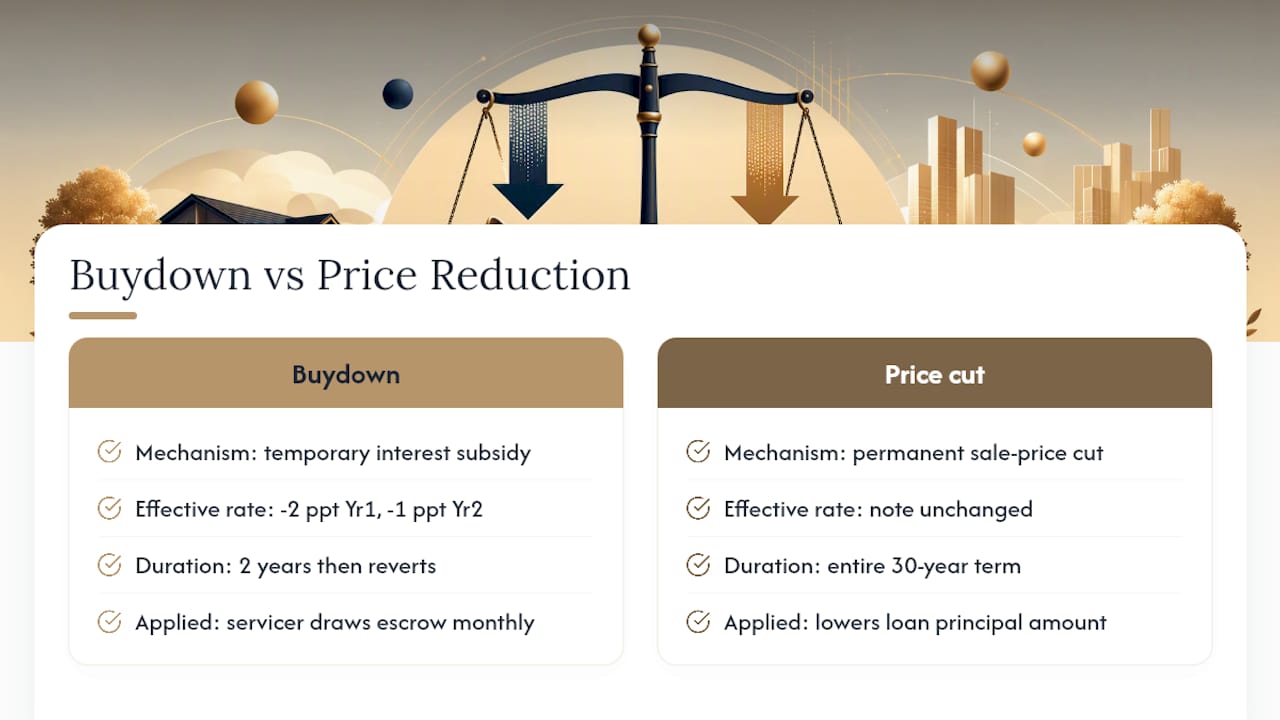
A price reduction is much simpler and much less clever. It lowers the sale price, which lowers your loan amount (assuming the same down payment percentage), which lowers your monthly principal and interest by a small amount for the entire 30-year term. There’s no escrow, no draw-down schedule, and no expiration date on the savings.
Here’s the part that trips people up: those two mechanisms aren’t playing the same game. A buydown attacks the interest calculation temporarily and heavily. A price reduction attacks the principal permanently but lightly, since a smaller loan balance produces smaller savings spread thin across 360 payments. That’s why the same $10,000 concession can feel completely different depending on which bucket it lands in.
Pro Tip: Ask your lender to run both scenarios through an amortization schedule before you decide. Seeing the actual payment numbers side by side, instead of just the concept, makes the choice obvious in about thirty seconds.
One more thing worth flagging before you get attached to either option: seller concessions have caps that vary by loan type (conventional, FHA, VA, USDA), loan-to-value ratio, and occupancy. Your lender needs to confirm your specific cap before you negotiate for either a buydown or a bigger price cut.
What Does the Math Actually Look Like Side by Side?
Let’s use one clean, reusable scenario. Say you’re buying a home for $450,000 with 10% down, financing $405,000 on a 30-year fixed loan at a 6.5% note rate. The seller agrees to a $10,000 concession, and you’re deciding how to deploy it.
- Full note rate, no concession: your principal and interest payment runs about $2,561 a month for all 360 payments.
- 2-1 buydown ($10,000 applied): year one, your effective rate drops to 4.5%, dropping your payment to roughly $2,052. Year two, the rate sits at 5.5%, payment around $2,300. Year three onward, you’re back to the full $2,561.
- Price reduction ($10,000 applied to the sale price): your loan amount drops to $396,000 (assuming the same 10% down), and your payment for all 30 years runs about $2,505, a savings of roughly $56 a month, every month, forever.
Add it up and the gap is stark. In year one alone, the buydown saves you several thousand dollars in cash flow ($509 a month times 12). In year two, it saves a few thousand more. After that, the buydown savings stop completely, since the subsidy escrow only covers the two discounted years. Meanwhile the price reduction has only saved you about $1,344 through those same two years, but it never stops. Run the clock to year five and the buydown’s cumulative lead is around $9,240 versus the price cut’s $3,360. Run it to year 30 and the picture flips hard: the price reduction has delivered roughly $20,160 in total nominal savings, while the buydown’s savings capped out at $9,240 back in year two and never grew another dollar.
That crossover point, where the price reduction’s slow-and-steady savings overtake the buydown’s front-loaded relief, typically lands somewhere between years five and seven in scenarios like this one. It moves earlier or later depending on the concession size, your rate, and your loan balance, but the shape of the curve rarely changes.

One caveat that changes everything: if you sell or refinance before the buydown period ends, any money still sitting in that escrow account typically goes toward paying down your loan balance at closing, not back to you or the seller. So if you’re planning an early exit, you want to make sure you actually use most of that subsidy before it disappears into a payoff.
When Should You Push for a Buydown Instead of a Price Cut?
Your timeline decides this more than anything else. If you know you’ll refinance within 24 to 36 months, either because rates are expected to drop or because this is a starter home, the buydown makes sense. You get the cash-flow relief exactly when you need it, and you refinance out before the rate reverts anyway, letting you capture the temporary savings without ever paying the full note rate.
The buydown also wins when a builder flatly refuses to lower the sale price, which happens constantly in new construction. Builders protect their comps aggressively, since a lower recorded sale price drags down every future listing in the development. A seller-funded buydown lets the builder hold the line on price while still sweetening the deal for a monthly-payment-focused buyer.
- Tight year-one budget after a move, renovation, or job change
- Planned refinance or planned sale within a few years
- Builder or seller who won’t budge on list price but will fund concessions
The price reduction wins in the opposite situations: you’re settling in for the long haul, you want equity in the home on day one instead of two years from now, or a lower purchase price helps you dodge private mortgage insurance by hitting a better loan-to-value ratio.
Pro Tip: If you’re comparing competing offers, remember appraisers and future buyers see the recorded sale price, not the buydown. A price reduction shows up in comps forever; a buydown is invisible to everyone but you and your lender.
How Do Lenders Qualify You With a Temporary Buydown?
This is where a lot of buyers get surprised. Lenders qualify you at the full note rate, not the discounted year-one payment, per Fannie Mae’s guidance on temporary buydowns. Your debt-to-income ratio gets calculated against the $2,561 payment in our example, not the $2,052 you’ll actually pay in year one. That means a buydown never helps you qualify for a bigger loan than you already qualify for at full rate. It just makes the early years more comfortable.
- Seller concession caps vary by loan program (conventional, FHA, VA, USDA) and loan-to-value ratio.
- Confirm your program’s specific cap before negotiating, since exceeding it can force a renegotiation late in the process.
- Temporary buydowns differ fundamentally from permanent discount points, which lower your note rate for the entire loan term in exchange for an upfront payment, and which have their own separate break-even math based on how long you keep the loan.
- You can verify a lender’s licensing through NMLS Consumer Access before you sign anything.
Since qualification runs on the full note rate anyway, don’t let a buydown talk you into a home that’s genuinely a stretch. It’s breathing room for your monthly budget, not a new borrowing ceiling.
How Do You Negotiate a Buydown or Price Cut Into Your Offer?
Get specific in your offer language. Instead of “seller to provide concessions,” write “seller to fund a 2-1 temporary interest rate buydown not to exceed $X, deposited into a buydown escrow account at closing” or “seller to reduce purchase price to $Y.” Vague concession language is how buyers end up disputing terms during underwriting.
- Confirm exactly how the concession appears on the purchase contract, and get the dollar figure or reduced price in writing.
- Ask your loan officer to show you the Loan Estimate with the buydown reflected, then compare it against the Closing Disclosure at the closing table to make sure nothing shifted.
- Ask directly what happens to unused buydown funds if you sell or refinance early, and get that answer in writing from the lender, not just a verbal assurance from the seller’s agent.
Pro Tip: Watch for a seller who quietly raises the list price to “cover” the buydown cost. If the appraisal doesn’t support the higher price, the whole deal can stall. Always check that the buydown or price change matches what your own negotiation strategy called for, not what got added after the fact.
Red flags worth walking away from: contract language that doesn’t match your lender’s documents, a seller who won’t put the buydown terms in writing, or a concession that exceeds your loan program’s cap and forces a last-minute restructure.
What Do Experienced Agents See in Real Negotiations?
Mike Mogavero has spent more than 20 years negotiating Austin real estate deals, and the buydown-versus-price-cut decision comes up on nearly every new construction contract his team touches. Builders in competitive Austin neighborhoods almost never move on price, since a lower recorded sale hurts every comp in the subdivision for months.
- A recent negotiation involved a buyer set on a specific floor plan whose builder refused any price movement to protect community comps.
- The Mogavero Group team redirected the ask toward a seller-funded 2-1 buydown instead, matching the buyer’s known plan to refinance within two years.
- The buyer got the exact cash-flow relief they needed during the window that mattered, without asking the builder to do something it was never going to agree to.
The best concession isn’t always the one that sounds biggest on paper. It’s the one that matches how long you’re actually going to hold the loan.
If you want the numbers run against your own price range and timeline, browse Mogavero Group’s current listings or ask about private, off-market inventory where concession structures tend to be more flexible.
The Real Question Isn’t Which Option Is Better
The conventional advice treats this like a math problem with one right answer. It isn’t. The math tells you which option produces more dollars under a given holding period, but the actual decision hinges on something the math can’t see: how honest you’re being with yourself about how long you’ll keep this loan.
Most buyers overestimate their holding period. They plan to stay ten years and end up refinancing or selling in three, because life doesn’t follow spreadsheets. If there’s any real chance you’ll refinance or move within five years, weight your decision toward the buydown even if the price-cut math looks better on paper for a 30-year hold you might never see.
What gets underrated is asking for both, structured smaller. A partial price reduction plus a smaller buydown often beats going all-in on either one, and it gives you flexibility the pure math doesn’t capture. Run your own numbers before you negotiate. Don’t take a seller’s framing of “we’ll do a buydown instead” as the only option on the table.
This article is general information, not a substitute for advice from a qualified financial advisor. Consult a qualified financial professional about your own circumstances before acting on anything here.
Sources
- 2-1 and 3-2-1 Buydowns Explained | Lower Mortgage
- 2-1 buydown mortgage: how it works and when to use it | Better
- Buydown vs price reduction — Capital Partners Mortgage Services, LLC
- Price Reduction versus Rate Buydown | Advanta Real Estate
FAQ
Is It Smart to Do a 2-1 Buydown?
It’s smart when you expect to refinance or sell within a few years, since you capture the front-loaded savings before the rate reverts to the full note rate. It’s less smart for a buyer planning to hold the loan for decades, where a price reduction usually delivers more total savings.
How Much Does a 2-1 Buydown Save?
How Does a Seller Pay for a 2-1 Buydown?
The seller or builder deposits the agreed dollar amount into a buydown escrow account at closing, and the loan servicer draws down that account monthly to cover the gap between your discounted payment and the full note-rate payment.
Is a Mortgage Rate Buydown Worth It?
It’s worth it if the concession genuinely matches your holding-period plan, since lenders still qualify you at the full note rate regardless of the buydown. Compare the actual amortization numbers for both a buydown and a price reduction before deciding, rather than assuming either one is automatically better.
Recommended
- Austin Home Features: 30% Energy Savings & 15% Value Boost | Mogavero Group Austin Real Estate
- Pocket Listing Real Estate – Discretion and Value Impacts | Mogavero Group Austin Real Estate
- Negotiating in Real Estate – Maximizing Value in Austin | Mogavero Group Austin Real Estate
- Real Estate Market Analysis: Key for Informed Moves | Mogavero Group Austin Real Estate