Austin Homebuyers: Average Commute Is 26 Minutes, Rush Hour Can Top 45
Austin commuters should expect about a 26 minute one way drive, but rush hour often tops 45 minutes. See neighborhood drive ranges, weekday timing tips,...
Austin Homebuyers: Average Commute Is 26 Minutes, Rush Hour Can Top 45

Expect about a 26-minute one-way on a normal day, but that number falls apart during rush hour. Evening congestion adds substantially to typical travel time and morning traffic also adds a significant delay, so a 26 minute drive can stretch well beyond 45 minutes if you leave at the wrong time. The fix is simple: shift your departure by even 20 minutes outside the 7:30 to 8:30 a.m. and 4:30 to 6:30 p.m. windows and you’ll feel the difference immediately.
TL;DR:
- Leaving before 7:15 a.m. or after 9:30 a.m. on weekdays can significantly reduce commute times, especially between Tuesday and Thursday.
- I-35 through downtown is Austin’s most congested corridor, with recurring delays amplified by ongoing construction and high regional traffic volume.
- About one in nine commuters spends an hour or more each way, mainly due to routes crossing bottlenecks or coming from outer suburbs; the average drive is around 25.8 minutes.
- Peak delays are most predictable outside of Tuesday to Thursday midweek, with flexible start times and real-time traffic checks improving commute reliability.
- Incorporating remote work, carpooling, toll lanes, and neighborhood testing can help manage longer or more unpredictable Austin commutes.
Table of Contents
- When Austin’s Rush Hours Really Hit
- What the Commute Data Actually Shows
- The Corridors and Suburbs Driving Austin’s Worst Delays
- Transit, Toll Lanes, and Other Ways to Skip the Drive
- How to Plan Your Commute Day by Day
- What Commute Times Look Like by Neighborhood
- Where These Numbers Come From
- Does Weather Change Austin’s Commute Times?
- How Construction Projects Are Reshaping Commute Times
- An Honest Take on Commute Planning in Austin
- Let Mogavero Group Match Your Commute to the Right Neighborhood
- Sources
- FAQ
When Austin’s Rush Hours Really Hit
Austin traffic follows a predictable rhythm once you know where to look. The morning surge runs from about 7:00 to 9:30 a.m., but the real crunch is a tighter window: 7:30 to 8:30 a.m., when downtown-bound corridors and school drop-off traffic collide. The evening version is longer and, for most commuters, worse. It stretches from roughly 4:30 to 7:00 p.m., with the heaviest volume between 5:00 and 6:00 p.m.
Statistic: TomTom’s 2025 Traffic Index found that evening rush in Austin adds significantly to normal travel time, while morning rush adds a substantial delay. Austin drivers lose many hours a year sitting in that added time.
That gap between morning and evening delay is worth sitting with. It means the drive home is consistently the harder trip to plan around, not the drive in. If you have any flexibility in your schedule, protecting your evening departure time matters more than protecting your morning one.
Weekdays aren’t uniform either, and this is where a lot of newcomers get caught off guard.
- Monday tends to run lighter, with traffic building later, often not kicking into a real peak until closer to 7:15 a.m.
- Tuesday through Thursday are the heaviest days on the road. Start times creep earlier, sometimes near 6:45 a.m., because more people are actually in the office and volume compounds.
- Friday is a mixed bag: mornings are often lighter as hybrid workers stay home, but afternoon traffic can spike early as people leave ahead of the weekend.
This pattern isn’t unique to Austin, but it’s become more pronounced here as hybrid work reshapes the workweek. Texas A&M Transportation Institute research points to hybrid schedules flattening the old two-spike rush hour into a wider midweek bulge, with Tuesday through Thursday now producing the worst delays in many metro areas, Austin included. If you have any control over which days you go into the office, Monday and Friday are your friends.
Here’s the practical version of all this: if your commute runs through downtown or along I-35, leaving by 7:15 a.m. or after 9:30 a.m. usually beats splitting the difference. In the evening, either leave before 4:15 p.m. or wait until after 7:00 p.m.
Pro Tip: Test your actual commute on a Wednesday, not a Monday. Wednesday traffic is closer to what you’ll experience most of the week, and a Monday test drive will make Austin traffic look far better than it really is.
What the Commute Data Actually Shows
The U.S. Census Bureau’s American Community Survey puts Austin’s average one-way commute at 25.8 minutes, based on 2019 to 2023 five-year estimates. That figure has held fairly steady, with FRED’s tracking of Travis County commute data showing a mean around 25.2 minutes in more recent readings. Averages hide the spread, though, and the spread is where the real planning insight lives.
- A majority of Austin workers drive alone to their jobs.
- A significant share work from home, a factor that has reshaped when and how bad rush hour gets.
- A notable portion of commuters spend an hour or more getting to work one way.
That last figure matters. One in nine workers in the Austin area isn’t dealing with a 26 minute drive. They’re dealing with an hour or more, usually because they’re commuting from an outer suburb into the core, or because their route crosses one of the city’s chronic bottlenecks. The 25.8 minute average is real, but it’s an average of a genuinely bimodal experience: short, predictable trips for people near the core, and long, congestion-exposed trips for everyone else.
The high share of remote workers is also doing quiet work on the traffic numbers citywide. When more than a quarter of the workforce isn’t driving in every day, peak volume softens compared to a fully in-office era, even as population keeps growing.
Statistic: TomTom’s 2025 data indicates Austin experiences a sizable average congestion level, meaning a trip that would take 20 minutes with no traffic typically takes notably longer under normal daytime conditions, before factoring in rush hour multipliers.
Translate that congestion level into something concrete: a 15 minute free-flow drive across town becomes closer to 21 minutes on an average weekday, and can climb past 25 minutes if it overlaps with peak windows. The 40.5% figure isn’t a rush-hour number. It’s the baseline drag that’s present most of the day, which is part of why Austin traffic feels persistent rather than confined to two tidy windows.
The Corridors and Suburbs Driving Austin’s Worst Delays
One road causes more Austin commute frustration than any other. I-35 through downtown is the city’s primary choke point, a mix of sheer volume, an ongoing multi-year rebuild project, and a design that funnels regional through-traffic straight into the urban core. If your commute touches I-35 between roughly Riverside and US 290, budget extra time and expect variability day to day, not just delay.
A handful of other corridors show up consistently in TomTom’s Austin data and City of Austin traffic incident records as recurring trouble spots:
- MoPac (Loop 1) backs up heavily during both peaks, especially between the river and Parmer Lane, despite express lane additions meant to ease it.
- US 183 carries heavy cross-town and airport-adjacent traffic and sees frequent incident-driven slowdowns, particularly near the US 290 interchange.
- US 290 west of MoPac is a chronic bottleneck for commuters coming from Oak Hill and points further west.
- SH 71 toward the airport and southeast suburbs gets congested at both peaks and during any special event traffic tied to the airport or nearby venues.
Construction is the variable that makes all of this hard to predict from a spreadsheet. The I-35 rebuild alone has introduced lane closures, shifted traffic patterns, and nighttime work that can spill into morning commutes unpredictably. City of Austin sensor data on incident timing shows that a fender-bender on a corridor like MoPac during peak hours can cost far more time than the everyday congestion around it. Reliability, not just average speed, is often the bigger issue for daily commuters.
With all that context, here’s how suburb-to-downtown drive times generally shake out. These are ranges, not guarantees, and they shift with the corridor and the day of week discussed above.
| Origin area | Off-peak drive time | Peak drive time |
|---|---|---|
| Round Rock / Pflugerville | 25–35 minutes | 45 minutes |
| Cedar Park / Leander | 30–40 minutes | 50 minutes |
| South Austin / Oak Hill | 15–25 minutes | 30 minutes |
| Westlake / West Austin | 15–20 minutes | 25–40 minutes |
Notice the spread on the northern suburbs. Round Rock and Pflugerville can nearly double in drive time at peak, largely because those trips lean heavily on I-35 or MoPac for the final stretch into downtown. Westlake, by contrast, has a shorter peak penalty in absolute minutes, even though it’s not necessarily closer as the crow flies. Corridor exposure matters more than raw distance.
Transit, Toll Lanes, and Other Ways to Skip the Drive
Driving alone isn’t the only option, even if it’s what 58.8% of Austin workers currently choose. CapMetro’s MetroRail runs along the existing rail line connecting downtown to the northern suburbs, including stops useful for commuters from areas like Leander and parts of the northern corridor. It’s a genuinely time-competitive option if your home and workplace both sit near a station, but the last-mile problem is real: MetroRail and CapMetro’s bus network work best when you don’t need a car on either end, and frequencies outside peak service windows can make the schedule feel restrictive.
Toll roads offer a different kind of trade. The Central Texas Turnpike System’s managed lanes give commuters on routes like 183A and portions of 290 a way to buy predictability, paying a variable toll to bypass the worst of general-lane congestion. For someone commuting daily on a route with a reliable toll alternative, the calculation usually comes down to whether the time saved is worth the recurring cost, and for commuters with tight morning meetings or school pickup deadlines, that reliability often wins out over the savings from sitting in free lanes.
A few other levers worth using:
- Carpooling on corridors like I-35 or MoPac can qualify you for HOV access in some segments, cutting real time off a peak-hour trip.
- Flexible start times, even shifting 30 minutes earlier or later, can move you outside the worst of the 7:30 to 8:30 a.m. or 5:00 to 6:00 p.m. windows.
- Hybrid or remote arrangements remain one of the biggest levers in the whole system. With 27.5% of the workforce already working from home at least part-time, that shift is a real reason average congestion hasn’t gotten dramatically worse alongside population growth.
How to Plan Your Commute Day by Day
Good commute planning in Austin comes down to matching your departure time to the day of the week, then double-checking conditions right before you leave. Here’s a working system:
- Know your corridor’s worst window. I-35 and MoPac peak hardest Tuesday through Thursday between 7:30 and 8:30 a.m. and again from 5:00 to 6:00 p.m.
- Build in a buffer on midweek days. If you can leave by 7:15 a.m. or after 9:30 a.m., do it, especially Tuesday through Thursday.
- Check live conditions before you leave, not the night before. Waze and Google Maps both reflect real-time incidents, which matter more on Austin’s corridors than scheduled congestion does.
- Watch the City of Austin’s traffic camera feeds for a visual read on your specific corridor, particularly useful around known incident-prone stretches like the 183/290 interchange.
- Follow local social channels and community groups for incident reports that sometimes surface faster than app data, especially for sudden lane closures tied to the I-35 construction.
- Have a backup route ready, not as an afterthought, but as an actual second plan you’ve driven before.
Pro Tip: Before you commit to a new commute route, drive it at both your real departure times, not just once. A route that looks fast on a Sunday afternoon test can behave completely differently at 8:00 a.m. on a Wednesday.
What Commute Times Look Like by Neighborhood
Commute minutes vary enormously depending on where you land, and neighborhood-level commute data backs up what most longtime residents already know: distance to downtown correlates with commute time, but corridor exposure often matters more than raw mileage.
Downtown offers the shortest and most predictable commute for anyone working in the core. Trips are short enough that even a bad traffic day rarely adds more than 10 minutes. If you can work near where you live, this is the highest-certainty option in the whole city.
East Austin sits close to downtown geographically but leans on corridors like I-35 that carry heavy regional traffic, so proximity doesn’t always translate into speed the way you’d expect.
South Austin and Oak Hill offer more space and often lower housing costs, but commutes into downtown or northwest job centers run through US 290 and MoPac, both known for peak-hour backups.
Northwest suburbs, including Cedar Park and Leander, post the longest raw commute minutes in the metro, and those minutes lean heavily on highway conditions rather than local streets, which makes them the most sensitive to the peak multipliers discussed earlier.
If you’re choosing between neighborhoods, the smarter question usually isn’t “which is fastest on paper” but “which is most predictable for the trip I’ll actually make.” A neighborhood built around your specific lifestyle and commute pattern will serve you better over years of daily driving than one that only wins on a best-case Sunday test drive. In-office commuters should weigh predictability heavily. Hybrid workers have more room to absorb a longer worst-case commute since it happens fewer days a week.
Where These Numbers Come From
The figures in this guide come from a handful of primary sources, each measuring something slightly different. TomTom’s Traffic Index tracks live and historical congestion levels citywide, which is where the peak-hour percentage increases come from. The U.S. Census Bureau’s American Community Survey provides the baseline average commute time and mode-share breakdowns. The City of Austin’s open data portal supplies incident timing and Bluetooth sensor travel-time data that explain corridor-specific variability, and TTI’s Urban Mobility research tracks how hybrid work has reshaped weekly peak patterns.
- City-level averages smooth over block-by-block differences, so any suburb range in this guide is a starting point, not a guarantee.
- Construction schedules and incidents shift week to week, which is why ranges rather than single numbers are more honest.
- Local agents who show properties daily often pick up on patterns that lag behind official data, like which side streets absorb overflow when I-35 backs up.
That last point is where the Mogavero Group’s ground-level experience adds something the data alone can’t: actually driving a potential commute at the times a client will really use it, before they commit to a neighborhood.
Does Weather Change Austin’s Commute Times?
Austin’s traffic patterns shift noticeably with the seasons, and it’s not just about rain. Summer heat, which regularly pushes past 100 degrees, doesn’t slow traffic directly, but it does increase incident rates from vehicle breakdowns and tire failures on aging pavement, particularly on longer highway stretches like I-35 and SH 71.
Rain is the bigger factor. Austin drivers see disproportionate slowdowns during even moderate rainfall because the city’s road network wasn’t built with heavy year-round rain in mind, and drainage issues on low-lying stretches of MoPac and 183 can turn a 10 minute delay into a 30 minute one. The rare ice event, which happens most winters to some degree, can shut down elevated sections of highway entirely and turn a 25 minute average commute into an hour or more citywide.
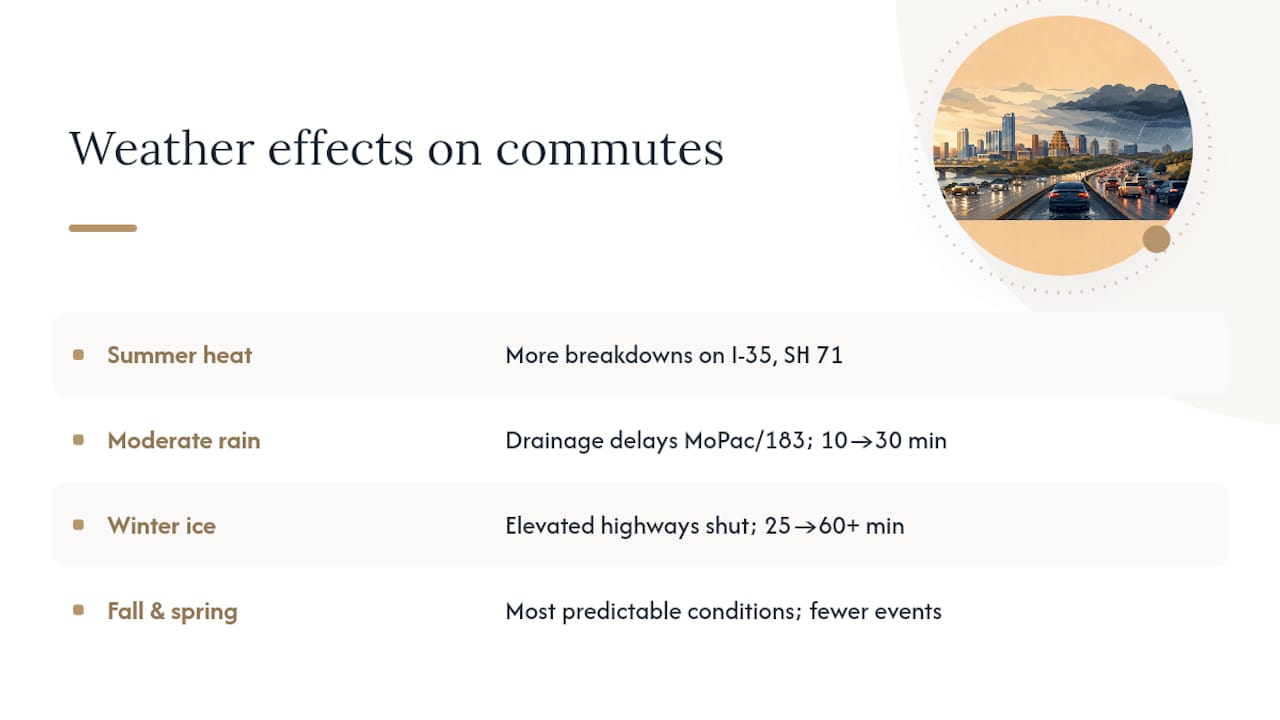
Fall and spring tend to bring the most predictable commute conditions, both in terms of weather and reduced special-event traffic compared to peak festival season in spring and fall. If you’re commute-testing a potential neighborhood, try to do it outside of a major weather event or festival week so you get a realistic baseline rather than an outlier.
How Construction Projects Are Reshaping Commute Times
The single biggest construction factor affecting Austin commutes right now is the multi-year I-35 rebuild through downtown, which has introduced rolling lane closures, shifted traffic patterns, and nighttime work that occasionally bleeds into early morning commutes. Because the project spans years rather than months, its impact isn’t a one-time disruption. It’s a recurring variable that changes month to month as work zones move.

Beyond I-35, smaller projects on MoPac express lane extensions and intersection work along US 290 and 183 add localized delays that don’t show up in citywide averages but matter enormously if your daily route runs through them. A project that adds five minutes to a citywide average can add 20 minutes to your specific drive if you cross its work zone twice a day.
The practical takeaway is to treat any commute estimate as a snapshot, not a permanent fact. A route that’s fine today can degrade for months once a nearby project breaks ground, and a route that’s currently painful can improve once a project wraps. Checking City of Austin’s open traffic data or current construction notices before finalizing a home purchase decision based on commute time alone is worth the ten minutes it takes.
An Honest Take on Commute Planning in Austin
Most people chase the smallest possible commute number and end up disappointed anyway, because a 22-minute commute with wild day-to-day variability feels worse than a steady 30 minute one. Predictability is the variable that actually determines whether a commute wears you down over years, not the average printed on a real estate listing.
If you’re house-hunting, don’t trust a single Sunday drive-by. Test the actual corridor at 7:45 a.m. on a Wednesday and again at 5:30 p.m. Look at neighborhood options with that real experience in hand, not a best-case guess. A slightly longer commute on a reliable route almost always beats a shorter one that turns unpredictable three days a week.
— Mike
Let Mogavero Group Match Your Commute to the Right Neighborhood
House-hunters benefit from guidance beyond traffic apps: knowledge of local flooding patterns and traffic overflow areas can be crucial for choosing a neighborhood. As part of buyer representation, Mike Mogavero and his team can arrange real commute test drives at the times you’d actually use them, matched against neighborhood options that fit both your budget and your tolerance for highway exposure.

Because the team specializes in off-market and pre-construction listings, you also get access to properties that never hit the public market, some in pockets specifically chosen for shorter, more predictable commutes. If commute time is shaping your search the way it should be, reach out through the buyer services page and get a neighborhood shortlist built around how you’ll actually get to work, not just how the map looks on paper.
Sources
- TomTom Traffic Index — Austin, TX
- U.S. Census Bureau 2019–2023 ACS commute estimates (via ArcGIS presentation)
- Texas A&M Transportation Institute — discussion of hybrid-work effects on peak patterns (2025)
- City of Austin — Traffic incidents by time of day (open data)
- CapMetro — MetroRail
FAQ
Is a 27 Minute Commute Too Long in Austin?
A 27 minute one-way commute is right around Austin’s average, based on the Census Bureau’s ACS estimate of 25.8 minutes, so it’s neither unusually long nor especially short for the metro. Whether it feels long depends more on route reliability and which corridors you’re crossing than the raw number itself.
Is $70,000 a Good Salary in Austin?
A reasonable salary can support a reasonable lifestyle in Austin, though it depends heavily on housing choice and commute distance, since suburbs with lower home prices often mean longer drives on congested corridors like I-35 or 183. Buyers balancing salary against commute costs sometimes find that a slightly pricier home closer to work saves more in time and fuel than it costs upfront, something a buyer’s agent can help weigh directly against specific listings.
What Are the Quiet Hours in Austin, Texas?
Austin’s noise ordinance generally restricts loud construction and certain noise activity overnight, typically from around 10:00 p.m. to 7:00 a.m. on weekdays, with specific rules varying by activity type and neighborhood zoning. This matters for commuters near active construction zones, since some road work is scheduled specifically within these overnight windows to reduce daytime traffic disruption.
Is Austin, TX More Liberal or Conservative?
Austin is widely recognized as one of the more politically liberal cities in Texas, often described as a liberal enclave within a conservative state. This dynamic shapes some local policy debates, including transit investment and road expansion decisions, that indirectly affect long-term commute infrastructure.
How Much Does Austin Traffic Really Add to a Commute?
Austin traffic can add substantially to travel time during peak windows, with TomTom’s 2025 data showing evening rush adding about 86.5% and morning rush adding roughly 53% to normal drive times.