Texas Buyer Representation Agreement: What Buyers Must Know
Understand Texas' new buyer representation agreement law starting in 2026. Learn the essential requirements before you buy your next home.
Texas Buyer Representation Agreement: What Buyers Must Know

As of January 1, 2026, Texas law requires any license holder to have a signed written agreement with a prospective residential buyer before showing a home or presenting an offer — no exceptions. That requirement comes directly from Texas Occupations Code §1101.563, and TREC’s official guidance spells out exactly what that agreement must contain.
Here is what that means in practice before you walk through a single door:
- When it applies: Any residential showing or offer submission requires a signed written agreement first, whether you found the property on MLS, at an open house, or through a private listing.
- Your two choices: A showing-only short form (TXR 1507) for initial tours, or a full-services long form (TXR 1501) for complete representation including offer drafting and negotiation.
- Compensation is negotiable: The agreement must state a specific, definite amount — a flat fee, a percentage, or an hourly rate. No open-ended ranges. No vague promises.
Your immediate next steps: ask your agent to show you the TXR 1507 or TXR 1501 before any tour. Confirm the compensation line shows a definite figure. Request a written list of services and a clear termination date before you sign anything.
Key Takeaways
Texas law now requires a written buyer representation agreement before any residential showing or offer — and the form you sign, and what it says about compensation, determines your legal rights and financial exposure throughout the transaction.
| Point | Details |
|---|---|
| Written agreement required by law | Texas Occupations Code §1101.563 mandates a signed agreement before any showing or offer as of January 1, 2026. |
| Short form vs. long form | Use TXR 1507 for showings (flat fee can be $0); use TXR 1501 for full representation including offer drafting. |
| Compensation must be specific | The agreement must state a definite dollar amount, percentage, or hourly rate — ranges and open-ended language do not comply. |
| Buyer may owe the fee | If the seller refuses to pay, Paragraph 7B of TXR 1501 may make the buyer contractually liable for the broker’s compensation. |
| Mogavero Group | Provides transparent, written representation agreements with defined deliverables and off-market access for Austin luxury buyers. |
Table of Contents
- What changed in 2026 and why it matters for Texas buyers
- What a compliant buyer representation agreement must include
- Which TXR form should you use, and when?
- How broker compensation works and who pays if the seller won’t
- How to sign, amend, and exit a buyer representation agreement
- What to confirm before you sign any buyer representation agreement
- How Mogavero Group structures agreements for luxury Austin buyers
- Why written agreements protect buyers more than agents
- Mogavero Group: full-service buyer representation in Austin
- Sources
- FAQ
What changed in 2026 and why it matters for Texas buyers
The 2026 amendment to the Texas Real Estate License Act, codified at §1101.563 of the Texas Occupations Code, created a hard legal floor that did not exist before: a license holder simply cannot show you a home or submit an offer on your behalf without a written agreement already in place.
TREC’s implementation guidance identifies two permissible agreement types:
- Non-representation showing-only agreements — used when a buyer wants to tour a property without committing to full representation. These limit broker duties and do not authorize the agent to draft or negotiate offers.
- Buyer representation agreements — full-service contracts that establish an agency relationship, authorize offer drafting and negotiation, and trigger fiduciary-level duties to the buyer.
The law applies to residential buyers, not commercial transactions. Open houses carry a specific nuance: if the agent hosting the open house is not from the listing broker’s office, that agent must provide the Information About Brokerage Services form (TXR 2501, also called the IABS) and execute a written agreement before showing the property. In practice, TREC’s guidance says the agreement should be presented before the buyer enters the property.
The IABS itself (TXR 2501) is a separate required disclosure that explains brokerage relationships in Texas. It is not a substitute for the buyer representation agreement — both must be provided.
What a compliant buyer representation agreement must include
Texas law and the standard TXR forms require specific content. Before you sign, verify every item below is present and filled in:
- Parties: Full legal names of the buyer(s) and the broker (not just the agent’s name).
- Services to be provided: A written description of what the broker will and will not do.
- Term and termination date: A specific end date is required. Showing-only agreements under TXR 1507 carry a recommended maximum of 14 days for short engagements.
- Exclusivity: Whether the agreement is exclusive (you can only work with this broker) or non-exclusive.
- Market area: The geographic scope of the representation — city, zip codes, or a defined region.
- Compensation: An objectively ascertainable amount — a specific dollar figure, a named percentage, or a stated hourly rate. A range or “to be determined” language does not comply.
- Negotiability disclosure: A conspicuous statement that compensation is not set by law and is fully negotiable.
- Broker obligations: A description of the broker’s duties to the buyer.
- Intermediary authorization (where applicable): If the broker may also represent the seller in the same transaction, the agreement must authorize intermediary status.
The table below maps these required items to the relevant fields on each standard form:
Pro Tip: Before signing, open the form to the compensation paragraph first. If the field is blank, contains a range, or says “per MLS offer,” ask the agent to fill it in with a specific figure before you initial anything.
Which TXR form should you use, and when?
The choice between TXR 1507 and TXR 1501 comes down to one question: are you touring, or are you ready to make an offer?
TXR 1507: the short form for showings
The TXR 1507 short form is built for two scenarios: a showing-only engagement or a brief full-services appointment. For showing-only use, the flat fee can be set at $0, making it a zero-cost way to satisfy the statutory requirement while you evaluate the agent. The term is typically short — one day to two weeks — and the form explicitly limits broker duties. The agent cannot draft or negotiate an offer under a showing-only TXR 1507 unless the agreement is amended.

TXR 1501: the long form for full representation
TXR 1501 covers the complete buyer representation relationship: property search, offer drafting, negotiation, contract management, and closing coordination. It establishes an exclusive agency relationship and includes Paragraph 7B, which addresses what happens if the seller refuses to pay the broker’s fee.
The staged approach most buyers should follow
- Sign TXR 1507 (showing-only, short term, $0 or minimal flat fee) before your first tour.
- Tour the property and assess the agent’s knowledge, responsiveness, and judgment.
- If you want to make an offer, execute the Amendment to Buyer/Tenant Representation Agreement (TXR 1505) to add full services and set compensation, or sign TXR 1501 directly.
- Confirm the compensation figure in the amended or new agreement before the agent submits anything.
Pro Tip: Treat the TXR 1507 as a test drive. NAR’s consumer guide explicitly recommends negotiating duration and fee before signing — a one-day showing agreement costs you nothing and gives you real information about how the agent operates.
How broker compensation works and who pays if the seller won’t
Compensation under a Texas buyer representation agreement is fully negotiable. TREC’s guidance is unambiguous: no law sets a standard commission rate, and the amount must be objectively ascertainable — meaning a specific dollar figure, a named percentage of the purchase price, or a stated hourly rate.
The seller often pays the buyer’s broker through the purchase contract, but that arrangement is not guaranteed. Texas REALTORS® guidance is direct on this point: if the seller refuses or fails to pay the broker’s fee, the buyer may be contractually obligated to pay it under Paragraph 7B of TXR 1501. Read that paragraph carefully. If it specifies a buyer-pay obligation, you are bound by it regardless of what the seller does.
A few practical points on compensation:
- Seller concessions and bonuses: Some sellers offer buyer-agent bonuses or concessions above the listed compensation. Any such payment must still be consistent with the written agreement — a bonus that pushes total compensation above the agreed figure can create compliance issues.
- MLS and objective ascertainability: MLS rules in Texas now require that any compensation offer to buyer brokers be stated as a specific amount, not a range, consistent with the written-agreement requirement.
- Negotiating a seller-obligation clause: When possible, ask that the purchase contract specify the seller will pay your broker’s fee. This does not eliminate your Paragraph 7B liability, but it creates a contractual obligation on the seller’s side.
Pro Tip: Budget broker compensation as part of your total acquisition cost from day one. If the seller pays, that is a benefit — but underwriting your purchase assuming the seller will cover it is a risk you can avoid by reading Paragraph 7B before you sign.
How to sign, amend, and exit a buyer representation agreement
Signing: what to do before you initial anything
- Confirm the form name and version number (TXR 1507 or TXR 1501) in the header.
- Read the term dates — verify the start and end date are filled in and acceptable.
- Check the compensation paragraph for a specific, definite figure.
- Confirm the market area matches where you actually intend to search.
- Review the exclusivity clause — exclusive agreements restrict you from working with other brokers in that market area during the term.
- Sign electronically or in person; both are legally valid in Texas.
Amending: TXR 1505 and when you need it
The Amendment to Buyer/Tenant Representation Agreement (TXR 1505) is the correct form for any mid-agreement change: adding full services to a showing-only agreement, adjusting compensation, extending the term, or changing the market area. Texas REALTORS® guidance stresses that amendments must reflect informed consent and cannot be used to create hidden compensation arrangements or bypass disclosure requirements. Both parties must sign the amendment before it takes effect.
Intermediary authorization becomes necessary when your broker also represents the seller in the same transaction. If that situation arises, the broker must get written consent from both parties before proceeding.
Termination: how to exit and what to watch for
Common red flags in buyer representation agreements:
- Open-ended terms: Any agreement without a specific termination date is noncompliant and should be corrected before signing.
- Automatic renewal clauses: Some agreements include language that extends the term unless you provide written notice. Identify and negotiate these out.
- Vague compensation language: “Customary” or “per MLS” is not a definite amount. Require a specific figure.
To request a release, ask the broker in writing. Most brokers will release a buyer who is genuinely dissatisfied, particularly under a short-term showing-only agreement. Showing-only agreements under TXR 1507 are typically limited to 14 days, which naturally limits your exposure.
Pro Tip: Add a mutual release clause to any long-form agreement before signing. A simple sentence — “Either party may terminate this agreement with [X] days’ written notice” — gives you an exit without requiring the broker’s goodwill.
What to confirm before you sign any buyer representation agreement
Use this checklist every time an agent hands you a TXR form:
- Form identity: Is this TXR 1507 (short form) or TXR 1501 (long form)? Confirm you are signing the right one for your situation.
- Compensation field: Is there a specific dollar amount, percentage, or hourly rate? If blank or vague, do not sign until it is filled in.
- Term dates: Are both the start and end dates present? Is the term length acceptable to you?
- Exclusivity: Does the agreement restrict you from working with other brokers? If so, is the term short enough to be comfortable?
- Market area: Does the defined area match your actual search geography? Overly broad market areas can create unexpected exclusivity problems.
- Services list: Does the agreement describe what the broker will do? For a showing-only agreement, confirm it explicitly excludes offer drafting.
- Amendment process: Ask the agent: “How do we add full services if I want to make an offer?” The answer should reference TXR 1505.
One-line scripts that work:
- “Can you fill in a specific compensation figure before I sign?”
- “I’d like to start with a three-day showing agreement — can we use TXR 1507?”
- “What’s the process to add full services if I decide to make an offer?”
Pro Tip: Treat the compensation figure as part of your acquisition budget, not a separate negotiation. Knowing your total cost — purchase price plus broker fee if the seller won’t pay — lets you make cleaner offers and avoid surprises at closing. Selecting the right agent before you sign is the single best way to avoid renegotiating terms mid-search.
How Mogavero Group structures agreements for luxury Austin buyers
In Austin’s luxury market, the staged agreement approach is not just practical — it is standard practice for buyers who want to evaluate an agent’s off-market access and market knowledge before committing to a full-service engagement.
Mogavero Group typically structures initial engagements using TXR 1507 for property tours, particularly when a buyer is new to Austin or comparing neighborhoods like Lake Austin or East Austin. The showing-only form is set to a short term with a flat fee at or near $0, giving the buyer a genuine, low-commitment look at how the team operates.
When a buyer is ready to move forward, Mogavero Group executes TXR 1505 to amend the showing agreement or signs TXR 1501 directly. For concierge and off-market work, the compensation structure often reflects the scope:
- Flat fee component: Covers defined deliverables — off-market sourcing, architectural walkthroughs, pre-construction analysis.
- Percentage-based success component: Tied to the purchase price at closing, negotiated and stated as a specific figure in the agreement.
- Deliverables clause: The long form specifies what the team will provide, which protects the buyer’s expectations and justifies the negotiated fee.
Pro Tip: If you are buying in a market where off-market inventory matters — and in Austin’s luxury segment, it often does — use the representation agreement to specify off-market sourcing as a required deliverable. An agent who cannot commit to it in writing may not have the access you need. Why Austin attracts luxury buyers worldwide explains why that access is increasingly the differentiator.
Why written agreements protect buyers more than agents
Most buyers approach a buyer representation agreement as something they are asked to sign for the agent’s benefit. That framing is backwards.
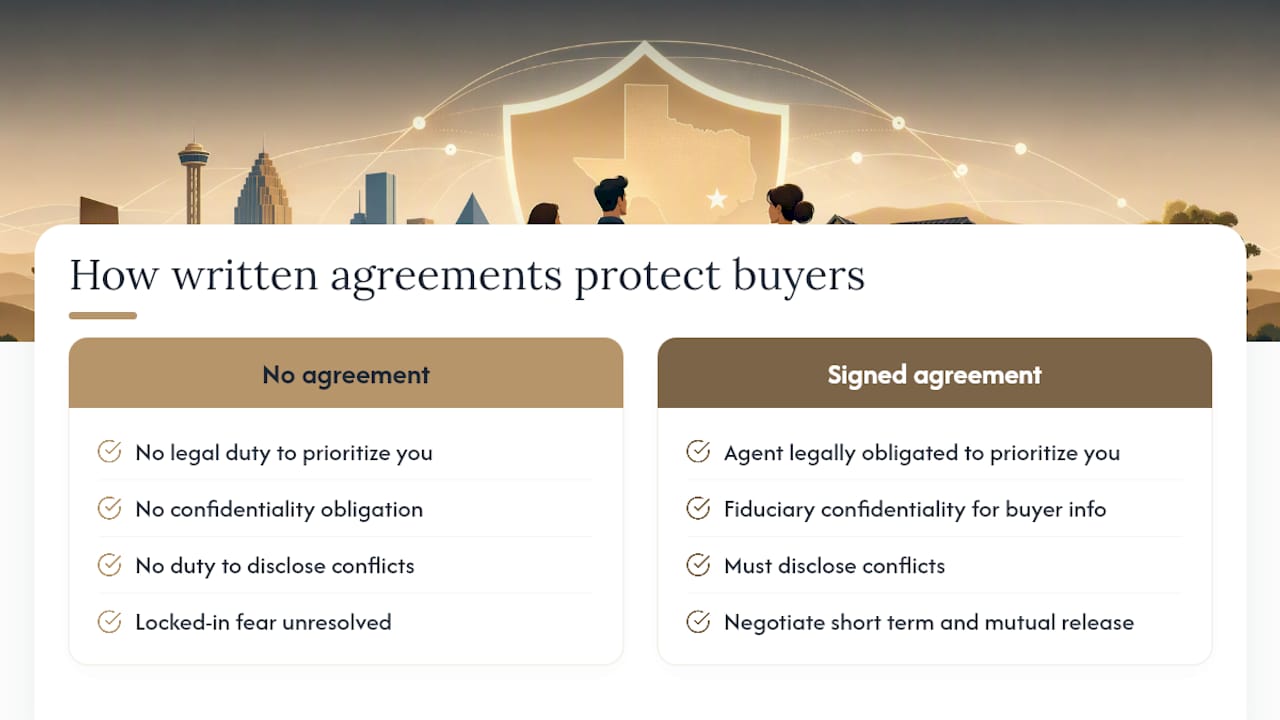
The written agreement is the document that legally obligates the agent to you. Without it, an agent in Texas has no documented duty to prioritize your interests, maintain your confidentiality, or disclose conflicts. The 2026 statutory change did not create paperwork for paperwork’s sake — it created a legal hook that buyers can use to hold agents accountable.
Common buyer fears about signing, and why they are manageable. Being “locked in” is a real concern, but it is solved by negotiating a short term and a mutual release clause before you sign — not by avoiding the agreement. Unanticipated fees are addressed by reading Paragraph 7B and the compensation field before you initial anything. Neither fear requires you to avoid the agreement; both require you to read it.
The agreement also protects your confidential information. Once signed, the broker owes you fiduciary duties including confidentiality about your financial position, your motivation to buy, and your negotiating limits. An agent who has not signed a representation agreement with you has no legal obligation to keep that information private.
Use the agreement to define service levels explicitly. If you expect weekly market updates, off-market sourcing, or architectural input, write it into the services description. Vague agreements produce vague service — and no legal remedy when expectations are not met.
Mogavero Group: full-service buyer representation in Austin
Mogavero Group gives Austin luxury buyers something most representation agreements only gesture at: a team that specifies deliverables in writing and then delivers them. With over 20 years in the Austin market, Mike Mogavero and his team handle showing coordination, offer drafting, contract negotiation, and off-market sourcing as defined services, not afterthoughts.

When you sign representation with Mogavero Group, the onboarding conversation covers your search criteria, target neighborhoods, budget, and timeline — and the compensation structure is stated clearly in the agreement before you tour a single property. There are no surprises in Paragraph 7B because the team walks through it with you before you sign.
For buyers seeking properties that never hit the MLS, access to private luxury listings is part of what full-service representation means here. To request a consultation or review current off-market inventory, contact the Mogavero Group directly through the private listings page.
Sources
The following official sources let you verify the law and download the exact forms referenced throughout this article:
- What Changes in 2026 About Buyer/Tenant Representation in Texas | TREC
- Buyer’s Representation – Texas REALTORS®
- Consumer Guide to Written Buyer Agreements | NAR
- Statutes
FAQ
Is a buyer representation agreement required in Texas?
Yes. As of January 1, 2026, Texas Occupations Code §1101.563 requires a signed written agreement before a license holder shows residential property or presents an offer on a buyer’s behalf.
How do I get out of a buyer representation agreement in Texas?
Ask the broker for a written release. Showing-only agreements under TXR 1507 are typically short-term (often 14 days or less), so they expire quickly. For long-form agreements, a mutual release clause negotiated before signing is the cleanest exit.
What is the most common buyer representation agreement in Texas?
Texas REALTORS® members most commonly use TXR 1501 (the long form) for full-service representation and TXR 1507 (the short form) for showing-only or brief engagements. TXR 1505 is the standard amendment form used to modify either agreement.
Can a seller refuse to pay the buyer’s agent?
Yes. A seller is not legally required to pay the buyer’s broker. If the seller refuses, Texas REALTORS® guidance notes that Paragraph 7B of TXR 1501 may make the buyer contractually liable for the broker’s fee — which is why reading that paragraph before signing matters.
Recommended
- 7 Essential Real Estate Investment Tips for Austin Buyers | Mogavero Group Austin Real Estate
- Why Use a Buyer’s Agent in Austin Luxury Homes | Mogavero Group Austin Real Estate
- Master the Home Buying Process Workflow in Austin | Mogavero Group Austin Real Estate
- Negotiating in Real Estate – Maximizing Value in Austin | Mogavero Group Austin Real Estate