Closing Costs in Texas 2026: What Buyers and Sellers Pay
Discover what closing costs in Texas will look like in 2026 for buyers and sellers, including essential tips to save money.
Closing Costs in Texas 2026: What Buyers and Sellers Pay
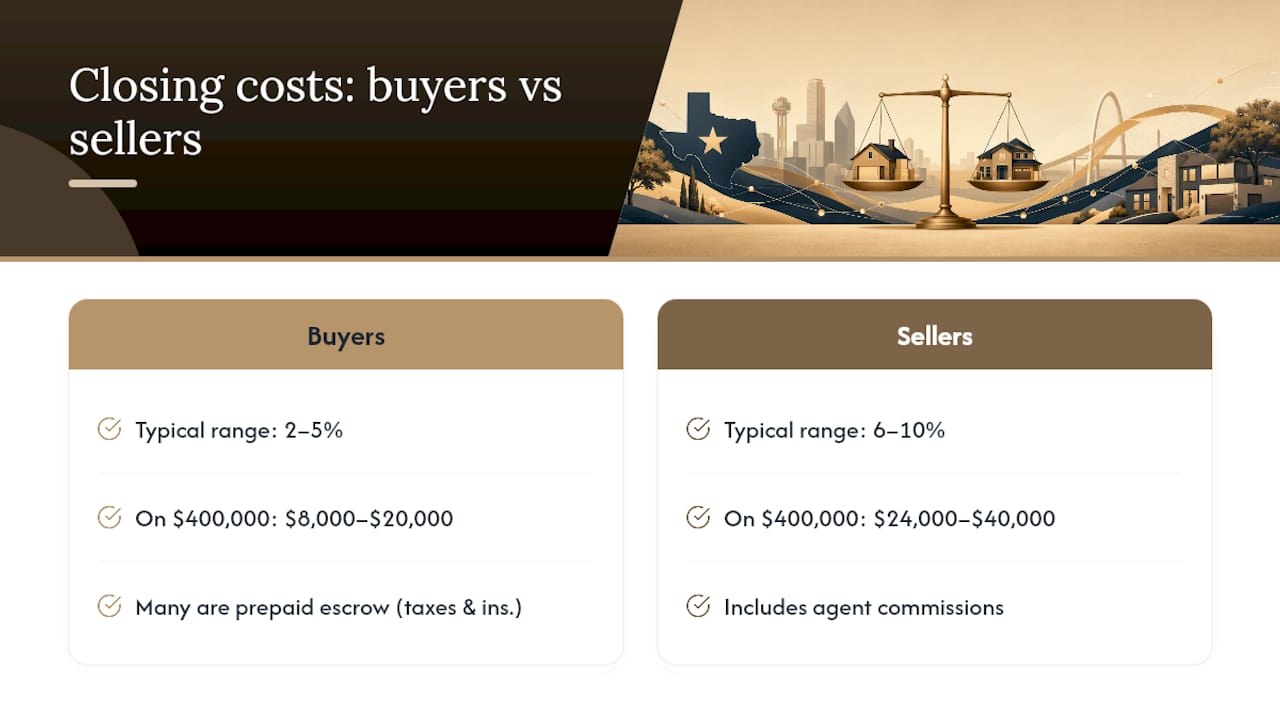
Buyers in Texas typically pay 2% to 5% of the purchase price in closing costs, while sellers pay roughly 6% to 10% once agent commissions are factored in. On a $400,000 home, that puts buyer costs around $8,000 to $20,000, and seller costs around $24,000 to $40,000. A big chunk of what buyers pay isn’t a fee at all. It’s prepaid escrow for property taxes and homeowners insurance, money you’d owe eventually anyway. Your next move: pull your Loan Estimate and get quotes from at least three lenders before you sign anything.
Key Takeaways
| Point | Details |
|---|---|
| Buyer range | Expect 2% to 5% of purchase price, or $8,000 to $20,000 on a $400,000 home. |
| Seller range | Expect 6% to 10% including commission, or $24,000 to $40,000 on a $400,000 home. |
| Prepaids drive cash needs | Property tax and insurance escrow often outweigh actual lender fees in Texas. |
| Everything is negotiable | Seller concessions, lender credits, and repair-driven credits can shift who pays what. |
| Local expertise matters | Mogavero Group coordinates lenders, title, and negotiations to catch surprises before closing day in Austin. |
Table of Contents
- How Much Are Closing Costs in Texas in 2026?
- What Do Buyers Pay in Closing Costs?
- What Do Sellers Pay When Closing in Texas?
- How Are Closing Costs Different for New Construction?
- Who Pays Closing Costs in Texas, and What Can You Negotiate?
- How Can You Reduce Your Closing Costs?
- When Are Closing Costs Due, and How Do You Pay Them?
- What Texas-Specific Rules Should You Know?
- Sample Calculation: What Would You Pay on a $400,000 Home?
- An Austin Agent’s View on Closing-Day Surprises
- How Mogavero Group Helps You Manage Closing Costs
- Sources
- FAQ
How Much Are Closing Costs in Texas in 2026?
Statewide, the math hasn’t shifted dramatically from prior years, but Texas property tax rates and insurance premiums keep pushing prepaid costs higher, which changes the real dollar figure even when the percentage range stays flat.
Buyers land in the 2% to 5% range of the purchase price. Sellers usually see 6% to 10% once you count the commission split, which remains the single biggest line item on their side.
Here’s what that looks like in real dollars:
- A $350,000 home: buyer costs run about $7,000 to $17,500; seller costs run about $21,000 to $35,000.
- A $400,000 home: buyer costs run about $8,000 to $20,000; seller costs run about $24,000 to $40,000.
Why such a wide spread? Loan type matters (an FHA loan carries different insurance requirements than a conventional one), lender fees vary by shop, county tax rates swing the escrow amount, and how much the seller agrees to concede changes the buyer’s final number substantially. Two buyers closing on identical houses two counties apart can pay noticeably different amounts purely because of local tax rates.
What Do Buyers Pay in Closing Costs?
Buyer costs break into three buckets: lender fees, third-party services, and prepaids. The prepaids bucket is usually the biggest surprise.
Lender-related fees:
- Loan origination fee: typically 0.5% to 1% of the loan amount
- Underwriting fee: often $400 to $900, sometimes bundled into origination
- Rate lock fee: usually included, but ask if it’s separate
Third-party fees:
- Appraisal: $450 to $700 for a standard single-family home
- Home inspection: $350 to $600 depending on square footage
- Survey: $400 to $600 (often required by lenders and title companies)
- Flood certification: $15 to $25, small but almost always present
Title costs work a little differently in Texas. You’ll typically pay for the lender’s title policy, which protects the bank, while the owner’s policy protecting you is customarily paid by the seller under TREC’s promulgated contract forms, though this is negotiable.
Then there’s the part that actually drives most of your cash-to-close: prepaids. You’ll fund an escrow account covering several months of property taxes and homeowners insurance up front. In high-tax counties around Austin, this single line item can dwarf every lender fee combined.
Pro Tip: Ask your lender for a “cash-to-close” worksheet, not just a fee estimate. The worksheet separates true transaction costs from prepaid escrow, so you know how much of your check is a fee versus money that was always going to be yours to pay eventually.
What Do Sellers Pay When Closing in Texas?
Commissions dominate the seller side. On a $400,000 sale, a 6% total commission split between listing and buyer’s agents comes to $24,000, right off the top before anything else gets calculated.
- Agent commissions: usually 5% to 6% combined, the largest single deduction from proceeds.
- Owner’s title policy: customarily paid by the seller in Texas, though the contract controls this, not tradition.
- Prorated property taxes and HOA dues: calculated for the days you owned the home in that billing cycle.
- Mortgage payoff and lien releases: your existing loan balance plus any recorded liens must clear before title transfers.
- Deed preparation and recording fees: modest, usually a few hundred dollars total.
Sellers can also offer concessions, agreeing to cover part of the buyer’s closing costs, which reduces net proceeds further but often speeds up a sale or fixes an appraisal gap.
How Are Closing Costs Different for New Construction?
New-construction buyers often pay less out of pocket upfront because builders dangle incentives: closing cost credits, rate buydowns, or upgraded finishes instead of a price cut. Resale buyers negotiate directly with a homeowner and have more flexibility on inspection-driven credits.
- Builder incentives can lower your effective cash-to-close, but read the fine print. Some incentives only apply if you use the builder’s preferred lender.
- Resale deals typically offer more room to negotiate seller-paid closing costs based on inspection findings.
- New-construction title work is sometimes simpler since there’s no existing mortgage to pay off.
Pro Tip: Builders love pushing their in-house lender because it keeps the deal, and the closing costs, in the family. Comparing their offer against two outside lenders often nets you a better rate even after accounting for any credit you’d lose.
Who Pays Closing Costs in Texas, and What Can You Negotiate?
Custom in Texas assigns buyers the financing fees and prepaids, and sellers the owner’s title policy and commission. But “customary” isn’t “mandatory.” Everything on that Closing Disclosure is negotiable if both sides agree in writing.
- Seller concessions: seller agrees to pay a portion of buyer’s closing costs, common when a home has sat on the market or an appraisal comes in low.
- Lender credits: you accept a slightly higher interest rate in exchange for cash toward closing, useful if you’re short on liquid funds but plan to refinance later.
- Rate versus credit tradeoff: paying discount points lowers your rate long-term; taking a credit lowers your cash needed now. Run both scenarios before choosing.
- Repair credits versus price cuts: after inspection, a credit toward closing costs is often easier to negotiate than a straight price reduction.
Check your lender’s cap on seller contributions. FHA and VA loans limit how much a seller can contribute, and exceeding that limit voids the excess.
Pro Tip: Use inspection report line items as leverage for a closing-cost credit, not just a repair request. Sellers often prefer writing a check at closing over scheduling contractors, and it keeps the negotiation focused on dollars instead of disputes over workmanship.
How Can You Reduce Your Closing Costs?
Shop lenders like you’d shop anything else worth thousands of dollars, because the spread between quotes is often wider than people expect.
- Get Loan Estimates from at least three lenders and compare Section A (origination charges) line by line, not just the headline rate.
- Ask the seller for a concession, especially in a slower market or after a below-asking appraisal.
- Decide between lender credits and points based on how long you plan to keep the loan; credits win for short holds, points win for long ones.
- Request an itemized bill from the title company. Some fees, like courier charges or document prep, are negotiable or waivable entirely.
- Ask about rolling prepaid items into the loan amount if your cash reserves are tight and the math still pencils out.
Pro Tip: Verify any lender offering credits or special terms through NMLS Consumer Access before you sign a rate lock. It takes five minutes and confirms the company is actually licensed to operate in Texas.
When Are Closing Costs Due, and How Do You Pay Them?
Timing is federally regulated, and missing the window causes real delays.
- You receive your Loan Estimate within three business days of applying for a mortgage, per HUD rules.
- Your lender must issue the Closing Disclosure at least three business days before your loan closes, giving you time to compare it against the original estimate.
- On closing day, funds move by cashier’s check or wire transfer, and the title company disburses payoffs, fees, and proceeds simultaneously.
- Always call the title company using a number you look up independently to confirm wiring instructions. Wire fraud targeting real estate closings remains one of the most common scams in the industry, and a last-minute email “change” is the biggest red flag.
What Texas-Specific Rules Should You Know?
Texas skips a few costs that trip up buyers moving from other states.
- No state real-estate transfer tax. That’s one line item you simply won’t see on a Texas Closing Disclosure.
- No mandatory closing attorney. Title companies and escrow officers handle most transactions, which tends to keep closing costs lower than states requiring attorney review.
- Owner’s title policy custom: sellers usually pay it, but confirm the contract since this is negotiable, not automatic.
- County variation matters. Recording fees and property tax billing cycles differ enough county to county that your cash-to-close can shift by a meaningful amount based purely on location.
Sample Calculation: What Would You Pay on a $400,000 Home?
Here’s a worked example using a $400,000 purchase price.
Buyer scenario:
- At 2% (low end, cash purchase or strong lender pricing): $8,000 in closing costs.
- At 4% (typical financed purchase with escrow prepaids): $16,000 in closing costs.
- Add roughly $3,000 to $5,000 more if your county’s property tax escrow requirement runs high, which is common around Austin.
Seller scenario:
- Sale price: $400,000. Commission at 6%: $24,000. Add owner’s title policy, prorations, and payoff fees, and total seller-side costs land near $28,000 to $32,000, leaving net proceeds after mortgage payoff.
Closing checklist before you sign:
- Confirm your final numbers match the Closing Disclosure, not just your original Loan Estimate.
- Ask the title company for an itemized breakdown of every fee over $50.
- Ask your lender directly whether any credits or points changed between estimate and closing.
An Austin Agent’s View on Closing-Day Surprises
The surprises that blow up a closing timeline in Austin are rarely the fees everyone expects. They’re the old HOA lien nobody disclosed, a survey that reveals an encroaching fence line, or a payoff amount that’s higher than the seller remembered because of a second lien from years back.
Catching these early means running title work and HOA estoppel letters the moment a contract is signed, not the week before closing. Coordinating directly with the lender’s processor and the title officer on timeline also prevents the classic last-minute scramble where a Closing Disclosure surprise pushes the date. After more than 20 years working Austin’s luxury market, the deals that close smoothly are the ones where someone caught the weird stuff on day three, not day thirty.
How Mogavero Group Helps You Manage Closing Costs
Mogavero Group is the alternative to guessing your way through closing math: instead of piecing together lender quotes, title estimates, and seller negotiations on your own, you get a team that’s coordinated hundreds of Austin closings and knows exactly where the local surprises hide.

We help you compare lender offers, flag prepaid escrow amounts before they blindside your cash-to-close, and negotiate seller concessions that actually stick in the contract. For buyers hunting something off the beaten path, our access to private, off-market listings comes with the same concierge-level closing support, no surprises, no guesswork on fees. If you’re weighing a purchase in Lake Austin or anywhere else in the city, reach out for a consultation and we’ll walk through your specific numbers before you ever sign a Loan Estimate.
Sources
- Closing costs explained: Your updated guide for 2026 — Rocket Mortgage
- Typical closing costs in Texas for buyers and sellers — Herring Bank
- HUD portal
- TREC contract forms (CN 1-3) — Texas Real Estate Commission
- NMLS Consumer Access — company details
FAQ
How much is the closing cost on a $400,000 house in Texas?
Is 2026 a good time to buy a house in Texas?
Who usually pays closing costs in Texas?
Buyers customarily cover financing fees and prepaid escrow, while sellers typically pay the owner’s title policy and agent commissions, though contract terms control the final split.
How much are closing costs for a $400,000 house?
Combined, buyer and seller closing costs on a $400,000 Texas home typically total somewhere between $32,000 and $60,000, split unevenly with sellers usually paying more due to commission.
Recommended
- Must-have amenities in Austin homes for 2026 buyers | Mogavero Group Austin Real Estate
- How to Stage Your Austin Home to Boost Sale Price in 2026 | Mogavero Group Austin Real Estate
- Master the Home Buying Process Workflow in Austin | Mogavero Group Austin Real Estate
- How to Price Austin Property for Maximum Seller Value | Mogavero Group Austin Real Estate