Budget 2–5% for Closing: Real Cost to Build a Luxury Home in Austin
What Austin luxury buyers pay beyond the sticker price: total monthly ownership, closing costs (2–5%), taxes, HOA, and the timing risks you must budget for.
Budget 2–5% for Closing: Real Cost to Build a Luxury Home in Austin
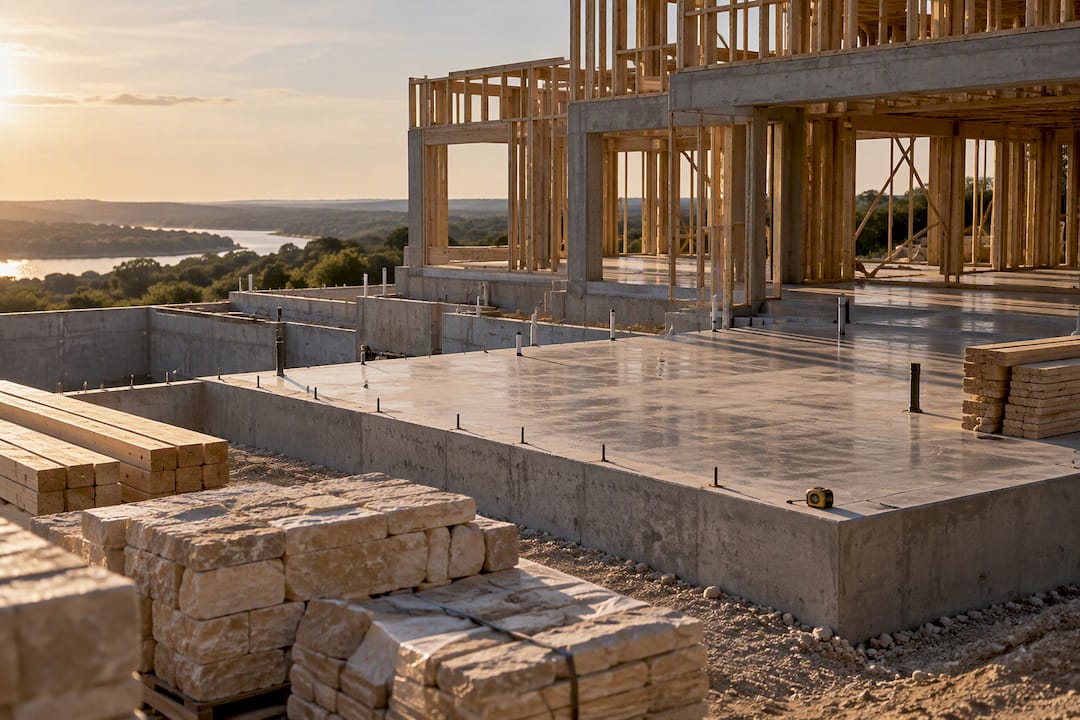
The base price on a builder’s listing or a pre-construction floor plan is rarely what you’ll actually pay. Current Austin luxury market data points to the same discipline: run total monthly ownership (mortgage, taxes, HOA or district fees, insurance) and a cash-to-close estimate before comparing any two properties, because this number, not the sticker price, decides whether a home fits your budget.
TL;DR:
- Property taxes, MUD or PID assessments, HOA dues, and insurance costs often exceed initial estimates, impacting monthly affordability significantly.
- Inventory homes or spec properties typically offer stronger negotiation leverage and faster closing options compared to custom pre-construction builds.
- Builder incentives vary in value; permanent rate buy-downs and incentives with expiration dates require careful review of official documentation before negotiations.
- Lot premiums, site work, permit fees, and lot-specific code requirements can substantially increase the actual cost compared to advertised base prices.
- Buyers should create a comprehensive total-cost worksheet covering taxes, fees, and estimates to effectively compare properties and avoid surprises at closing.
Table of Contents
- Cost to Build a House Austin Buyers Should Actually Budget For
- How Austin’s Luxury Market Tiers Shape Your Leverage
- Negotiating Incentives and Timing Your Purchase
- Three Real-World Purchase Scenarios in Austin
- What Closing Actually Costs, and Texas’ Title Insurance Rules
- Where Construction Costs Actually Go in Austin
- How Austin’s Building Codes Affect Your Price
- From Contract to Move-In: Realistic Austin Timelines
- Why Design Choices Swing the Price So Much
- What a Lot Really Costs Once Site Work Begins
- How Neighborhood Location Changes Your Total Cost
- Mike Mogavero’s Take on Buying Right in This Market
- How Mogavero Group Helps You Buy the Right Home for the Real Price
- Sources
- FAQ
Cost to Build a House Austin Buyers Should Actually Budget For
When people search for the cost to build a house in Austin, they’re usually pricing a purchase or a pre-construction contract, not swinging a hammer themselves. That number breaks into layers most listings never show you.
Start with the base price, then stack the lot premium (corner lots, greenbelt views, and cul-de-sac positions often add a separate line item), structural options chosen before the slab pours, and design-center upgrades picked after. Builders sometimes present these as a single “as-built” figure. Ask for the itemized version. Structural changes typically cost more per square foot than the same finish added later through a remodel, so sequencing matters.
Your monthly payment view needs three pieces: principal and interest, escrowed property taxes, and homeowners insurance. In Texas, taxes get folded into your monthly mortgage escrow, and that escrow is calculated off the completed home’s appraised value, not the dirt lot’s pre-construction assessment.
Ongoing carrying costs to verify before you sign anything:
- Property taxes based on the county’s effective rate against the finished appraisal
- MUD or PID assessments, which can run well above standard city tax rates in newer developments
- HOA dues, plus any special assessments tied to shared amenities
- Homeowners insurance, which climbs with square footage and rebuild cost
One-time costs at purchase include lender fees, appraisal, title and escrow charges, and prepaid taxes and insurance funded at closing. Local guides note that new construction buyers routinely underestimate the property-tax and HOA carrying costs tied to a completed home, since builders often quote a partial-year or lot-only tax figure during the sales process.
Pro Tip: Before you tour another home, build a one-page worksheet: projected finished appraisal times county tax rate, plus HOA/MUD dues, plus estimated principal and interest, plus insurance. That single number is what you compare across properties, not the base price.
How Austin’s Luxury Market Tiers Shape Your Leverage
Not every price band in Austin behaves the same way, and that difference decides how much room you have to negotiate.
Entry-luxury inventory tends to move faster, with tighter days-on-market and less room to push on price. Higher tiers often carry more inventory relative to buyer demand, which means longer time on market and more willingness from sellers or builders to talk. The July 2026 Austin luxury market report tracks these differences by tier, including days on market and sale-to-list ratios that reveal where sellers are actually accepting price adjustments.
Spec and inventory homes, meaning completed or nearly completed builder-owned properties not yet sold, frequently carry stronger incentive packages than a ground-up custom contract. Builders are financing that home’s carrying costs every month it sits unsold, so they’re often motivated to move it.
Before you write an offer, do this:
- Identify which price tier your target home falls into
- Pull the current supply and days-on-market data for that tier
- Compare spec inventory against ground-up options in the same price band
- Note whether the builder or seller has multiple similar units competing for buyers
A home in a tier with rising inventory and slower turnover gives you more negotiating room than the same home in a tight, fast-moving segment.
Negotiating Incentives and Timing Your Purchase
Builder incentives aren’t interchangeable, and treating them as equal value is one of the more expensive mistakes buyers make.
A permanent interest-rate buydown lowers your monthly payment for the life of the loan. A temporary buydown only softens the first year or two of payments before reverting to the note rate. Design allowances need scrutiny too, since builders sometimes mark up allowance categories above what an independent designer would charge for the same materials.
Before you negotiate, request these documents:
- A projected appraisal value for the completed home
- The county’s current effective tax rate, plus any MUD or PID tax schedule
- The HOA’s budget and reserve study, not just the dues figure
- Full written terms of any builder incentive, including expiration dates
Timing strategy: prioritize spec and inventory homes when you want negotiating leverage and a faster close. Reserve ground-up customization for cases where the design changes are worth paying a premium over, since custom builds rarely come with meaningful price flexibility.
Pro Tip: A low HOA reserve fund is a red flag even when dues look modest. If the reserve study shows a thin cushion, expect a special assessment within a few years, and factor that into your monthly ownership number now.
Watch for builder pricing opacity (refusing to itemize options), reserve studies that haven’t been updated in years, and any mention of “potential future assessments” without a dollar figure attached.
Three Real-World Purchase Scenarios in Austin
Numbers get clearer with examples. Here’s how three common purchase paths translate a base price into what you’ll actually pay monthly and at closing.
Scenario A: Spec home with a price concession and permanent buydown. A completed inventory home lists at $1.2 million. The builder, motivated to move a carrying-cost property, offers a $30,000 price reduction plus a permanent rate buydown of half a point.
Scenario B: Pre-construction custom build with lot premium and upgrades. A buyer selects a $1.5 million base plan on a premium lot adding $150,000, then layers in roughly $80,000 of structural and design-center upgrades. The final contract price runs well above the advertised base, and because there’s no completed comparable to appraise against yet, tax escrow estimates during construction often understate the eventual bill.
Scenario C: Off-market or pocket-listing negotiation. A buyer working through private listing access negotiates directly with a seller motivated by timeline flexibility rather than public market exposure. Seller credits toward closing costs and an extended rent-back period reduce upfront cash needs, even when the negotiated price sits closer to asking.
- Spec purchases favor immediate savings and predictable monthly costs
- Pre-construction custom builds favor design control at a real cost premium
- Off-market deals favor flexible terms over public-market price discovery
What Closing Actually Costs, and Texas’ Title Insurance Rules
Buyer closing costs in Austin typically run 2% to 5% of the purchase price, and prepaid taxes plus escrow setup are usually the single largest line item because of Texas’ comparatively high property tax rates.
Texas custom generally has the seller pay for the buyer’s owner’s title policy, which lowers buyer title costs relative to many other states. That doesn’t eliminate your cash-to-close burden, since you’re still funding prepaid taxes, escrow reserves, lender fees, and your own title insurance obligations tied to the loan policy.
Buyer closing costs commonly include:
- Lender origination and underwriting fees
- Appraisal and survey costs
- Escrow account funding for taxes and insurance
- Recording fees and any HOA transfer charges
For exact title premium math on a high-value transaction, the Texas Department of Insurance’s rate order effective March 1, 2026 publishes the official bracket multipliers and worked calculation examples. On a luxury purchase, that schedule is worth reviewing directly rather than relying on a rough estimate from a closing agent.
Where Construction Costs Actually Go in Austin
Even when you’re buying rather than physically building, understanding what drives a builder’s price helps you evaluate whether a quote is fair. Labor accounts for a large share of total build cost in Austin, and skilled-trade availability tightens during high-demand periods, pushing framing, electrical, and finish-carpentry rates up. Material costs fluctuate with lumber, concrete, and specialty finish pricing, and luxury-tier finishes (natural stone, custom millwork, high-end HVAC systems) carry a proportionally larger cost impact than they would on a standard-tier home.
Permit fees in the City of Austin and surrounding jurisdictions vary by project scope, and builders typically pass these through as a line item rather than absorbing them. Utility connection costs, meaning tap fees for water, wastewater, and electric service, can vary significantly depending on whether the lot sits within existing city infrastructure or requires extension into a newer development.
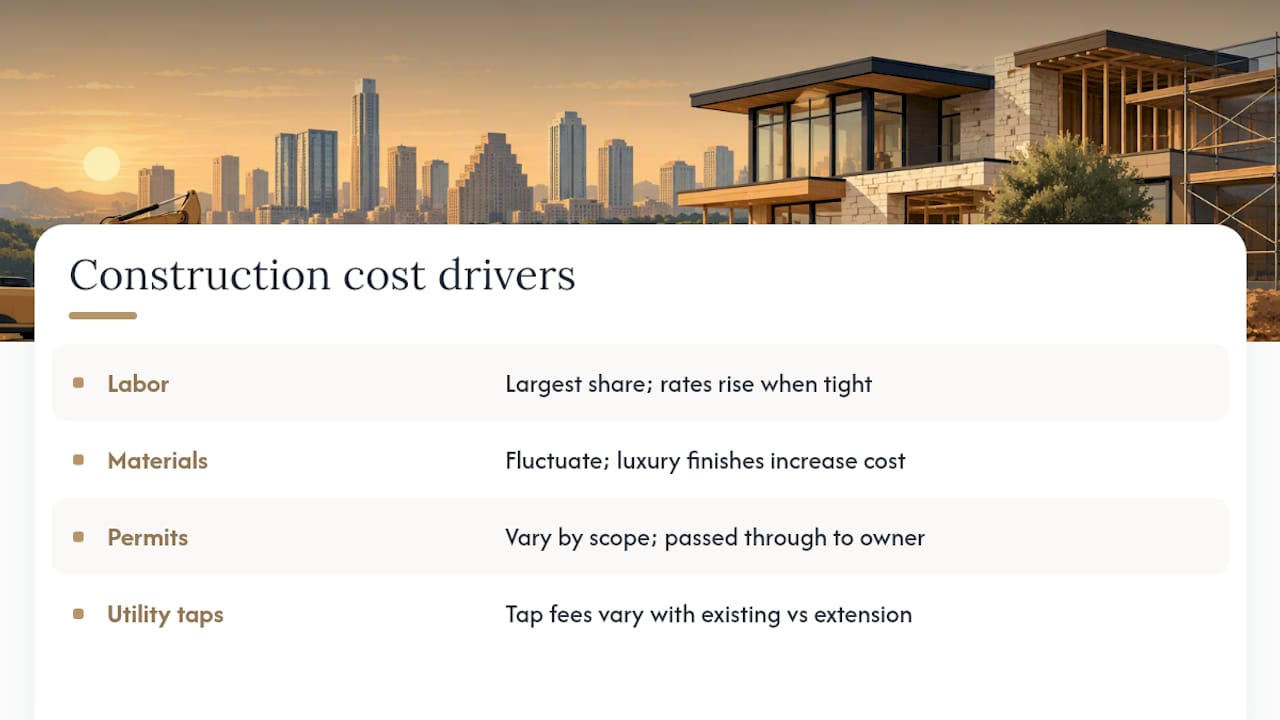
For a pre-construction or custom-build buyer, these line items usually show up bundled into the base contract price rather than itemized separately. That’s precisely why requesting a detailed cost breakdown before signing matters. A builder unwilling to itemize labor, materials, permits, and utility connections separately is one you should question harder, particularly on a contract in the seven-figure range where a few percentage points translate into real money.
How Austin’s Building Codes Affect Your Price
Austin’s building code requirements, energy efficiency standards, and site-specific zoning rules all shape what a builder charges, and those costs eventually land in your contract price whether or not you see them itemized.
Energy code compliance (insulation standards, window performance ratings, HVAC efficiency requirements) adds cost upfront but reduces long-term utility expenses, which matters for your total monthly ownership calculation. Site-specific rules, including impervious cover limits and tree preservation ordinances in certain Austin neighborhoods, can restrict how much of a lot is buildable, which affects both design flexibility and lot premium pricing.
Floodplain regulations near creeks and waterways can require elevated foundations or additional drainage work, adding cost that varies significantly by specific address rather than by neighborhood generally. Historic district overlays, where they apply, impose design review requirements that can extend timelines and limit certain exterior material choices.
None of this is optional for a builder to work around, and a buyer evaluating a pre-construction contract should ask directly whether the quoted price already accounts for the specific lot’s code requirements or whether those costs could still surface as change orders during construction.
From Contract to Move-In: Realistic Austin Timelines
Ground-up custom builds in Austin typically run from initial design and permitting through completion over a period that regularly extends past initial builder estimates, particularly when custom structural or design-center selections require additional engineering review. Permitting alone can take weeks to months depending on the jurisdiction and the complexity of the site plan.
Spec and inventory homes, since they’re already built or substantially complete, cut this timeline dramatically. A buyer purchasing a finished inventory home can often close within thirty to forty-five days, limited mainly by financing and inspection contingencies rather than construction schedules.
Pre-construction contracts sit in between. Buyers typically commit early in the process, select upgrades over subsequent months, and wait through the full construction cycle before closing. Weather delays, material availability, and permitting backlogs are all real variables, and a builder’s initial completion estimate should be treated as optimistic rather than guaranteed.
For buyers relocating on a fixed timeline, this distinction changes the calculation entirely. Prioritizing spec inventory over ground-up customization is often the more realistic path when a firm move-in date matters more than design control.
Why Design Choices Swing the Price So Much
Square footage is the most obvious cost driver, but it’s rarely the biggest swing factor in a final Austin luxury contract. Design complexity, meaning the number of exterior corners, roofline changes, and custom window configurations, adds labor cost disproportionate to the square footage it covers.
Finish-level selections at the design center often move the needle more than structural changes. Natural stone countertops versus engineered quartz, custom cabinetry versus semi-custom lines, and imported tile versus domestic alternatives can each shift a project’s total cost by tens of thousands of dollars without changing the floor plan at all.
Customization also affects timeline, and timeline affects carrying cost for whoever’s financing the build. A highly customized ground-up project with extensive structural changes and design-center selections will generally cost more per square foot than a comparable spec home with standard finishes, purely because of the labor and coordination required to execute custom work correctly.
What a Lot Really Costs Once Site Work Begins
The advertised lot price rarely reflects what it actually costs to make that lot buildable. Site preparation, including grading, drainage work, and foundation engineering specific to the soil conditions, varies considerably across Austin given the region’s mix of clay-heavy soils and limestone bedrock in different areas.

Slopes and grade changes on hill country lots can add meaningful foundation and drainage cost compared to a flat lot. Tree preservation requirements, where mature oaks or other protected species sit on the property, can restrict building footprint or require costly root-protection measures during construction.
Utility access matters just as much as the lot’s topography. A lot within an established neighborhood with existing water, sewer, and electric infrastructure nearby generally costs less to develop than one requiring extension of utility lines, which some newer or more remote luxury developments still require. Buyers evaluating a raw lot for a custom build should request a site assessment before finalizing a purchase price, since these costs are difficult to estimate accurately from the street.
How Neighborhood Location Changes Your Total Cost
Where a home sits within Austin affects its price through channels that have nothing to do with the structure itself. School district boundaries carry real weight in the luxury segment, and homes in top-rated districts command a premium that shows up in both purchase price and, indirectly, in resale expectations.
Zoning and land-use restrictions vary block by block in some Austin neighborhoods, affecting everything from allowable lot coverage to accessory structure rules. A neighborhood’s position in the current real estate cycle also shapes pricing, since some areas are appreciating faster than others based on infrastructure investment, new development, and shifting demand patterns.
Infrastructure quality, including road access, proximity to major employment corridors, and planned transit or roadway projects, factors into both current pricing and future value. A buyer comparing two similarly priced homes in different Austin neighborhoods should weigh these location-specific factors as heavily as the structure’s finish level, since they drive both your immediate carrying costs (through tax rates and HOA structures that vary by development) and your long-term equity position.
Mike Mogavero’s Take on Buying Right in This Market
Buyers who treat the base price as the real number consistently get surprised at closing or, worse, months later when the first full tax bill arrives. Over two decades in the Austin luxury market, the pattern holds: the buyers who negotiate best are the ones who show up with a completed worksheet, not just a pre-approval letter.
Before your first serious conversation with a builder or seller, build your total-cost worksheet, request the tax, MUD, and HOA documents directly, and get buyer representation in place so someone’s reviewing contract terms on your behalf, not the builder’s. Private listing access matters here too. It puts negotiation and timeline options on the table that public listings simply don’t offer, particularly for buyers willing to move on a seller’s schedule in exchange for better terms.
— Mike
How Mogavero Group Helps You Buy the Right Home for the Real Price
This service provides an advocate reviewing contract terms, incentive structures, and tax exposure before you sign, not after. Our buyer representation covers new construction, pre-construction contracts, and resale luxury homes across Austin, and our private listing access opens negotiation paths that never reach public search platforms.
An introductory conversation with our team starts with your budget worksheet and your timeline, then moves into which tiers and neighborhoods actually match both. We’ll walk through incentive terms, tax exposure, and HOA documentation before you commit to anything. If you’re evaluating a specific pre-construction contract or an off-market opportunity right now, reach out to start buyer representation or ask about current private listings that fit your target price range.
Sources
For title insurance premiums on high-value Austin transactions, go directly to the Texas Department of Insurance’s rate order, which includes the bracket multipliers and worked examples used to calculate exact premiums.
To confirm property tax and HOA exposure on a specific new-construction property, cross-reference the local new-build tax and HOA guide against your target county’s actual effective tax rate and the specific HOA’s budget documents. For closing-cost ranges by price tier, the Mortgage Austin closing-cost breakdown offers concrete examples across different purchase price points. For current supply and negotiation conditions, the Austin luxury market price report tracks days on market and inventory by tier.
- Texas Department of Insurance — Commissioner’s Order: Title Insurance Basic Premium Rate Hearing (Docket No. 2858)
- Closing costs in Austin by price tier | Mortgage Austin
FAQ
What’s the Real Cost to Build a House in Austin Beyond the Base Price?
The base price rarely includes lot premiums, structural upgrades, design-center selections, and closing costs, all of which can add well beyond the advertised figure. Budget using total monthly ownership (mortgage, taxes, HOA or MUD/PID fees, insurance) plus a cash-to-close estimate rather than comparing sticker prices alone.
How Much Are Typical Buyer Closing Costs in Austin?
Buyer closing costs in Austin generally run 2% to 5% of the purchase price, with prepaid taxes and escrow setup usually the largest single item. Texas custom has sellers commonly cover the buyer’s owner’s title policy, which lowers but doesn’t eliminate buyer-side costs.
Why Does My First Property Tax Bill Jump After Move-In?
New construction tax escrow estimates are often based on the lot’s pre-construction value, not the finished home’s appraisal. Once the county reassesses the completed property, the full tax bill can substantially exceed the builder’s initial escrow projection.
Do Spec Homes Really Offer Better Deals Than Custom Builds?
Spec and inventory homes often come with stronger incentives because builders are financing the carrying cost of an unsold property every month it sits on the market. Custom ground-up builds offer more design control but typically come with less price flexibility, according to Austin new-construction buyer guidance.
Can Mogavero Group Help Me Find Off-Market Luxury Listings?
Yes. Mogavero Group’s private listing access connects buyers to off-market and pre-construction opportunities not available through public search, often with more flexible negotiation terms. Pricing for buyer representation isn’t published; contact the team directly for current availability and terms.