Custom Home vs. Spec Home: Which Is Right for You?
Decide between a custom home and a spec home by understanding design control, pricing, and timelines. Find out which suits you best.
Custom Home vs. Spec Home: Which Is Right for You?
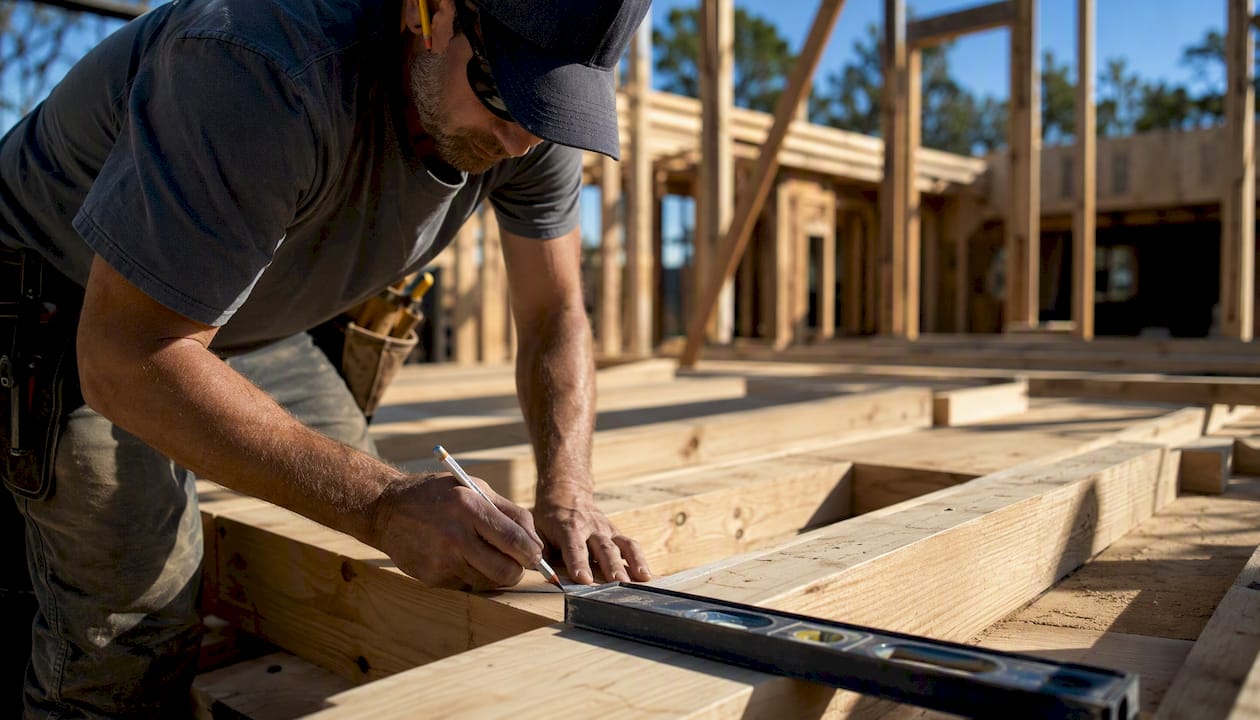
Choose a spec home if you need to move quickly and want predictable pricing. Choose a custom home if design control, lot selection, and long-term fit matter more than speed or upfront cost. The core trade-off in any custom home vs spec home decision comes down to three axes: how much you’ll spend, how long you’ll wait, and how much say you get over the final product.
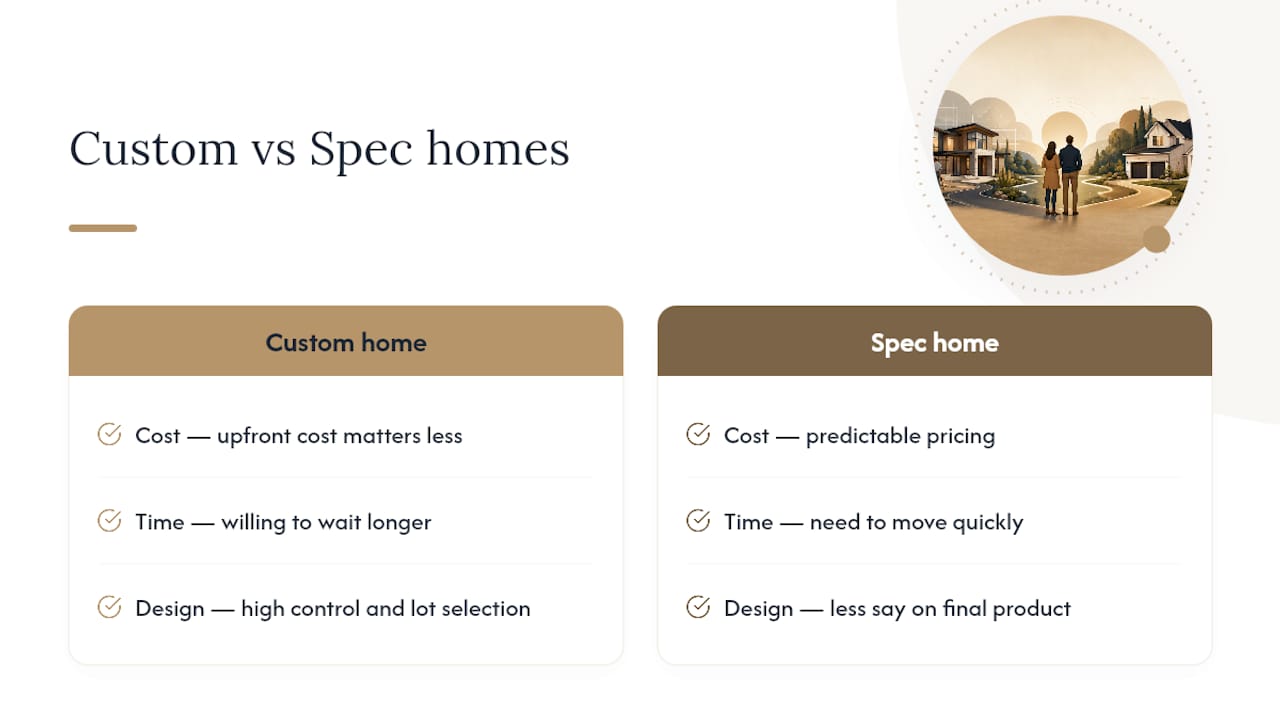
Most buyers land somewhere between those poles, which is exactly why the semi-custom category has grown so quickly. But before you can pick the right path, you need to know what each term actually means.
Key Takeaways
Spec homes win on speed and cost predictability; custom homes win on design control, lot flexibility, and long-term fit — the right choice depends on your timeline, budget buffer, and how long you plan to stay.
| Point | Details |
|---|---|
| Speed vs. control | Spec homes close in 30–60 days if near completion; custom builds realistically take 18–24 months from lot purchase. |
| Cost structure differs | Spec pricing is all-in; custom budgets require separate line items for land, design fees, permits, and a 10–15% contingency. |
| Market timing favors spec now | In June 2025, 37% of builders cut prices by an average of 5% and 62% offered incentives, making spec unusually competitive. |
| Semi-custom is the practical middle | Semi-custom compresses timeline and cost while preserving meaningful layout and finish choices. |
| Mogaverogroup adds local expertise | The team provides builder vetting, off-market access, and contract review for both spec and custom buyers in Austin. |
Table of Contents
- What is a spec home, a custom home, and everything in between?
- Spec homes: the real advantages and the real limits
- Custom homes: full control, real costs, and the risks most buyers underestimate
- What does each path actually cost, and how long will you wait?
- How to decide: a practical checklist for buyers
- What the current market is telling buyers
- Your next steps, depending on which way you’re leaning
- Why the agent you hire for new construction matters more than most buyers realize
- Mogaverogroup can help you find the right path in Austin
- Sources
- FAQ
What is a spec home, a custom home, and everything in between?
These three terms get used loosely, and the confusion costs buyers real money.
- Spec home: A builder constructs the home without a specific buyer in mind, selecting the floor plan, finishes, and lot based on what sells in that market. You buy it as-is or near completion. Think of it as a home built to broad-market taste, priced for speed.
- Custom home: Designed and built for one buyer on one specific lot. You drive every decision, from the foundation type to the cabinet hardware. The builder works from your plans, not a catalog.
- Semi-custom home: A hybrid. The builder offers pre-designed floor plans with meaningful modification options — you might change the kitchen layout, add a bedroom, or upgrade finishes within a defined range. It compresses the timeline and cost relative to fully custom while still giving you real input.
In practice, a first-time buyer in a new subdivision is almost always looking at spec or semi-custom. A buyer who already owns a lot in a specific neighborhood, or who has particular accessibility or lifestyle needs, is the natural candidate for a fully custom build. Real estate terms like these carry specific contract and financing implications worth understanding before you sign anything.
Spec homes: the real advantages and the real limits
Speed is the headline advantage, and it’s genuine. A spec home that’s already framed or near completion can close in 30–60 days. Even a spec home started from scratch averages roughly 8.9 months from authorization to completion, which is meaningfully faster than any custom path.
Cost is the second advantage. Builders buy lumber, fixtures, and appliances in bulk across dozens of homes simultaneously. That volume purchasing passes through to the buyer as a lower per-square-foot price than you’d pay building the same home one-off. Add the current market dynamic: Recently, a notable share of builders have cut prices modestly and offered incentives such as mortgage-rate buydowns and upgraded finishes. For a buyer who can move on a builder’s timeline, that’s real money. For a buyer who can move on a builder’s timeline, that’s real money.
The limits are equally real:
- Finish-level compromises. Builder-grade cabinets, countertops, and flooring are selected for margin, not longevity. What looks good in a model home may not hold up the same way.
- Limited customization. If the floor plan doesn’t fit your life, you’re adapting your life to the floor plan.
- Variable builder quality. Not all spec builders operate at the same standard. Warranty terms, punch-list responsiveness, and construction oversight vary widely.
- Resale predictability cuts both ways. Spec homes are designed for broad-market appeal, which supports resale but also means nothing distinguishes your home from the six others on the same street.
Pro Tip: Before making an offer on a spec home, ask the builder for the permit history and any open punch-list items from previous closings in the same community. A builder who resists that request is telling you something important.
Custom homes: full control, real costs, and the risks most buyers underestimate
The case for building custom is straightforward: you get exactly what you want, where you want it. You choose the lot orientation for natural light, specify energy-efficient systems that can deliver measurable savings and value uplift, and build in features like Universal Design accessibility that eliminate costly retrofits later. NAHB specifically highlights Universal Design as one of the enduring advantages of custom construction, and it’s a point that rarely comes up in spec-home conversations.
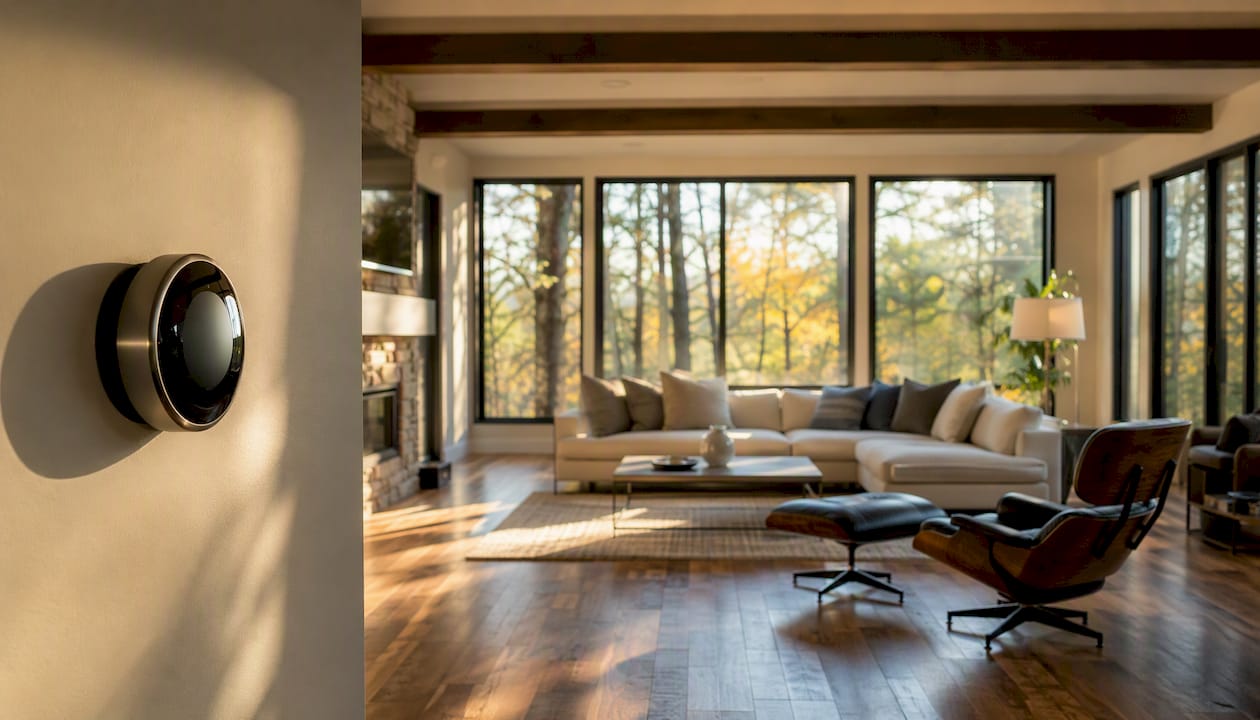
The benefits of building a custom home include site-specific orientation, higher-grade components, and energy-efficiency choices that compound over time. For a buyer planning to stay 10 or more years, those advantages often justify the premium.
The cons are harder to stomach:
- Higher cost per square foot, driven by one-off purchasing, bespoke design fees, and site-specific engineering.
- Longer timeline with more exposure to delays.
- Decision fatigue. Hundreds of selections across months of construction is genuinely exhausting, and fatigue leads to expensive last-minute changes.
- Cost overruns. Change orders are the single biggest driver of budget blowouts on custom projects.
Budget for overruns before they happen. Industry guidance consistently recommends a 10–15% contingency on top of your fixed contract price to cover change orders, site surprises, and permit-driven redesigns. Buyers who skip this step routinely end up negotiating mid-build.
On resale: hyper-personalized homes can narrow your buyer pool. A purple kitchen or a six-car garage appeals to a specific buyer, not the median one. If you plan to sell within five years, that’s a real risk. If you’re building for the long term, it’s largely irrelevant.
Rising materials costs and supply-chain volatility remain consistent contributors to custom-build budget pressure, which is one more reason the contingency buffer matters.
What does each path actually cost, and how long will you wait?
The sticker price on a spec home usually includes the lot, standard finishes, and builder warranties. A custom budget is a different animal: land, site work, permits, architectural fees, and the build itself are all separate line items, and each one can move.
| Dimension | Spec home | Semi-custom | Fully custom |
|---|---|---|---|
| Cost shape | All-in price; land included | Base price + upgrade allowances | Land + design fees + build contract |
| Typical timeline | ~8.9 months (build) | 10 months | 12–15+ months (plus 3–6 months for design and permits) |
| Move-in window | 30–60 days if near completion | 3–6 months from contract | 18–24 months from lot purchase is realistic |
| Financing | Standard mortgage | Standard mortgage or construction-to-perm | Construction loan, then permanent mortgage |
| Cost contingency needed | Minimal | 5–10% for upgrades | 10–15% for change orders and site costs |
A few points worth spelling out:
- Construction loans carry higher interest rates than standard mortgages and require interest-only payments during the build. That carrying cost adds up fast over 18 months.
- Builder mortgage buydowns on spec homes can offset a meaningful chunk of that rate difference, which is part of why the current incentive environment makes spec homes unusually competitive.
- Luxury custom builds face additional cost pressure from high-end finishes, bespoke mechanical systems, and site logistics. A detailed look at luxury custom build costs illustrates how quickly per-square-foot figures climb when finish level and site complexity increase.
Understanding how the home buying process works in terms of timelines and carrying costs is worth doing before you commit to either path.
How to decide: a practical checklist for buyers
The right choice depends on your specific situation, not on which option sounds better in theory. Work through these questions honestly.
- How quickly do you need to move? If you have a lease ending in four months or a school enrollment deadline, spec is almost certainly your answer.
- Do you already own a lot? If yes, custom or semi-custom is the natural path. If no, add lot-sourcing time and cost to your custom timeline.
- What’s your real budget ceiling? Include the contingency. If the custom budget only works without a 10–15% buffer, it’s not a safe budget.
- How long do you plan to stay? Under five years, spec’s resale predictability is an asset. Over ten years, custom’s long-term fit pays off.
- How much decision-making can you handle? Custom requires hundreds of choices over months. Some buyers love that. Many find it exhausting.
- What’s your risk tolerance? Spec homes have predictable pricing. Custom builds have exposure to cost overruns, permitting delays, and contractor scheduling.
- What matters most: location or layout? Custom wins on location control. Spec wins on layout predictability within a known community.
Questions to ask a builder or listing agent:
- What’s the warranty coverage, and what does it exclude?
- Can I see the permit history and any open punch-list items?
- What’s the typical change-order cost for this builder?
- What incentives are available, and are they tied to using the builder’s preferred lender?
Red flags to watch for:
- A builder who won’t share permit history or references from recent buyers.
- A spec listing that’s been sitting for more than 90 days without a price adjustment.
- A custom builder who quotes a fixed price without a contingency line or a clear change-order policy.
| Decision factor | Spec | Semi-custom | Fully custom |
|---|---|---|---|
| Speed to move-in | Best | Moderate | Slowest |
| Cost predictability | High | Moderate | Lower |
| Design control | Minimal | Meaningful | Full |
| Resale appeal | Broad | Broad to moderate | Depends on personalization |
| Lot flexibility | None | Limited | Full |
| Financing complexity | Low | Low to moderate | High |
What the current market is telling buyers
The spec vs. custom decision doesn’t happen in a vacuum. Market conditions in 2024–2026 have shifted the math in ways that favor spec buyers more than usual.
Realtor.com’s reporting found that 37% of builders cut prices by an average of 5% in June 2025, and 62% were actively offering incentives. Mortgage-rate buydowns, upgraded finish packages, and closing-cost credits are all on the table in many markets right now. That’s a meaningful gap from the seller’s-market conditions of 2021–2022, when spec homes sold before the drywall was up.
NAHB’s guidance on custom homes points in a different direction for buyers with specific needs: Universal Design features, site-specific energy systems, and higher-grade materials are advantages that spec homes structurally cannot offer. For a buyer with mobility considerations, a multigenerational household, or a specific lot in mind, the current incentive environment on spec homes doesn’t change the fundamental fit problem.
The practical read: if you’re flexible on location and timeline, the current spec market is unusually favorable. If you have a specific site, specific needs, or a long planning horizon, custom still makes sense despite the higher cost and longer wait.
Your next steps, depending on which way you’re leaning
If you’re buying a spec home
- Get pre-approved for a mortgage before you tour communities, so you can move fast when you find the right home.
- Research the builder’s reputation: look for permit history, Better Business Bureau standing, and reviews from buyers who closed 12–18 months ago (not just at closing).
- Hire an independent inspector even on a new build. Builder warranties don’t cover everything, and a third-party inspection catches issues before closing.
- Negotiate incentives directly: rate buydowns, closing-cost credits, and finish upgrades are all negotiable, especially on homes that have been listed for more than 60 days.
- Review the purchase contract carefully, particularly warranty exclusions and the dispute resolution clause.
If you’re starting a custom build
- Secure your lot first, and get a site analysis done before you commit. Local permitting, site constraints, and zoning can add months and significant cost if you discover them mid-design.
- Hire an architect or semi-custom builder before you finalize your budget. Design fees typically run 5–15% of the build cost, and they belong in your budget from day one.
- Get at least three fixed-price bids from licensed builders with local permitting experience. A builder who knows your municipality’s review process is worth a premium.
- Build your contingency in from the start: 10–15% above your contract price, held in reserve and not touched unless a change order or site surprise requires it.
- Understand your construction loan terms before you break ground. Interest-only payments during the build are a real carrying cost, and the rate on a construction loan is typically higher than a standard mortgage.
- Plan for 3–6 months of design and permitting before construction starts. That timeline is separate from the build itself.
Pro Tip: If you’re building custom in a market with active zoning changes or infrastructure projects, ask your builder to pull a preliminary permit review before you finalize the design. Discovering a setback requirement or utility easement after your plans are drawn is an expensive lesson.
Why the agent you hire for new construction matters more than most buyers realize
Most buyers assume a real estate agent is only useful for resale homes. That’s a costly assumption when you’re buying spec or building custom.
On the spec side, a buyer’s agent who knows the local builder landscape can tell you which communities have had punch-list problems, which builders honor their warranties without a fight, and which incentive packages are genuinely good versus marketing theater. Builders have their own sales agents whose job is to represent the builder, not you.
On the custom side, the value is even more specific. Site evaluation, builder vetting, contract review, and coordination with architects and permitting offices are all areas where an experienced local agent adds real protection. In Austin specifically, local permitting expertise and site constraints can make or break a custom project’s timeline and budget.
A full-service buyer’s agent in new construction typically provides:
- Independent builder vetting and reference checks
- Contract review focused on warranty terms, change-order policies, and dispute resolution
- Access to off-market and pre-construction opportunities not listed publicly
- Negotiation of builder incentives on your behalf
- Referrals to independent inspectors, architects, and permitting consultants
The agent’s commission in new construction is almost always paid by the builder, not the buyer. There’s no financial reason to walk into a builder’s sales office without representation.
Mogaverogroup can help you find the right path in Austin
Whether you’re weighing a spec home in a new Austin community or planning a custom build on a specific lot, the decision is easier with someone who knows the local market from the inside.
Mogaverogroup brings over 20 years of Austin real estate experience to exactly this kind of decision: builder vetting, site analysis, access to private listings and pre-construction opportunities that never hit the public market, and the architectural insight to evaluate whether a spec home’s finish level or a custom builder’s bid actually reflects the market. The team works exclusively on behalf of buyers, which means the advice you get is never shaped by a builder’s sales goals.
If you’re ready to see what’s available, browse current Austin listings or reach out directly to schedule a consultation. The right home, whether spec or custom, starts with the right information.
Sources
- Realtor
- Custom Home vs Spec Home in 2026: How to Choose the Right Build for Your Life and Budget
- Custom Homes: Design Trends, Benefits and Sustainability | NAHB
- The Benefits of Building a Custom Home — Home Building and Repair News
- Your Guide to Custom Homebuilding in Austin: Insights from Proform Builds — Proform Builds
This article is general information, not a substitute for advice from a qualified financial advisor. Consult a qualified financial professional about your own circumstances before acting on anything here.
FAQ
What is the difference between a spec home and a custom home?
A spec home is built by a developer without a specific buyer, using pre-selected plans and finishes, and is typically sold near or at completion. A custom home is designed and built for one buyer on a specific lot, with the owner controlling every design and material decision.
Are custom-built homes better quality than spec homes?
Custom homes generally allow for higher-grade materials and site-specific engineering, but quality depends heavily on the builder. A well-built spec home from a reputable builder can outperform a custom home with a poorly managed contractor or budget overruns that forced finish compromises.
How much more does a custom home cost than a spec home?
Custom homes typically cost more per square foot than spec homes because builders cannot use bulk purchasing or repeated floor plans to reduce costs.
How long does it take to build a custom home versus buy a spec home?
Spec homes average roughly 8.9 months from authorization to completion, and move-in-ready units can close in 30–60 days. Custom builds with a hired contractor average about 12.1 months of construction, plus 3–6 months for design and permitting, putting the realistic timeline at 18–24 months from lot purchase.
Is a semi-custom home a good compromise between spec and custom?
Yes. Semi-custom homes use pre-designed floor plans with meaningful modification options, compressing both timeline and cost compared to fully custom while still giving buyers real input on layout and finishes. They’re the most practical middle path for buyers who want personalization without the full custom process.
Recommended
- 7 Types of Austin Home Styles for Smart Buyers | Mogavero Group Austin Real Estate
- What Austin Luxury Home Buyers Want in 2026: Architectural Styles, Tech, and Outdoor Living | Mogavero Group Austin Real Estate
- What Today’s Luxury Austin Buyers Really Want: 2026 Edition | Mogavero Group Austin Real Estate
- What Today’s Luxury Austin Buyer Really Wants in 2026: Architecture, Tech & Outdoor Living | Mogavero Group Austin Real Estate