Earnest Money in Texas: What Buyers Need to Know
Learn vital details about earnest money in Texas, including amounts, timing, and how it protects your home purchase. Get informed now!
Earnest Money in Texas: What Buyers Need to Know

Getting the timing and paperwork right protects you if the deal falls apart. Here’s what matters most before you sign anything:
- Typical amount: Most Texas buyers put down 1% to 3% of the sales price, though hot markets and luxury deals sometimes push higher.
- TREC deposit rule: Under TREC Rule 535.146(b)(3), the deposit is due by the close of the second working day after the contract is signed unless the parties agree otherwise in writing.
- Option fee is separate: The option fee buys your unrestricted right to walk away during the option period. Earnest money does not.
- Refund depends on timing: Money is generally recoverable if you cancel for a reason the contract covers, financing falls through on schedule, or the seller can’t deliver clear title. Miss a deadline or waive a contingency, and the seller may keep it.
- Confirm receipt immediately: Ask your agent or title company for written confirmation the funds were deposited, and keep that receipt with your closing file.
Once your check or wire clears escrow, calendar every deadline in your contract, especially the option period expiration, and get everything in writing from there forward.
Key Takeaways
Earnest money in Texas works as intended only when buyers pair a market-appropriate deposit with airtight contingency language and documented proof of every deadline met.
| Point | Details |
|---|---|
| Standard deposit range | Expect 1% to 3% of the purchase price; on a $400,000 home that’s $4,000 to $12,000. |
| Deposit deadline | Funds are typically due within three days of the Effective Date under TREC-promulgated forms. |
| Option fee is separate | The option fee (usually $100 to $350) buys your right to walk away during the 7 to 10 day option period; earnest money doesn’t. |
| Refund depends on contingencies | Recovery hinges on inspection, financing, appraisal, or title contingencies actually written into your contract. |
| Releases require agreement | Title companies won’t release disputed funds without a mutual signed release or a court order. |
Table of Contents
- What Earnest Money Actually Does in a Texas Contract
- How Much Earnest Money Is Normal in Texas?
- When Must Earnest Money Be Delivered in Texas?
- Option Fee vs. Earnest Money in Texas
- Getting Your Earnest Money Back: Contingencies and the Refund Process
- If the Seller Keeps the Earnest Money: Remedies and Your Options
- What Happens When a Deposit Isn’t Made or a Check Bounces
- How Title Companies Hold and Release Earnest Money
- A Texas Buyer’s Agent Checklist for Protecting Your Earnest Money
- Earnest Money in Texas: What Texas Buyers Should Prioritize
- Sources
- FAQ
What Earnest Money Actually Does in a Texas Contract
Earnest money exists to prove you’re serious about buying and to give the seller a financial cushion if you back out without cause. It’s a two-way arrangement: you show commitment, and the seller agrees to take the home off the market knowing there’s a deposit at stake if you default without a valid excuse.
In most Texas transactions, a title company or escrow agent holds the money, not the seller and not the seller’s broker. That separation matters. Because a neutral third party controls the funds, neither side can unilaterally grab the deposit. Release requires either a mutual written agreement, completion of closing, or a court order, according to NerdWallet’s earnest money primer. Some contracts route the deposit through the listing broker’s trust account instead, but a licensed title company handling it alongside the closing is far more common in Texas.
Here’s how the money typically moves through a transaction:
- Buyer wires or delivers a check to the title company within the contract deadline.
- Title company deposits it into a trust or escrow account and issues a receipt.
- Funds sit untouched through inspection, financing, and appraisal periods.
- At closing, the deposit is credited toward your down payment or closing costs.
- If the deal falls through under a valid contingency, the title company processes a refund once both parties sign a release.
That last step, the mutual release, trips up more buyers than any other part of the process. Nobody gets paid automatically just because a deal dies.
How Much Earnest Money Is Normal in Texas?
Texas law sets no fixed earnest money amount. The number is negotiated between buyer and seller, and it typically lands between 1% and 3% of the purchase price, according to LegalClarity’s breakdown of Texas earnest money rules.
Where you land in that range depends on a few practical factors:
- Market competitiveness: In a multiple-offer situation, a larger deposit signals you won’t walk for a minor reason, which can make your offer more attractive.
- Price tier: Luxury and off-market properties sometimes carry proportionally larger deposits because sellers want stronger assurance from buyers competing for scarce inventory.
- Lender expectations: Some lenders want to see a deposit that reflects genuine financial commitment relative to the loan size.
- Offer strategy: Cash buyers and investors sometimes offer higher earnest money specifically to beat out financed offers.
On a $400,000 home, 1% to 3% earnest money works out to $4,000 to $12,000, per LegalClarity’s figures. A buyer in a slower market might offer $4,000 and still get accepted. A buyer competing against four other offers on a desirable Austin property might offer $10,000 or more to stand out. Neither number is wrong. What matters is whether the amount matches the risk you’re comfortable putting on the table if something goes sideways.
Pro Tip: Don’t assume a bigger deposit always wins. Sellers care about total offer strength, financing certainty, and closing timeline just as much as the earnest money figure. A well-structured offer with a modest deposit often beats an inflated one with shaky financing.
When Must Earnest Money Be Delivered in Texas?
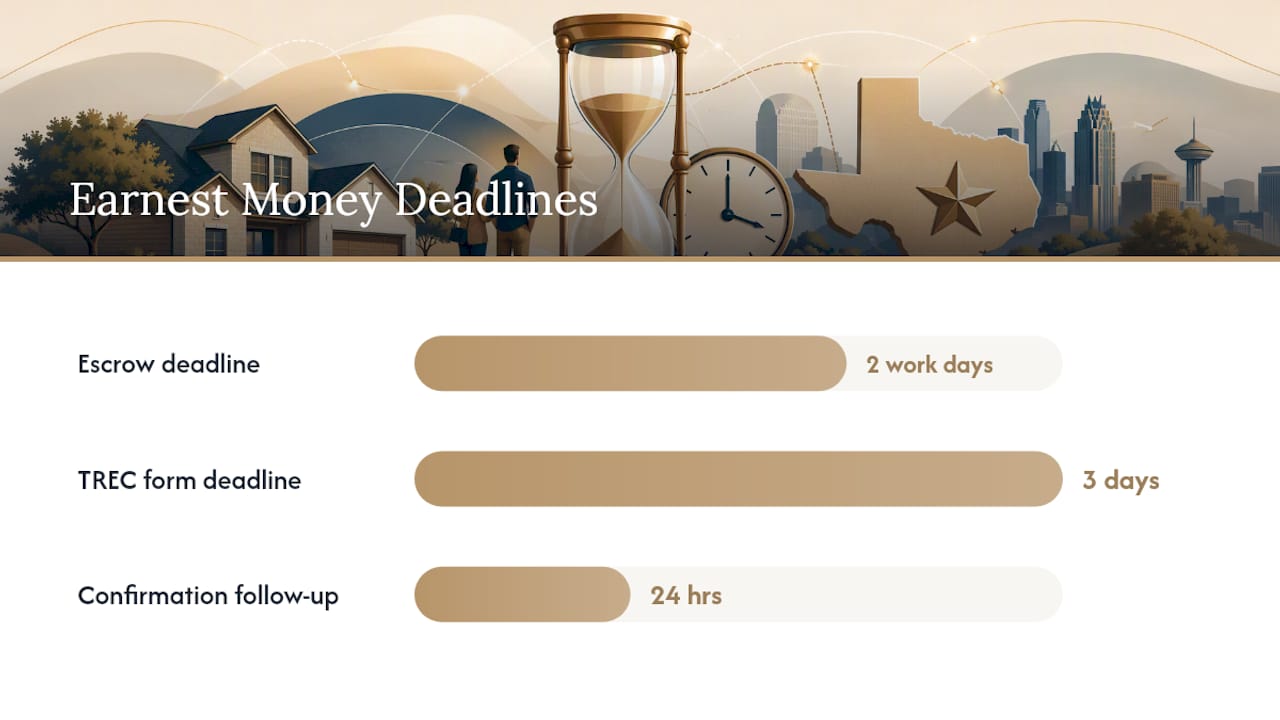
Texas contracts require the deposit reach the escrow agent by the close of business on the second working day after the contract is executed, unless the parties agree in writing to a different deadline (TREC Rule 535.146(b)(3)). TREC-promulgated contract forms typically phrase this as delivery within three days of the Effective Date, and that language shows up in nearly every standard Texas residential contract.
One nuance worth knowing: TRERC’s analysis of Texas contract law notes that these deadlines usually don’t carry “time is of the essence” weight unless the contract explicitly says so. That means courts have sometimes given buyers a reasonable window to cure a late deposit rather than voiding the deal outright, according to TRERC’s earnest money article. Don’t rely on that cushion, though. A cooperative seller might grant leeway. An impatient one might not.
Acceptable delivery methods include:
- Wire transfer directly to the title company’s escrow account
- A personal or cashier’s check delivered to the title company
- Electronic payment platforms some title companies now accept, with confirmation emailed to both parties
Once you sign the contract, move fast:
- Confirm with your agent exactly which title company holds escrow and get their contact information the same day.
- Deliver funds well before the deadline, not on the last possible day.
- Request a written receipt or deposit confirmation from the title company.
- Save that confirmation with your transaction file. You’ll want it if a dispute ever surfaces.
- Follow up within 24 hours if you haven’t received written confirmation.
Buyers who wire money and never confirm it landed are taking an unnecessary risk. Title companies process dozens of transactions simultaneously, and a wire can occasionally get misrouted or delayed. A five-minute phone call closes that gap.
Option Fee vs. Earnest Money in Texas
The option fee buys you the right to walk away for any reason during the option period. Earnest money is your good-faith deposit tied to specific contract contingencies. They’re often confused because both get paid around the same time, but they serve entirely different purposes and follow different refund rules.

The option fee is typically small, usually $100 to $350 for a standard option period of 7 to 10 days, according to Har. It goes directly to the seller, not into escrow, and it’s generally non-refundable regardless of why you terminate.
Here’s how the money splits depending on timing:
- Terminate during the option period: You get your full earnest money back. The option fee stays with the seller as compensation for taking the home off the market during your inspection window.
- Terminate after the option period ends: You need a contract-based contingency (financing, appraisal, title defect) to recover earnest money. Without one, you risk losing the deposit entirely.
A TRERC-affiliated analysis of the option period puts it plainly: earnest money is not a substitute for solid contract protections, and once the option period lapses, your ability to recover the deposit narrows fast unless another contingency still applies (see TRERC’s option period overview). Pay both fees correctly and on time, keep receipts for each, and treat the option period as your real inspection safety net, not the earnest money deadline.
Getting Your Earnest Money Back: Contingencies and the Refund Process
Earnest money is refundable when you terminate under a contingency the contract actually covers, and it’s at risk when you miss a deadline or waive that protection. The most common refundable scenarios include a failed inspection during the option period, financing denial within the financing contingency deadline, a low appraisal that triggers your appraisal contingency, an unresolved title defect, or casualty loss the seller doesn’t remedy before closing, per LegalClarity’s rundown of refund scenarios.
Before you sign, review the contract for these protections:
- Inspection deadline: Confirm the option period gives you enough time to schedule an inspection and review results. Seven days is standard, but ten is safer for larger or older homes.
- Financing contingency language: Make sure the financing addendum specifies a clear deadline and defines what counts as a good-faith loan application effort on your part.
- Repair negotiation window: Know how many days you have to request repairs after inspection and how the seller must respond.
- Title delivery timeline: Check when the seller must provide a title commitment and how much time you have to object to defects.
If a legitimate contingency applies, the release process generally works like this:
- You or your agent notifies the seller’s side in writing that you’re terminating under a specific contract paragraph.
- Both parties sign a mutual release form (commonly the TREC Release of Earnest Money form).
- The title company reviews the signed release for completeness.
- The title company disburses funds according to the release terms, often within a few business days.
- If the parties only partially agree (for example, splitting the deposit), the release form reflects that split and both signatures are still required.
Trouble starts when the seller refuses to sign. Escrow agents will not release funds without either full agreement or a court order, a point NerdWallet and title industry guidance both emphasize repeatedly. If a seller won’t cooperate:
- Have your agent reach out to the seller’s agent first. Many disputes resolve once both sides revisit the actual contract language.
- Request that the title company provide a written accounting of the funds and confirm what documentation they need to process a release.
- Consider mediation, which many Texas contracts require before litigation and which resolves most earnest money disputes faster and cheaper than court.
- If mediation fails and the amount is modest, small-claims court is a realistic option. Larger disputes may require a civil suit, which is where you’ll want an attorney involved.
The lesson here is straightforward: your contingencies are your leverage. A vague or missing contingency clause is the single biggest reason buyers lose earnest money they should have recovered.
If the Seller Keeps the Earnest Money: Remedies and Your Options
Under standard TREC-promulgated contract forms, a seller facing a buyer default can either sue for specific performance or terminate the contract and keep the earnest money as liquidated damages, but not both. This is called election of remedies, and it exists specifically to prevent a seller from double-dipping, forcing the sale through while also pocketing the deposit.
If a seller claims you defaulted and moves to keep your deposit, you have several paths:
- Negotiate a release. Many sellers prefer a partial settlement over a drawn-out dispute, especially if their actual damages (relisting costs, carrying costs) are smaller than the deposit itself.
- Demand a full accounting from the title company. You’re entitled to know exactly how the funds are held and what triggers a release under your contract’s terms.
- Pursue mediation or litigation if the seller won’t budge and the amount justifies the cost. Texas contracts typically require mediation as a first step.
- Raise a defense if you dispute the default. Common defenses include the seller failing to deliver required disclosures, a title defect that was never cured, or the seller’s own breach that excused your performance.
Pro Tip: If a seller threatens to keep your earnest money, ask your agent to pull the exact contract paragraph they’re relying on. Sellers sometimes cite “buyer default” without any contingency actually being triggered, and a plain read of the contract language often ends the dispute fast.
Title companies charge modest handling or cancellation fees in some cases, typically a small flat amount deducted before disbursement. Ask upfront what those fees are so there are no surprises when funds finally move.
What Happens When a Deposit Isn’t Made or a Check Bounces
Texas courts have treated a failure to deposit earnest money on time as a potential material breach, though the outcome depends heavily on the specific contract language and which deposit in a multi-deposit contract was missed. This isn’t a hypothetical risk. It’s shown up in real litigation.
Case analysis from the Texas Real Estate Research Center notes that when a contract calls for more than one earnest money deposit, courts have sometimes treated a missed initial deposit as the critical default event, even if later deposits were made on time. The reasoning ties back to whether the contract’s deadline language created a binding condition or merely a procedural formality.
TRERC’s review of relevant Texas case law, including reasoning that echoes decisions like Hudson v. Wakefield, points to a consistent theme: courts look closely at what the contract actually says before deciding whether a late or bounced deposit voids the deal or simply gives the other side a chance to cure it (see TRERC’s earnest money case analysis).
Practical takeaways for buyers:
- Confirm your deposit cleared within 24 to 48 hours of sending it. Don’t assume a wire went through just because you initiated it.
- If a check bounces, fix it immediately and get written confirmation from the title company that the corrected deposit was received.
- Ask for a written extension or waiver from the seller if you anticipate any delay, even a short one.
- Talk to a real estate attorney if a seller threatens termination over a deposit timing issue. Contract language varies enough that generic advice won’t cover your specific situation.
How Title Companies Hold and Release Earnest Money
Texas title and escrow companies hold earnest money in a dedicated trust account and release it only on joint written instructions from both parties, at closing, or under a court order. This structure protects both sides from unilateral claims on the deposit.
When you deliver earnest money, get these documents:
- A written receipt confirming the amount and date received
- A copy of the escrow instructions showing how the funds will be handled
- Wire confirmation if you sent funds electronically
- The disbursement form used at closing or upon termination
At closing, the process is simple:
- The title company confirms the deposit amount matches the contract.
- That amount is applied as a credit toward your closing costs or down payment.
- Any excess funds beyond what’s owed are refunded directly to you.
If the deal terminates instead, the title company won’t move on its own. It needs the signed mutual release described earlier. Some title companies charge a small administrative fee for processing a cancellation, typically deducted from the refunded amount. Ask about this fee before you’re in the middle of a dispute, since it’s much easier to negotiate or waive when both parties are still cooperating.
A Texas Buyer’s Agent Checklist for Protecting Your Earnest Money
After two decades navigating Austin’s luxury market, one pattern is consistent: buyers who protect their earnest money treat it like a paper trail project from day one, not an afterthought once something goes wrong.
Start with the basics the moment you go under contract:
- Confirm with your agent which title company is handling escrow and get direct contact information the same day.
- Deliver funds well ahead of the deadline, and request written confirmation the same day funds are received.
- Calendar every deadline in the contract: option period expiration, financing contingency, appraisal deadline, and title objection date.
- Keep every receipt, email, and confirmation in one folder, digital or physical, from contract execution through closing.
- Request written confirmation from your lender the moment financing is fully approved, not just pre-approved.
Negotiation language matters more than most buyers realize. When reviewing your contract, ask your agent to clarify or adjust these areas:
- Deposit schedule: If you’re offering a larger deposit, negotiate whether it’s paid in one lump sum or split, with the second portion due only after the option period ends.
- Option period length: A 10 day option period instead of the default 7 gives you more room for inspections and negotiations, especially on larger or older homes.
- Repair contingency language: Push for clear, specific language on what happens if the seller refuses reasonable repair requests, rather than vague “good faith negotiation” wording.
- Escrow instructions: Ask that escrow instructions specify exactly how disputed funds get handled if both parties don’t agree on a release.
A buyer’s agent who verifies your deposit landed, follows up with the title company proactively rather than waiting for problems, and reviews contingency deadlines against your calendar before they become urgent is doing exactly what separates a smooth transaction from a stressful one. If you’re weighing an offer strategy on a competitive Austin property, understanding how negotiation shapes contract terms is worth reviewing before you submit anything.
Pro Tip: Ask your agent to request a copy of the title company’s escrow receipt within 48 hours of contract execution, not just a verbal confirmation. A written receipt is the single most useful document if a dispute ever arises later.

Browsing available luxury properties in Austin or exploring private, off-market listings before you make an offer gives you a clearer sense of how competitive pricing and deposit expectations run in your target neighborhood, whether that’s Lake Austin or elsewhere in the city.
Earnest Money in Texas: What Texas Buyers Should Prioritize
Most advice on earnest money focuses on the number, how much to offer, as if a bigger deposit is inherently smarter. It isn’t. The contract language protecting that deposit matters far more than the dollar amount attached to it.
I’ve seen buyers offer aggressive earnest money to win a bidding war, then lose that same money because their financing contingency deadline was vague or their option period was too short to catch a real problem during inspection. The deposit size didn’t cause that loss. Sloppy contract language did.
If you take one thing from this guide, prioritize your option period and contingency deadlines over the deposit amount itself. A buyer with a modest deposit and a well-negotiated 10 day option period is in a far stronger position than one who offered double the earnest money with a rushed 5 day window. Texas contract law gives you real protections, but only if you use the paperwork correctly and confirm every deadline in writing. That discipline, not the size of your check, is what actually keeps your money safe.
Sources
- How long does an agent have to deposit the earnest money once a binding contract has been negotiated? | TREC
- In earnest | Texas Real Estate Research Center (TRERC)
- Har
- What Is Earnest Money? - NerdWallet
FAQ
How much earnest money is normal in Texas?
How much is earnest money on a $400,000 house?
On a $400,000 home, a typical earnest money deposit falls between $4,000 and $12,000, based on the standard 1% to 3% range.
Are there earnest money rules in Texas?
Yes. TREC Rule 535.146(b)(3) requires the deposit reach the escrow agent by the close of the second working day after contract execution, and TREC-promulgated forms commonly set a three day delivery deadline from the Effective Date.
Can I get my earnest money back in Texas?
You can generally recover earnest money if you terminate under a contingency the contract covers, such as a failed inspection during the option period, financing denial, a low appraisal, or an uncured title defect. Waiving those protections or missing a deadline puts the deposit at risk.
Recommended
- 7 Essential Real Estate Investment Tips for Austin Buyers | Mogavero Group Austin Real Estate
- Ranch and Equestrian Property in Austin – What High Net Worth Buyers Need to Know | Mogavero Group Austin Real Estate
- Austin Real Estate FAQs | Mogavero Group Austin Real Estate
- Master the Home Buying Process Workflow in Austin | Mogavero Group Austin Real Estate