Escalation Clause Texas Real Estate: What Buyers Should Know
Discover how to effectively use an escalation clause in Texas real estate. Learn the rules and avoid common pitfalls for better offers.
Escalation Clause Texas Real Estate: What Buyers Should Know

Yes, you can use an escalation clause in a Texas home purchase, but the rules around it are stricter than most buyers expect. The core restriction: your real estate agent legally cannot draft the clause. The Texas Real Estate Commission has been direct about this in its guidance piece titled “Escalating to Trouble,” warning that a license holder who writes escalation language may be committing the unauthorized practice of law.
That single fact reshapes how you should approach this tool. An escalation clause automatically raises your offer above a competing bid, in set increments, up to a maximum you choose. It sounds simple. But because it changes the parties’ legal rights and obligations, TREC treats it as attorney territory, not agent territory. There’s no TREC-promulgated form for it. Instead, it typically shows up as custom language in Paragraph 11 of the One to Four Family Residential Contract, and TREC limits what agents can put there to factual, non-legal statements.
Before you ask your agent to write one, know the top constraints:
- Unauthorized practice of law (UPL) risk: agents who draft escalation terms can face disciplinary penalties.
- Proof requirements: most clauses require the seller to show written evidence of a competing offer, and weak proof language invites disputes.
- Appraisal gap exposure: an escalated price can land above appraised value, leaving you to cover the difference.
- Seller counter-tactics: sellers sometimes counter at your stated cap, erasing your negotiating room.
Key Takeaways
Escalation clauses are legal to use in Texas, but only when a licensed attorney or the buyer, not the real estate agent, supplies the actual contract language.
| Point | Details |
|---|---|
| Agents cannot draft the clause | TREC treats agent-drafted escalation language as the unauthorized practice of law, risking disciplinary penalties. |
| Pair it with appraisal protection | Add the appraisal-termination addendum so an escalated price above appraised value doesn’t trap your earnest money. |
| Demand strong proof language | Require written verification of any competing offer to prevent disputes or fabricated bids. |
| Watch for seller countering at your cap | Sellers often counter directly at your stated maximum, so keep other negotiating strengths in reserve. |
| Get local coordination | Mogavero Group connects Austin buyers with attorneys and appraisal strategy so escalation language, when used, is built correctly from the start. |
This article is general information, not a substitute for advice from a qualified lawyer. Consult a qualified legal professional about your own circumstances before acting on anything here.
Table of Contents
- How Does an Escalation Clause Work in Texas Real Estate?
- What Elements Belong in a Texas Escalation Clause?
- What Do Worked Escalation Clause Examples Look Like?
- Are Escalation Clauses Legal Under TREC Rules?
- What Are the Benefits and Risks of an Escalation Clause?
- How Should Texas Buyers Draft an Escalation Clause Safely?
- When Does an Escalation Clause Make Sense in Texas?
- What Are Better Alternatives to an Escalation Clause?
- How Do Experienced Texas Agents Handle Escalation Requests?
- How Do Sellers Typically Respond to an Escalation Clause?
- Sources
- FAQ
How Does an Escalation Clause Work in Texas Real Estate?
An escalation clause is a contract addendum that automatically increases your offer if the seller receives a higher competing bid, up to a price ceiling you set. Instead of guessing what the highest bidder will offer and hoping you guessed right, the clause manages the price increase within limits you control.

The mechanics run on four variables: your base offer, the escalation increment, the cap, and a proof requirement. Say you offer a base price with a defined increment and a maximum cap. If another buyer offers a price exceeding your base offer, your price automatically rises by the increment above that competing bid, up to your cap. If a rival bid exceeds your maximum cap, your offer stops climbing at the cap, and you potentially lose the escalation competition.
Think of it like a bidding paddle with a hard stop. You’ve told the auctioneer, in writing, exactly how high you’re willing to go, and the mechanism does the raising for you.
Most clauses also specify:
- A time window, so the clause only applies during active multiple-offer review, not indefinitely.
- A proof-of-offer trigger, requiring the seller or listing agent to produce documentation of the competing bid before your price escalates.
- A tie to appraisal or financing contingencies, since an escalated price can outrun what a lender’s appraiser will support.
That last point deserves its own conversation, and we’ll get into the actual math, plus two sample clause templates, in the worked examples section below. For now, understand this: the clause is a pricing mechanism, not a guarantee. It can lose to a higher cash offer, and it can leave you contractually bound to a number your appraisal won’t back up. Both are common enough in Texas real estate contracts that any competent attorney will ask about them before finalizing your language.
What Elements Belong in a Texas Escalation Clause?
A well-built escalation clause has seven working parts, and skipping any one of them is usually where things go wrong.
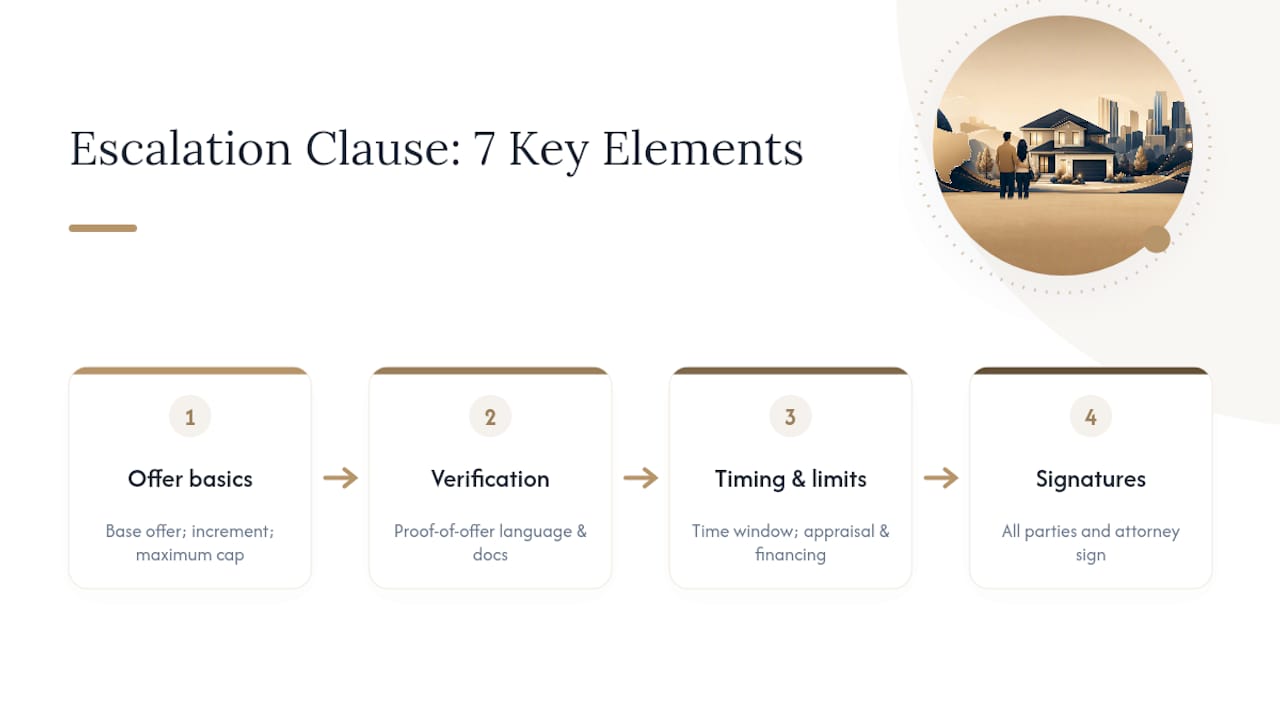
Base offer. This is your starting bid, the number you’d be comfortable paying if no escalation ever triggers. Set it at a price you’d genuinely accept even if the clause never activates.
Escalation increment. The dollar amount your offer rises above each competing bid. Smaller increments ($1,000 to $2,500) keep you from overpaying by a wide margin; larger increments ($5,000 to $10,000) signal aggression but can push you past your appraisal ceiling fast.
Maximum cap. Your absolute ceiling. This is the number sellers will see, and once they see it, they may treat it as your real offer rather than your outer limit.
Proof-of-offer language. The clause should specify exactly what counts as proof: a redacted copy of the competing contract, a signed statement from the listing agent, or similar documentation. Vague language here (“upon notice of a higher offer”) is where disputes and, occasionally, fabricated competing offers creep in.
Effective time window. Escalation clauses should apply only during the active offer-review period, not linger as an open-ended commitment weeks later.
Appraisal and financing contingencies. Your clause should state clearly whether escalation is capped by appraised value, or whether you’re prepared to bring extra cash if the appraisal comes in low.
Signature and acknowledgment. Every party, and ideally the drafting attorney, should sign off on the final version before it’s attached to your offer.
Pro Tip: Ask your attorney to require a full, unredacted copy of the competing offer’s signature page, or a notarized statement from the listing broker, rather than accepting a verbal claim or a text message screenshot. Weak proof standards are the single most common source of post-closing disputes over escalation clauses.
Each of these elements is a negotiation lever. A tight increment and a modest cap protect you financially, but a generous cap can be the difference between winning and losing a home you actually want. The trade-off is real, and it’s worth walking through with your agent and attorney together rather than deciding alone at 11 p.m. before an offer deadline.
What Do Worked Escalation Clause Examples Look Like?
Here’s how the math plays out in two realistic Central Texas scenarios.
- Standard scenario. You offer $600,000 with a $7,500 increment and a $650,000 cap. The seller receives a competing offer of $615,000 with proof provided. Your price escalates to $622,500 (competing offer plus increment). You win the home, assuming no higher bid appears, at a price still $27,500 below your ceiling.
- Appraisal-risk scenario. You offer $600,000 with a $10,000 increment and a $650,000 cap. A competing offer of $645,000 surfaces. Your price escalates to $655,000, but that exceeds your stated cap, so your contract price locks at $650,000. Your lender’s appraisal comes back at $625,000. Without an appraisal-related addendum, you’re now on the hook to cover a $25,000 gap in cash or renegotiate.
That second scenario is exactly why pairing escalation language with an appraisal contingency matters, a point covered further in the legal section below.
Short, plain template (starting point only, not for direct use):
“Buyer’s offer of $[base price] shall automatically increase by $[increment] over any bona fide competing written offer, up to a maximum price of $[cap], upon Seller’s or Listing Broker’s written verification of such competing offer.”
Detailed, attorney-style template (example only, consult a Texas-licensed attorney before use):
“In the event Seller receives one or more bona fide written offers on the Property with terms comparable to Buyer’s offer, Buyer’s Purchase Price shall increase by $[increment] increments above the highest such competing offer, not to exceed $[cap], contingent upon Seller providing Buyer or Buyer’s agent with a copy of the competing offer’s signature page or other documentation reasonably verifying its terms within [X] hours of request, and contingent further upon the Property appraising at or above the escalated Purchase Price per the terms of the Third Party Financing Addendum.”
Fields you must customize: base price, increment, cap, verification time window, and whether an appraisal contingency applies. Phrases carrying legal risk: any language defining what counts as “bona fide,” any waiver of appraisal rights, and any clause that doesn’t specify a hard expiration.
Are Escalation Clauses Legal Under TREC Rules?
Escalation clauses are not banned in Texas, but the way they get created is tightly regulated, and this is where most confusion starts.
TREC’s guidance is unambiguous on one point: a license holder who drafts language defining or affecting a buyer’s or seller’s rights, obligations, or remedies is practicing law without a license. Escalation clauses, by definition, do exactly that. They alter contractual price obligations based on future contingent events, which places them squarely outside what an agent is permitted to write.
TREC’s own guidance states that “a license holder who drafts a clause purporting to increase the sales price incrementally” is engaged in the unauthorized practice of law, and doing so exposes the license holder to disciplinary action. There is no TREC-approved escalation form; the language has to come from a client or a Texas-licensed attorney.
That guidance ties directly back to TREC Rule 537.11, which restricts license holders from drafting provisions that define legal rights or obligations of the parties. In practical terms, if a client asks their agent to “just add an escalation clause,” the agent has exactly three acceptable moves:
- Refer the client to a real estate attorney for the language itself.
- Accept only exact, client-supplied wording and insert it verbatim, without editing or advising on its legal effect.
- Decline to include the language if the brokerage’s risk policy prohibits it, which many do even when clients provide their own wording.
Where does this typically show up in a Texas contract? Almost always as an attachment or insertion tied to Paragraph 11 (Special Provisions) of the One to Four Family Residential Contract. TREC’s own commentary on that paragraph warns that Special Provisions should be limited to factual statements, not legal terms, which is precisely why escalation language belongs in a separately attorney-drafted addendum rather than jammed into the standard form. TREC’s broader contracts and forms library also lists related addenda, including the Addendum Concerning Right to Terminate Due to Lender’s Appraisal, worth requesting alongside any escalation language.
The penalties for crossing this line are not hypothetical. TREC enforcement can carry administrative fines and license disciplinary action for agents who draft prohibited contract provisions. Texas Realtor guidance echoes the same three-step process: advise the client to see an attorney, get the client’s instructions in writing, and insert only the client’s exact language, nothing paraphrased or “cleaned up.”
What Are the Benefits and Risks of an Escalation Clause?
The appeal of an escalation clause is obvious: it lets you compete without guessing the market’s ceiling in advance. The risks are less obvious until you’ve watched one backfire.
Benefits:
- Keeps you competitive in multiple-offer situations without forcing you to name your absolute maximum up front.
- Avoids reflexive overbidding. You’re not tempted to just offer your cap outright out of fear, since the mechanism only escalates when it needs to.
- Signals seriousness to a listing agent managing several offers under deadline pressure.
Risks:
- Reveals your ceiling. Once a seller sees your cap, some will simply counter at that number, and the legal risk of losing negotiating leverage is well documented in Texas market commentary.
- Appraisal and financing exposure. An escalated price can exceed what a lender’s appraiser will support, leaving you to cover the gap in cash.
- Verification and fraud risk. Weak proof-of-offer language creates room for a seller to claim a competing offer that doesn’t fully exist, or exaggerate its terms.
A buyer competing for a home in a fast-moving Central Texas neighborhood might set a $10,000 cap above list price, only to have the listing agent counter immediately at the cap once the escalation clause is submitted. The buyer gets the house, but pays exactly what they hoped to avoid revealing. In another common pattern, a buyer’s escalated price clears $625,000 against a $600,000 appraisal, and without a termination option tied to that appraisal, the buyer either brings extra cash to closing or walks away from earnest money.
Pro Tip: Always pair an escalation clause with the Addendum Concerning Right to Terminate Due to Lender’s Appraisal, available through TREC’s promulgated forms library. It gives you a contractual exit if the appraisal comes in below your escalated price, instead of leaving you to negotiate from a position of desperation days before closing.
How Should Texas Buyers Draft an Escalation Clause Safely?
Treat this as a sequence, not a checklist you can skip around in.
- Consult a Texas real estate attorney first. This isn’t optional given TREC’s UPL restrictions. Budget for a short paid consultation before you’re mid-negotiation.
- Set your cap at a realistic appraisal threshold, not just at the top of what you can financially stretch to pay.
- Require written proof of any competing offer, specifying exactly what documentation qualifies (signature page, broker attestation, or similar).
- Add an appraisal or financing termination option so an escalated price above appraised value doesn’t trap you.
- Include a firm time window and signature requirements so the clause can’t be invoked after the offer-review period closes.
For agents, the don’ts matter as much as the dos. Never draft, edit, or “clean up” a client’s escalation language, even informally in an email. Never suggest specific dollar increments or caps as your own recommendation. Do refer clients to counsel immediately, and do document, in writing, any client-supplied language before inserting it verbatim into an addendum.
When reviewing a draft clause with your attorney, flag these red flags immediately:
- Ambiguous triggers like “if Seller receives a better offer,” with no defined proof standard.
- Open-ended increments with no cap at all, which defeats the purpose of the tool.
- Missing time boundaries, letting the clause theoretically apply weeks after the original offer deadline.
Pro Tip: Bring your attorney a printed copy of the One to Four Family Residential Contract with Paragraph 11 highlighted before your meeting. It saves billable time and gets you a usable addendum faster.
When Does an Escalation Clause Make Sense in Texas?
An escalation clause earns its keep only under specific market conditions, and using one outside those conditions usually does more harm than good.
Signals that favor using one:
- Multiple confirmed offers, not just a listing agent’s suggestion that “there might be other interest.”
- A short marketing period, typically under two weeks, indicating genuine competitive pressure rather than a slow-moving listing testing the waters.
- A seller focused on net proceeds with no particular concern about appraisal contingencies holding up closing.
Buyer profiles where escalation clauses tend to backfire:
- Financing-dependent buyers with thin cash reserves, who can’t cover an appraisal gap if the escalated price outruns the appraisal.
- Buyers prone to second-guessing, since watching your price climb automatically can trigger genuine buyer’s remorse before you’ve even closed.
- Buyers in thinner markets outside Austin’s core neighborhoods, where “multiple offers” claims are harder to verify and less likely to be genuine.
Pro Tip: An escalation clause works best as one strength among several, not your only strength. Combine it with a larger earnest money deposit, a flexible closing date, or fully underwritten financing rather than relying on the clause alone to win the deal. Sellers weigh certainty of closing as heavily as price, sometimes more. Reviewing negotiation tactics specific to the Austin market before you write any offer helps you see where escalation fits into a broader strategy rather than standing alone.
What Are Better Alternatives to an Escalation Clause?
Escalation clauses aren’t the only path to winning a competitive offer, and for many buyers, they’re not the best one.
A clean, higher offer. Skip the mechanism entirely and simply offer your real maximum up front. It avoids UPL complications, appraisal-cap confusion, and seller countering tactics, at the cost of potentially overpaying if no competing bid materializes.
An “escalation-proof” offer. Instead of a price mechanism, strengthen your base offer with terms sellers value: a larger earnest money deposit, a faster closing timeline, or a waived option period. This approach requires no special contract language and carries no UPL risk.
Escalation paired with an appraisal-termination addendum. If you do use an escalation clause, attaching TREC’s appraisal-related addendum gives you a contractual exit if the appraisal lands below your final price, addressing the single biggest downside of escalation language.
A back-up offer position. If a home already has an accepted contract, a formal back-up offer secures your place in line without any escalation mechanics at all, useful in Central Texas markets where financing sometimes falls through.
Each of these fits a different risk tolerance. A cash-heavy buyer with no financing contingency might prefer the clean higher offer for simplicity. A financing-dependent buyer should lean toward escalation paired with appraisal protection, or skip escalation altogether in favor of a stronger base offer. Buyers weighing these trade-offs often benefit from a full walkthrough of Austin bidding tactics before deciding which path fits their situation.
How Do Experienced Texas Agents Handle Escalation Requests?
Agents who’ve worked through several bidding cycles tend to follow a consistent internal process when a buyer asks about escalation language, and it starts well before any contract is drafted.
- Immediate attorney referral the moment escalation comes up, rather than trying to sketch out terms informally over a call.
- Written documentation of client instructions if the client supplies exact language, protecting both the agent and the client if a dispute arises later.
- Full risk disclosure, including the appraisal-gap scenario and the possibility that a seller counters at the stated cap.
- Escalation treated as a last resort, used only when the offer’s other terms (financing, timeline, contingencies) are already as strong as they can be.
A buyer competing for a well-priced property in a fast-selling Austin neighborhood submitted an escalation clause with a $15,000 cap above list price. The listing agent countered immediately at the cap, and the buyer, having no cash reserve for an appraisal shortfall, spent an anxious ten days waiting on the appraisal report before closing. Contrast that with a similar situation where the buyer paired a modest escalation increment with an appraisal-termination addendum. When the appraisal came in $8,000 short, the buyer had a documented exit and used it to renegotiate rather than absorb the loss.
Mike Mogavero has spent more than 20 years navigating competitive Austin offers, and the pattern holds across price points: clauses that work are the ones built with attorney input and appraisal protection baked in from the start, not bolted on after a seller has already countered. Specialty counsel becomes especially important on higher-value transactions, where the dollar amounts at stake in an appraisal gap can run into six figures rather than a few thousand dollars.
How Do Sellers Typically Respond to an Escalation Clause?
Sellers and their listing agents have seen enough escalation clauses to have a standard playbook, and buyers should know it before submitting one.
Common responses include:
- Accepting the clause as written, which happens most often when the seller trusts the buyer’s proof-of-offer terms and wants a fast resolution.
- Removing the clause and countering directly at the buyer’s stated cap, the most common reaction and the one that erases your negotiating leverage.
- Requesting immediate proof of any claimed competing offer before allowing the escalation to trigger at all.
- Ignoring the clause and negotiating the base terms separately, treating your escalation language as a starting point rather than binding.
- Rejecting the offer outright if the seller’s agent has a policy against escalation mechanics, which some brokerages maintain.
If a seller counters at your cap, you have room to negotiate back. Push for seller concessions elsewhere: closing cost credits, a home warranty, or a repair allowance, rather than treating the cap as your final number simply because it’s the number you wrote down. If the seller demands proof of a competing offer that never surfaces, your attorney can advise on whether the seller’s counter is even enforceable.
- State clearly, in writing, what proof standard your offer requires before responding to any seller counter.
- Confirm your financing is still solid at the higher price before agreeing to the seller’s counter at your cap.
- Ask for a short extension on your option period if the countered price requires additional inspection or lending review.
Buyer rebuttal language might read: “We’re prepared to proceed at our stated cap contingent on receiving documented evidence of the competing offer and confirmation that our financing terms remain unaffected.” It’s direct, and it protects you from paying your ceiling price without ever seeing the leverage that justified it.
A Local Perspective on Guiding Clients Through Escalation Clauses
Every Austin luxury buyer who asks about escalation clauses gets the same first answer from our team: talk to an attorney before we talk about numbers. That’s not deflection. TREC’s restrictions on agent drafting are specific enough that skipping this step creates real exposure for everyone involved in the transaction.
What we can do, and where our experience genuinely helps, is coordinate. We connect clients with real estate attorneys who draft this language regularly, review the resulting addendum for consistency with the rest of the offer package, and think through appraisal strategy before the number ever gets submitted. In a market where pricing strategy shifts by neighborhood almost month to month, that coordination often matters more than the clause itself.
If you’re weighing whether an escalation clause fits your offer strategy, we’d rather walk through the specifics with you directly than have you guess from a blog post, however thorough. Reach out to schedule a consultation before your next offer deadline.
How Mogavero Group Helps You Structure a Competitive Offer
There are other paths to winning a bidding war in Austin: a clean higher offer, a stronger earnest money position, or working with a general buyer’s agent who submits your paperwork and steps back. None of those give you what a specialized, high-end buying process does, which is a team that has already built the attorney relationships, appraisal strategy, and off-market pipeline that make escalation clauses unnecessary more often than not.

Mogavero Group works with Austin buyers on exactly this kind of offer strategy, from structuring competitive terms to coordinating with real estate attorneys when a clause genuinely makes sense. Because the team also maintains a roster of private, off-market listings, clients sometimes skip the multiple-offer scenario entirely, no escalation clause required at all. If you’re preparing to compete for a home in this market, or want access to opportunities that never reach open bidding, browse current Austin properties and schedule a consultation to talk through your offer strategy before you submit anything.
Sources
- Escalating to Trouble - TREC
- Escalation Clauses in Texas: How They Work and Key Risks - LegalClarity
- One to Four Family Residential Contract Guide - Texas Realtor
FAQ
Is an Escalation Clause a Good Idea in Texas?
It can be, but only when a competing-offer situation is confirmed, your cap reflects a realistic appraisal ceiling, and an attorney has drafted the language, since your agent legally cannot.
Do Sellers Dislike Escalation Clauses?
Many listing agents are wary of them because they can complicate negotiations and invite disputes over proof of competing offers; some sellers simply counter at your stated cap instead of accepting the clause as written.
What Is the Biggest Potential Problem With an Escalation Clause?
The appraisal gap is the most common and costly issue: if your escalated price exceeds what the lender’s appraiser supports, you may need to cover the difference in cash or terminate the contract.
Can an Escalation Clause Backfire?
Yes. It can reveal your true ceiling to the seller, trigger a counter at your maximum, or leave you contractually bound to a price your appraisal won’t support if you skip an appraisal-termination addendum.
Can My Real Estate Agent Write My Escalation Clause for Me?
No. TREC guidance is explicit that agents who draft this language risk engaging in the unauthorized practice of law; the language must come from you or a Texas-licensed attorney.
Recommended
- Negotiating in Real Estate – Maximizing Value in Austin | Mogavero Group Austin Real Estate
- Real Estate Terms Explained: Navigating Austin Luxury | Mogavero Group Austin Real Estate
- 7 Essential Real Estate Investment Tips for Austin Buyers | Mogavero Group Austin Real Estate
- Austin Real Estate FAQs | Mogavero Group Austin Real Estate