AEGB First: Verify Green Home Certifications in Austin
Start with AEGB. Compare AEGB, LEED and NGBS, use the steps to certify or verify a green home in Austin and avoid costly verification gaps.
AEGB First: Verify Green Home Certifications in Austin

If you’re building, remodeling, or buying in Austin, three programs matter: Austin Energy Green Building (AEGB), LEED for Homes, and the National Green Building Standard (NGBS). AEGB is your first stop since it’s the local, city-integrated program with the most Austin-specific data and support. The immediate move: check a home’s AEGB rating through the Online Rating System or call a certified Green Rater or energy rater before you sign anything.
TL;DR:
- Austin Energy Green Building (AEGB) has rated over 15,000 homes locally, offering the most relevant data for comparison in Austin.
- Certification requires early registration, verifier involvement during design, thorough documentation, and scheduled performance testing before approval.
- LEED certification involves independent on-site verification, tiered performance levels, and performance testing, often used for larger or nationally recognized projects.
- NGBS allows pre-approvals for materials and is recognized by many lenders and officials, making it advantageous for some multifamily or standardized projects.
- Buyers should demand proper documentation, verify certification records, and avoid trusting builders’ claims without supporting paperwork or verified test results.
Table of Contents
- What Is Austin Energy Green Building (AEGB)?
- LEED for Homes and NGBS: The National Alternatives
- How to Get a Home Certified in Austin: The Actual Steps
- Finding and Verifying a Certified Home in Austin
- Incentives, Costs, and What Certification Actually Buys You
- A Local Agent’s View: Why Certification Shows Up in Luxury Listings
- Why AEGB-First Thinking Actually Serves Austin Buyers Better
- How Mogavero Group Helps You Verify Green Claims Before You Buy
- Where to Verify Program Details Directly
- Sources
- FAQ
What Is Austin Energy Green Building (AEGB)?
AEGB isn’t a newcomer. Austin Energy launched what’s widely considered the nation’s first residential green building rating system back in 1991, and the city has been feeding results from that program into its own energy code updates ever since, according to program overview documents filed with Austin’s Environmental Commission. That local track record is exactly why AEGB carries weight here in a way an out-of-state buyer might not expect.
The program rates single-family and multifamily projects, both new construction and major remodels, across energy performance, water use, building materials, and indoor air quality. A higher rating tells you the home was verified, not just designed, to hit those marks.
Homeowners and builders interact with AEGB mainly through:
- The Online Rating System (ORS), where projects register and track scoring
- Monthly seminars, some of which qualify for AIA or GBCI continuing-education credit
- Marketing support, including rating plaques and score cards builders can hand to buyers
Austin Energy’s own program pages describe a searchable population of more than 15,000 AEGB rated homes already on record in the Austin area, which gives you a real baseline for comparison shopping if you’re weighing a certified home against an uncertified one down the street.
LEED for Homes and NGBS: The National Alternatives
If you’re building a larger multifamily project, working with a developer brand that wants national recognition, or selling to buyers relocating from a market where LEED is a household term, AEGB alone might not cut it. That’s where LEED for Homes and the NGBS come in.
LEED for Homes, run by the U.S. Green Building Council (USGBC) through its certification body GBCI, requires:
- On-site verification by an independent LEED Green Rater
- Performance testing from a qualified energy rater, often a HERS rater, covering things like duct leakage and insulation quality
- A tiered outcome (Certified, Silver, Gold, Platinum) based on points earned across energy, water, materials, and site categories, per USGBC’s certification guide
NGBS (ICC 700), administered by Home Innovation Research Labs, is the ANSI-approved standard that runs from Bronze up through Emerald. One practical advantage: NGBS allows product pre-approvals, so a builder can specify materials that already map to the standard’s criteria, which speeds up inspector review considerably.
Lenders and code officials in many jurisdictions recognize NGBS, which matters if a project needs financing flexibility that a purely local rating can’t offer.
How to Get a Home Certified in Austin: The Actual Steps
Certification fails most often not because a house performs poorly, but because someone skipped a step. Here’s the sequence that actually works, whether you’re pursuing AEGB, LEED, or NGBS.
- Register early. Sign up through AEGB’s Online Rating System, or through USGBC/GBCI for LEED, before construction starts, not after.
- Hire your verifier during design, not construction. A LEED Green Rater or HERS energy rater needs to weigh in on plans before walls go up.
- Document everything as you build. Photos, receipts for pre-approved products, insulation specs, all of it feeds the final review.
- Schedule on-site testing. Blower-door tests, duct leakage tests, and visual inspections happen at defined construction milestones, not just at the end.
- Submit for final sign-off. Once testing clears, the verifier submits results and the program issues your rating or certification level.
- Collect your marketing assets. AEGB provides plaques and score cards; LEED and NGBS issue certificates and plaques buyers recognize.
Pro Tip: Registering for LEED without a Green Rater already attached is one of the most common and costly mistakes builders make. Lock in your verifier before you finalize floor plans, and you’ll avoid the rework that comes from discovering a compliance gap mid-build.
Finding and Verifying a Certified Home in Austin
Buying a home marketed as “green” without paperwork is just taking someone’s word for it. Ask for specifics.
- Check the MLS listing for AEGB, LEED, or NGBS designations, then ask the seller or builder directly for supporting documentation.
- Look up the property in AEGB’s Online Rating System or request the physical rating score card.
- Ask for on-site verification records, including blower-door and duct-test results, not just a summary sheet.
- Work with a green-trained agent carrying an EcoBroker or NAR green designation who knows how to read this paperwork and where verification gaps typically hide, per Austin Energy’s own buyer guidance.
- Red flag: a builder who mentions “green features” but can’t produce a rating number or a verifier’s name. That’s marketing language, not certification.
If you’re also lining up a pre-purchase inspection, pairing it with a review of the home inspection process in Austin gives you a fuller due-diligence picture before closing.
Incentives, Costs, and What Certification Actually Buys You
Solar incentives and efficiency rebates change often enough that you should verify current terms directly on Austin Energy’s green building pages rather than trust a number from an old blog post, including this one.
Certification costs vary by program and project size, but expect line items for verifier fees, energy testing, and sometimes minor performance upgrades needed to clear a rating threshold. What you get in return isn’t just a plaque. Verified homes tend to show real operational savings and carry documented efficiency claims that resonate with buyers, an advantage detailed in coverage of Austin homes with energy-efficient features. Treat any specific dollar-savings promise from a builder with some skepticism until a rater’s numbers back it up.
A Local Agent’s View: Why Certification Shows Up in Luxury Listings
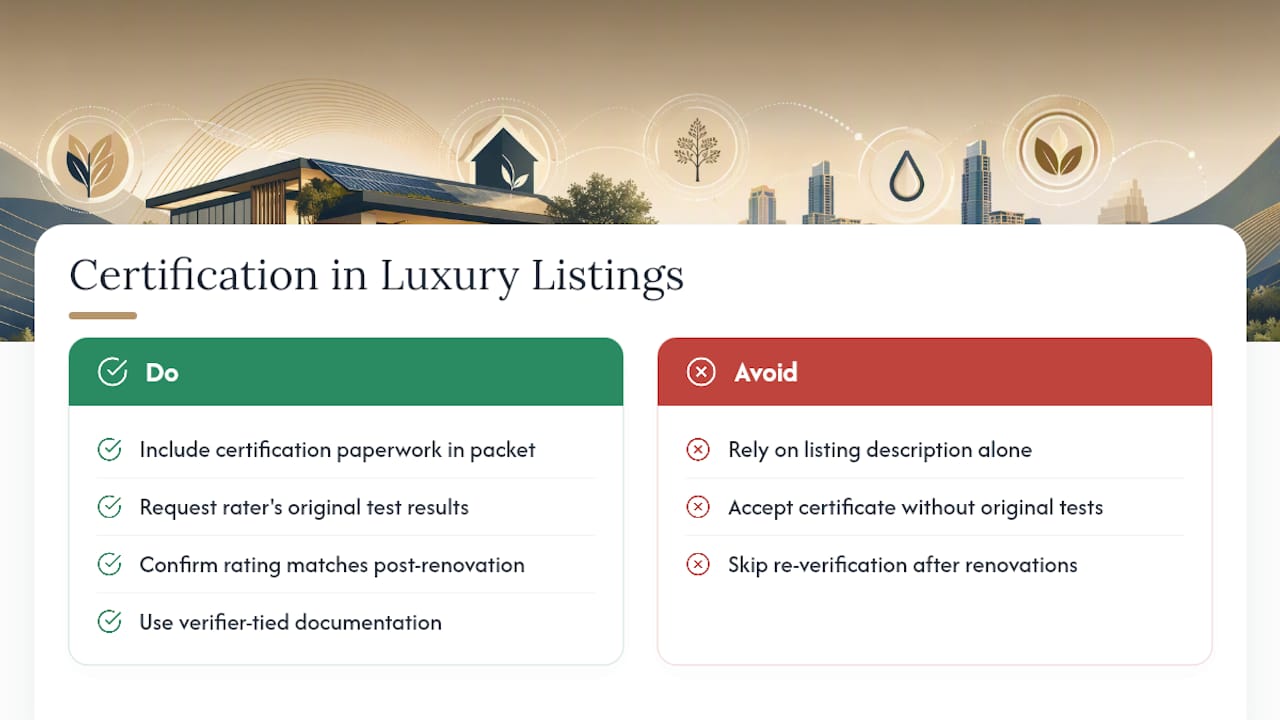
When Mogavero Group lists a certified home, the certification paperwork goes into the buyer packet alongside energy reports and inspection records, not as an afterthought. High-end buyers in Austin increasingly ask about indoor air quality, envelope performance, and long-term durability before they ask about finishes.
Verified efficiency data functions as a selling point precisely because it’s independently checked rather than self-reported. During escrow, we recommend buyers request the rater’s original test results, not just the final certificate, and confirm the rating level still matches the home’s current condition if renovations happened after certification. That extra step catches the rare case where a home was rated once and never re-verified after later work. Documented performance, tied to a specific rating and a specific verifier, tends to hold up better under buyer scrutiny than a listing description ever will, which is reflected in how these homes market in Austin’s luxury segment.
Why AEGB-First Thinking Actually Serves Austin Buyers Better
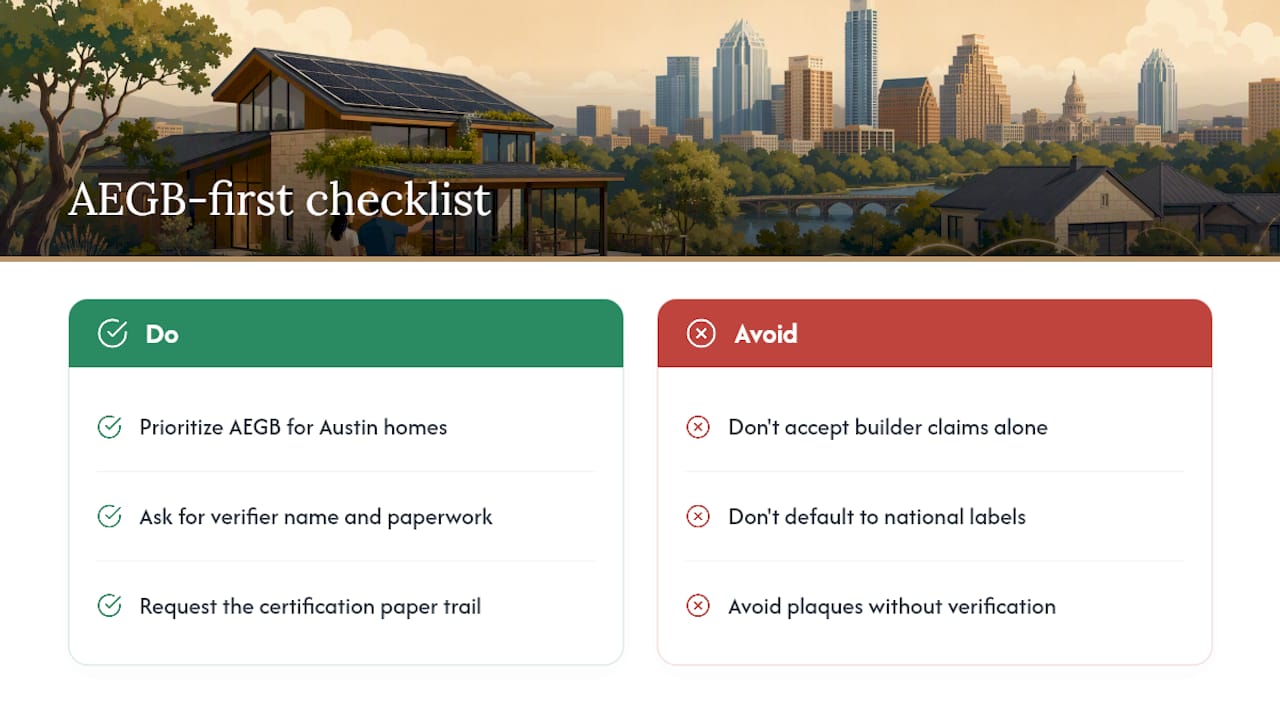
Most guides treat LEED as the default gold standard and mention local programs as an afterthought. That’s backwards for Austin specifically. AEGB has three decades of local data behind it, direct influence over city energy code, and a rating population large enough that you can actually compare a candidate home against real neighborhood peers. LEED and NGBS earn their place when a project needs national lender recognition or a developer wants a brand buyers already trust from other markets, but for a single-family home search here, dismissing AEGB in favor of a national label is leaving local context on the table.
The bigger failure isn’t picking the wrong program. It’s skipping verification altogether and trusting a builder’s claim at face value. A rating without a verifier’s name attached to it is a marketing sentence, not a certification. If you take one thing from this, prioritize asking for the paper trail over asking for the plaque.
— Mike
How Mogavero Group Helps You Verify Green Claims Before You Buy
Mogavero Group works the due-diligence side of this every day: reviewing AEGB score cards, LEED certificates, and NGBS documentation against what a listing actually claims, and flagging gaps before they become closing-day surprises.
We work with certified and pre-construction properties and can assist with marketing verified efficiency and air-quality data to interested buyers. If you’re comparing certified properties in areas like Lake Austin, or planning efficiency upgrades before a sale with help from a partner like One Day Doors & Closets, we can walk you through what the numbers actually mean for value. Browse our current luxury Austin listings or reach out to schedule a consultation on a specific property, certified or not.
Where to Verify Program Details Directly
For current rules, registration steps, and verifier directories, go straight to the source: Austin Energy Green Building, USGBC’s LEED for Homes guide, and NGBS certification resources.
Sources
- Austin Energy Green Building
- Guide to Certification: Residential | U.S. Green Building Council
- NGBS Green home & development | Get certified
- ICC 700 National Green Building Standard® | NAHB
FAQ
What does a home need to earn green certification?
It generally needs registration with a program (AEGB, LEED, or NGBS), design-phase involvement from a verifier or energy rater, on-site performance testing, and a final documentation review before a rating or certification level is issued.
What’s the most widely recognized green building certification?
LEED, administered by USGBC, has the broadest national name recognition, though NGBS is also widely accepted by lenders and code officials, and AEGB carries the most local authority within Austin specifically.
What solar incentives are currently available in Austin?
Incentive programs and rebate amounts change over time, so confirm current terms directly on Austin Energy’s green building and incentive pages rather than relying on a fixed figure.
How do I actually start the certification process?
Register your project through AEGB’s Online Rating System or with USGBC/GBCI for LEED, then hire a Green Rater or energy rater during the design phase, before construction begins, so testing and documentation stay on schedule.