HOA vs No HOA: Which Fits Your Lifestyle and Budget?
Deciding between HOA and no HOA? Discover which option suits your lifestyle and budget for stress-free living or ultimate freedom.
HOA vs No HOA: Which Fits Your Lifestyle and Budget?

If you want maintenance-free living, predictable curb appeal, and shared amenities, an HOA usually fits better. If you value autonomy, want to skip recurring fees, and don’t mind handling your own repairs and disputes, a non-HOA home usually serves you better. That’s the real trade-off, and almost everything else in this decision flows from it.
- Best for HOA living: buyers who travel often, retirees who don’t want yard work, and anyone who wants a pool, gate, or clubhouse without owning the upkeep headache.
- Best for no-HOA living: buyers who want to park an RV in the driveway, paint their door purple, rent out a room without asking permission, or simply hate the idea of a board voting on their landscaping.
The rest of this guide breaks down the costs, the rules, the resale math, and a pre-offer checklist so you can verify which side of that line actually applies to the specific property you’re considering.
Key Takeaways
Choosing between an HOA and a non-HOA home comes down to whether you’d rather pay for predictability and shared upkeep or keep full control at the cost of doing the work yourself.
| Point | Details |
|---|---|
| Match structure to lifestyle | HOAs suit buyers who want maintenance-free living; non-HOA homes suit buyers who want autonomy. |
| Read the reserve study first | Underfunded reserves are the strongest predictor of a future special assessment. |
| Pull minutes and litigation history | Twelve to twenty-four months of meeting minutes reveal recurring disputes better than any brochure. |
| Rules vary by state | Enforcement steps, hearing rights, and lien procedures differ by state, so verify local law before you assume how disputes get resolved. |
| Work with a local agent | Mogavero Group coordinates HOA document review and local market context for Austin buyers comparing HOA and non-HOA properties. |
Table of Contents
- HOA vs No HOA: What an HOA Actually Is Legally
- Pros of Buying in an HOA Community
- Cons of Buying in an HOA Community
- Is a $500 HOA Fee High? Breaking Down the Costs
- What Happens if You Don’t Pay HOA Dues?
- How HOA Status Affects Resale Value
- The Pre-Offer Checklist: What to Review Before You Buy
- POA, Condo Association, or Deed Restrictions: Know the Difference
- How an Agent Evaluates HOA Health Before You Offer
- What Buyers Consistently Get Wrong About HOAs
- How Mogavero Group Helps You Choose the Right HOA Fit
- Sources
- FAQ
HOA vs No HOA: What an HOA Actually Is Legally
A homeowners association is a legal entity, usually a nonprofit corporation, that governs a community through a set of recorded documents called Covenants, Conditions, and Restrictions, or CC&Rs. When you buy a home inside an HOA’s boundaries, membership isn’t optional. It’s automatic and it runs with the property, meaning the obligation transfers to whoever owns the house next, according to the National Association of Realtors’ consumer guide.
You’ll encounter several governing documents during a purchase, and each one controls something different:
- CC&Rs set the substantive rules: what colors you can paint, whether you can park a boat in the driveway, fence height limits, and rental restrictions.
- Bylaws dictate how the association itself operates, including board elections and meeting procedures.
- Rules and regulations cover day-to-day details like pool hours or trash can placement that the board can typically amend without a full vote.
- Articles of incorporation establish the HOA as a legal entity in its state.
- Reserve study projects long-term repair costs for shared infrastructure like roofs, roads, and pools.
- Meeting minutes and budgets reveal how the board actually spends money and handles conflict.
Enforcement isn’t symbolic. Associations can levy fines, suspend amenity privileges, charge special assessments, and in cases of prolonged nonpayment, file a lien against your property, according to the same NAR consumer guide. That lien can eventually lead to foreclosure in some states, which is a detail plenty of first-time buyers never see coming.
Pros of Buying in an HOA Community
The upside of HOA living is real, and it’s why so many buyers choose it on purpose rather than by accident.
- Shared maintenance. Exterior painting, roof repairs, landscaping, and common-area upkeep get handled by the association instead of falling entirely on you.
- Amenities you’d never build yourself. Pools, gyms, walking trails, and gated entries come standard in many HOA communities, without the cost of installing or maintaining them individually.
- Predictable neighborhood appearance. Uniform standards for lawns, paint, and fencing keep the block looking consistent, which some buyers find genuinely reassuring.
- Coordinated security. Gate staff, camera systems, or neighborhood patrols are easier to fund and manage collectively than individually.
- A modest resale edge in some markets. Research cited by HomeLight points to average price increases near 4% for HOA-governed single-family homes compared to similar non-HOA properties, and satisfaction surveys from the Community Associations Institute show many residents report being happy with their association overall.
A retiree who wants to travel three months a year without worrying about a dead lawn is the textbook HOA buyer. So is a dual-income couple who wants a gym and a pool without a second mortgage to build one.
Here’s the catch: every one of these benefits depends on competent management. A well-run HOA delivers transparent budgets, active board participation, and consistent enforcement. A poorly run one delivers all the fees and none of the reliability, which is exactly why the due-diligence section later in this guide matters so much.
Cons of Buying in an HOA Community
The complaints about HOAs aren’t exaggerated internet folklore. They’re common enough that “why do people hate HOAs” is one of the most searched HOA questions out there, and the reasons are consistent.
- Recurring fees, no matter your usage. You pay dues whether you swim in the pool once a summer or never at all.
- Restrictive rules on modifications. Paint colors, fence styles, parking, and even holiday decorations can require board approval, according to Realtor.com’s breakdown of HOA pros and cons.
- Special assessment risk. When reserves run short, the board can bill homeowners a lump sum, sometimes thousands of dollars, to cover an unplanned roof or road repair.
- Board mismanagement and selective enforcement. Volunteer boards vary wildly in competence, and some communities develop reputations for enforcing rules unevenly.
Picture a homeowner who parks a work truck in their own driveway for a decade without issue, until a new board member decides to enforce a long-ignored rule and issues fines retroactively. Or a family who repaints their front door a shade the architectural committee didn’t pre-approve and gets a violation notice within a week. These aren’t rare stories. They’re the day-to-day friction that drives a lot of HOA dissatisfaction.
Member recourse is often limited to attending meetings, voting in board elections, or pursuing a formal dispute process, and unpaid fines or assessments can still escalate to a lien, according to Realtor.com. That’s a serious legal exposure for what might start as a $50 fine over a mailbox.
Is a $500 HOA Fee High? Breaking Down the Costs
Whether $500 a month is high depends entirely on what it buys. A $500 fee covering a gated community with a staffed clubhouse, resort-style pool, and full landscaping is arguably a bargain. The same $500 for a townhome with a small shared lawn and no amenities is worth questioning.
HOA dues typically fund three buckets: the operating budget (day-to-day expenses like landscaping contracts and utilities for common areas), reserve contributions (savings for future big-ticket repairs), and management fees (paying a professional company to run the books and enforce rules). National HOA fees vary widely depending on amenities and location, according to LegalClarity’s analysis of HOA costs.
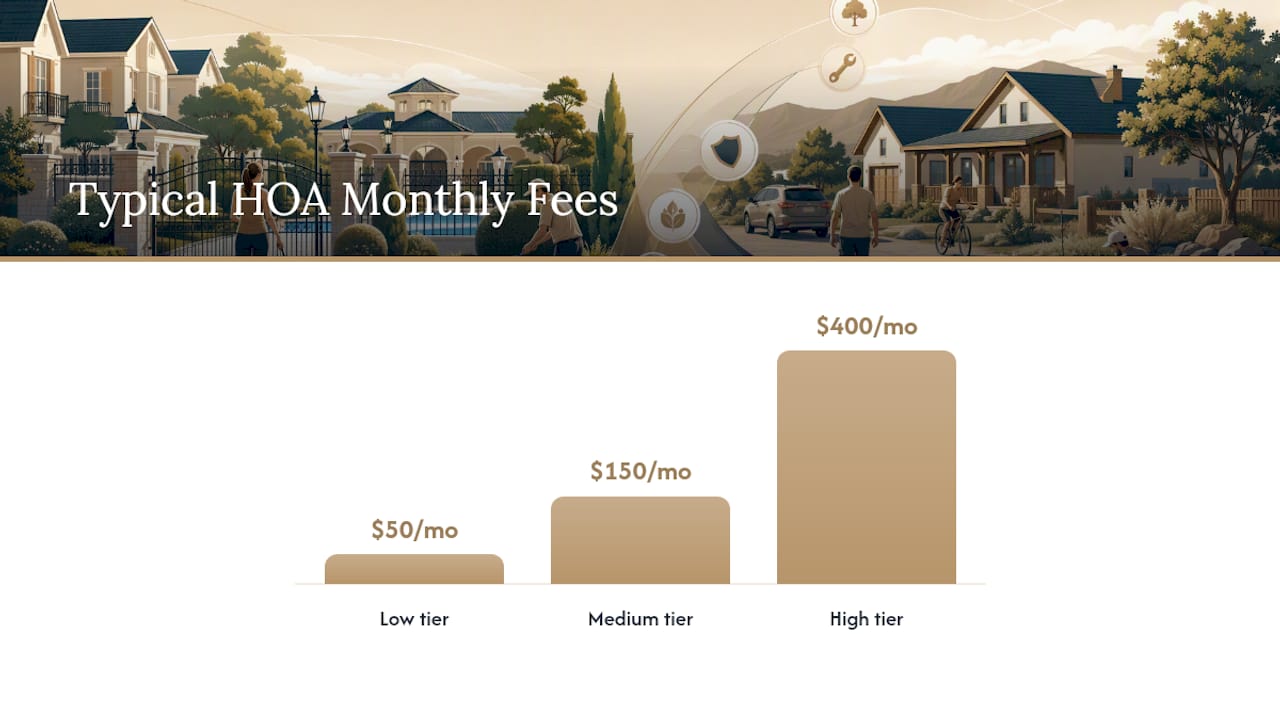
| Fee tier | Monthly range | Typically includes |
|---|---|---|
| Low | $50 | Basic landscaping, minimal common areas, no staffed amenities |
| Medium | $150 | Pool, playground, some exterior maintenance, part-time management |
| High | $400 | Gated entry, clubhouse, staffed amenities, full exterior maintenance, larger reserve contributions |
The bigger risk isn’t the monthly number. It’s what happens when reserves run dry. If an association hasn’t saved enough for a roof replacement or road resurfacing, it issues a special assessment, a one-time bill that can run into the thousands, and those bills tend to land hardest on communities that kept dues artificially low for years.
- Ask what percentage of the reserve study’s recommended funding level the HOA has actually saved.
- Ask how many special assessments have been issued in the last five years.
- Ask whether dues have kept pace with inflation or been frozen to keep buyers happy at closing time.
Pro Tip: Always request the reserve study along with the past two years of budgets and board meeting minutes before you sign anything. An underfunded reserve is one of the strongest predictors of a special assessment landing in your mailbox within the first two years of ownership.
What Happens if You Don’t Pay HOA Dues?
Enforcement follows a fairly consistent sequence, though the exact timeline and homeowner protections vary by state.
- Notice of violation or delinquency. The association informs you in writing of the issue, whether it’s a missed payment or a rule violation.
- Opportunity for a hearing. Many states, including Texas, require the HOA to give homeowners a chance to respond or appeal before fines take effect, according to Texas State Law Library guidance on property owners’ associations.
- Fines or suspension of privileges. Repeated violations can result in fines or loss of access to shared amenities like the pool or gym.
- Lien filing. Persistent nonpayment of assessments typically results in a lien recorded against the property, which can affect your ability to sell or refinance.
- Foreclosure, in the most extreme cases. Some states allow HOAs to foreclose over unpaid assessments, though procedural protections and thresholds differ significantly by jurisdiction.
Condo associations and subdivision HOAs handle enforcement a bit differently. Condo boards often have more direct control because owners share physical structures, while subdivision HOAs generally govern individual lots with more separation between properties. Either way, an HOA can’t override state or federal law. Fair housing protections and certain consumer rights still apply regardless of what the CC&Rs say.
In Texas specifically, POAs and HOAs are frequently structured as nonprofit corporations, and state guidance outlines specific homeowner rights, including access to records and hearing requirements before fines are levied, per the Texas State Law Library. If you’re evaluating an Austin-area property with an unusual governance structure or any hint of active litigation, loop in a local real estate attorney before you go under contract.
How HOA Status Affects Resale Value
A well-funded, amenity-rich HOA can genuinely help your home sell faster and for more. A gated community with a strong reserve fund and active board tends to attract buyers who want that predictability, and the price premium research from HomeLight bears that out for many single-family HOA homes.
The opposite is just as true. An aging association with deferred maintenance, a history of special assessments, or pending litigation can actively suppress your sale price. Buyers who pull the resale certificate and see a lawsuit against the HOA, or a reserve fund at 20% of recommended levels, often walk away or lowball the offer to account for future assessments they expect to inherit.
| Decision factor | HOA community | No-HOA community |
|---|---|---|
| Lifestyle fit | Maintenance-free, structured | Full autonomy, self-managed |
| Cost | Monthly dues, reserve contributions, assessment risk | No dues, but owner covers all repairs and shared infrastructure |
| Rules and restrictions | CC&Rs govern paint, fencing, parking, rentals | Municipal code only, unless deed restrictions apply |
| Amenities and maintenance | Shared pools, gyms, common-area upkeep included | None provided; owner arranges everything individually |
| Resale impact | Can add value if well-managed; can hurt value if underfunded | Value depends more on lot, house condition, and location alone |
| Enforcement risk | Fines, liens, possible foreclosure for nonpayment | Limited to municipal code enforcement, generally slower |
If you’re comparing two similar houses, one with an HOA and one without, Austin neighborhood research can help you weigh which structure actually supports the resale trajectory you’re after in that specific submarket.
The Pre-Offer Checklist: What to Review Before You Buy
Due diligence on an HOA isn’t optional if you want to avoid an ugly surprise six months after closing. Consumer guidance from NAR consistently recommends pulling these documents before you go firm on an offer.
- Resale certificate — the HOA’s official disclosure package, often including outstanding dues, violations, and pending litigation tied to the property.
- Declaration and CC&Rs — the full rulebook governing the property.
- Bylaws and rules and regulations — how the board operates and what day-to-day restrictions apply.
- Meeting minutes from the last 12 to 24 months — the single best window into recurring disputes, board turnover, or brewing conflict.
- Current budget — where the money actually goes.
- Reserve study — how well the HOA has saved for major future repairs.
- Insurance certificates — what the master policy covers versus what you’d need your own policy to cover.
- List of pending litigation — lawsuits against or by the HOA that could affect your liability or dues.
- Management contract — whether a professional company runs operations, and on what terms.
Beyond paperwork, ask direct questions of the HOA, the seller, and the listing agent:
- How often, and how large, have special assessments been in the last five years?
- What percentage of the reserve study’s recommended funding does the HOA currently hold?
- Are there rental caps, and if so, do they affect your plans?
- Is there any pending litigation involving the association?
Watch for these red flags:
- Reserve funding below 50% of the study’s recommendation.
- Multiple special assessments in a short window.
- Ongoing or recent litigation against the board.
- High board turnover or a history of contested elections.
- Enforcement that seems inconsistent from one homeowner to the next.
An experienced agent or a real estate attorney typically verifies these documents line by line, and if you’re financing the purchase, ask your lender directly whether the HOA’s insurance, reserve levels, or litigation history could affect underwriting. Buyer’s agent guidance for luxury purchases covers this kind of document review in more depth, and partner resources like Fiesta Properties’ buying process breakdown walk through similar due-diligence steps from a broader real estate perspective.
POA, Condo Association, or Deed Restrictions: Know the Difference
Not every community with rules is technically an HOA, and “no HOA” doesn’t always mean no rules at all.
- Property owners association (POA): Functions much like an HOA but often covers a broader area, sometimes including multiple subdivisions or a master-planned community with sub-associations underneath it.
- HOA: Typically governs a single subdivision or planned community, with CC&Rs covering individual lots.
- Condo association: Governs a building or complex where owners hold individual units but share structural elements, meaning rules and shared costs tend to be more extensive than a typical single-family HOA.
- Deed-restricted, non-HOA property: No association, no dues, and no board, but a developer or previous owner recorded restrictions directly on the deed. These can still limit fence height, lot use, or building setbacks even though there’s no organization to pay or attend meetings for.
That last category catches a lot of buyers off guard. A property style guide for Austin buyers is worth reviewing if you’re weighing a condo purchase against a single-family lot, since the rules and shared obligations shift significantly between property types.
Which structure makes sense depends on what you’re optimizing for. If amenities and predictability matter more than flexibility, a POA or HOA generally serves you better. If autonomy is the priority and you’re comfortable researching deed restrictions yourself, a non-HOA property, understanding it may still carry some recorded limits, is usually the better fit.
How an Agent Evaluates HOA Health Before You Offer
A buyer’s agent earns their keep during HOA due diligence in ways that aren’t always obvious from the outside. Pulling the resale certificate is one thing. Actually reading eighteen months of meeting minutes to spot a recurring argument about a leaking clubhouse roof, or noticing that “reserve study” line item hasn’t been updated in six years, takes a trained eye.
Consider a fairly common scenario: a buyer falls in love with a home in a gated community, and everything on the surface looks fine. Dues seem reasonable, the pool is beautiful, the landscaping is immaculate. But a closer read of the reserve study shows the association is funded at roughly 30% of what the study itself recommends for the next decade of anticipated repairs. That’s the kind of detail an agent flags before you write an offer, not after you’ve closed and received a $4,000 special assessment notice in your first year.

An agent’s job also includes asking the seller pointed questions the disclosure forms might soft-pedal: has the HOA issued any special assessments recently, is there current litigation, has the board changed hands more than once in the past two years? For off-market or private listings, where less public information circulates, this kind of direct verification matters even more.
When the numbers or the governance history look genuinely unusual, that’s the point to bring in a real estate attorney or an accountant who can review the HOA’s financials in more depth than a purchase contract timeline typically allows.
What Buyers Consistently Get Wrong About HOAs
The biggest misconception I see is treating the monthly fee as the whole cost of an HOA. It isn’t. The fee is just the visible number. The real cost is whatever the reserve study says the association hasn’t saved yet, and that number rarely shows up in a listing description.
I’d also push back on the idea that “no HOA” automatically means more freedom. Sometimes it does. Often it just means the freedom to be your own general contractor, your own dispute mediator when a neighbor’s fence encroaches on your lot, and your own enforcement mechanism when the city takes eight months to respond to a code complaint. Freedom without infrastructure is still freedom, but it comes with homework most buyers underestimate.
One practical habit worth adopting: walk the neighborhood at a different time of day than your scheduled showing, and if you get the chance, ask a resident directly how often the association has levied special assessments. People who actually live there will tell you things a listing sheet never will.
How Mogavero Group Helps You Choose the Right HOA Fit
Finding the right HOA fit in Austin means more than comparing amenities. It means someone actually reading the reserve study, cross-checking meeting minutes for red flags, and knowing which neighborhoods carry a history of special assessments before you ever write an offer. Mogavero Group coordinates that document review as part of the buying process, drawing on local market context you won’t get from a listing sheet alone, including access to off-market properties where HOA structure and privacy concerns often intersect.

If you’re weighing an HOA community against a non-HOA property anywhere in Austin, from Lake Austin to East Austin, start by browsing current Austin listings or ask about private, off-market opportunities where HOA terms and lot restrictions can differ significantly from what’s publicly advertised. A quick consultation before you tour can save you from falling for a house whose HOA won’t actually support how you want to live.
Sources
- Consumer Guide: Homeowners Associations
- HOA Pros and Cons for Homebuyers: Are the Perks Worth the Trouble?
- Property owners’ associations — SLL Texas guides
Pull the specific documents referenced in the pre-offer checklist above, resale certificate, reserve study, meeting minutes, and budgets, directly from the HOA or listing agent before you rely on any secondhand summary of a community’s financial health.
FAQ
Is It Better to Have an HOA or No HOA?
Neither is universally better. HOAs suit buyers who want maintenance-free living and predictable amenities, while non-HOA homes suit buyers who prioritize autonomy and want to avoid recurring fees, according to Britannica’s overview of homeowners associations.
Is $500 a Month for HOA Fees a Lot?
It depends on what’s included. A $500 fee covering gated access, a clubhouse, and full exterior maintenance can be reasonable, while the same fee for minimal shared amenities is worth questioning closely against the reserve study.
Can I Refuse to Join the HOA?
No. Membership is mandatory once you purchase a property inside an HOA’s recorded boundaries, and the obligation transfers automatically with ownership, according to NAR’s consumer guide.
Why Do People Not Like HOAs?
Common complaints include restrictive rules on modifications and parking, recurring fees regardless of usage, surprise special assessments, and inconsistent enforcement by volunteer boards, according to Realtor.com.
Does a Non-HOA Home Really Have No Rules?
Not necessarily. Some non-HOA properties still carry deed restrictions recorded by a developer or previous owner, which can limit fence height, lot use, or setbacks even without a board or dues.
Recommended
- How to choose Austin neighborhoods for your lifestyle | Mogavero Group Austin Real Estate
- Spanish Oaks in Bee Cave: Hill Country Luxury Meets Austin Convenience | Mogavero Group Austin Real Estate
- Advantages of Living in Austin: Lifestyle & Housing 2026 | Mogavero Group Austin Real Estate
- Living in Lake Travis vs Lake Austin | Mogavero Group Austin Real Estate