What Texas Homeowners Actually Pay for Home Insurance in 2026
Discover what Texas homeowners can expect to pay for home insurance in 2026, and how factors like location and coverage impact costs.
What Texas Homeowners Actually Pay for Home Insurance in 2026
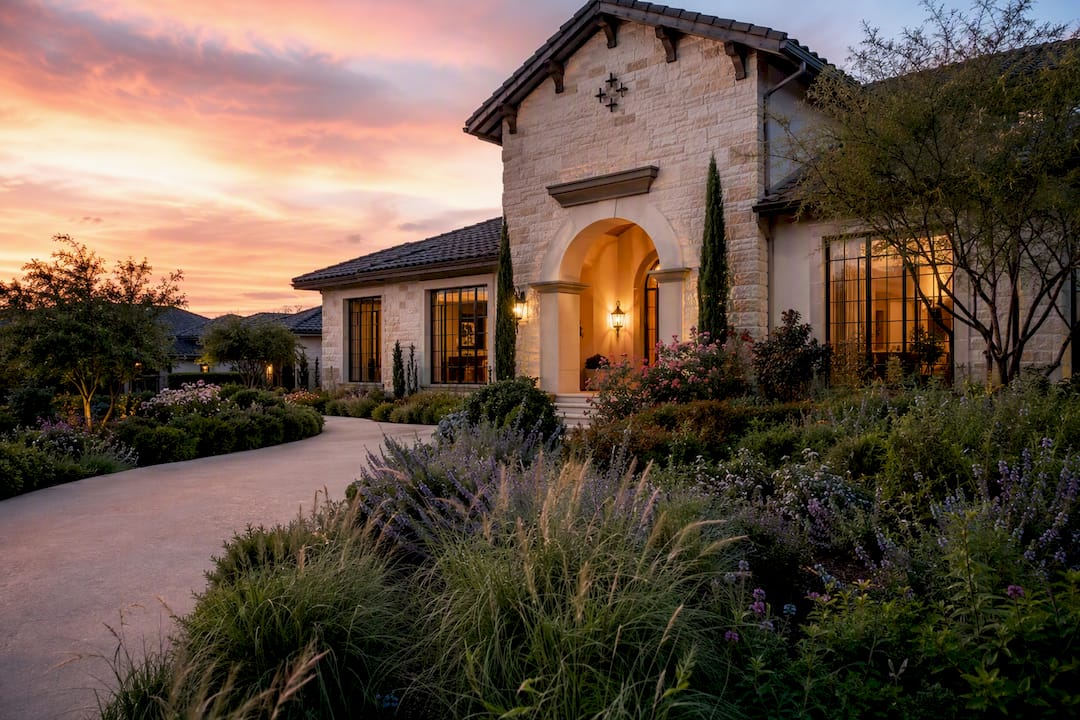
Texas homeowners pay an amount above the national average for a standard policy, with coastal and hail-prone properties often paying higher premiums. The biggest reason Texas sits well above the national norm is straightforward: the state absorbs more billion-dollar hail, wind, and hurricane events than almost anywhere else in the country, and the Texas Department of Insurance tracks that pressure directly in its market data.
If you’re budgeting for a purchase, plan on this range as your baseline, then adjust up or down based on your ZIP code, your roof, and how much dwelling coverage you actually need. A $500,000 home in Round Rock and a $500,000 home in Galveston will not carry the same premium, and the gap between them can be a couple thousand dollars a year.
Key Takeaways
Texas homeowners insurance costs run higher than the national average primarily because of recurring hail, wind, and hurricane losses that shape how carriers price every policy statewide.
| Point | Details |
|---|---|
| Statewide baseline | Expect homeowners insurance costs to be higher than the national average, with regional variation. |
| Coverage scales the price | A $500,000 dwelling generally incurs a higher premium than a $200,000 dwelling, reflecting the scaled cost of coverage. |
| Region changes everything | Coastal TWIA counties incur significantly higher premiums compared to West Texas, reflecting differing regional risks. |
| Flood is always separate | Standard policies exclude flood damage; NFIP or private flood coverage requires a distinct purchase. |
| Mitigation lowers cost | Class 4 roofing, higher deductibles, and bundling can meaningfully reduce annual premiums. |
Table of Contents
- What Drives Home Insurance Costs in Texas
- How Much Coverage You Need Changes the Price Fast
- Regional Differences: Coast vs. Metro vs. West Texas
- What a Standard Texas Homeowners Policy Actually Covers
- How to Lower Your Premium Without Cutting Real Protection
- Getting Accurate, Comparable Quotes
- Do You Need Flood Insurance in Texas?
- Wind/Hail Deductibles: What They Actually Cost You
- Insuring a Luxury or Custom-Built Texas Home
- Why Insurance Belongs in Every Austin Home Search
- Where These Numbers Come From
- Sources
- FAQ
What Drives Home Insurance Costs in Texas
No two Texas homes insure the same, even at identical price points. Underwriters weigh a stack of variables, and a few of them swing premiums more than most homeowners expect.
- Location and catastrophe exposure: hail frequency, hurricane proximity, wildfire risk in Central Texas brush country, and flood zone all shift pricing before anything else is considered.
- Replacement cost versus market value: insurers price your policy to rebuild the structure, not to match what you paid for the lot and house together.
- Roof age and material: a 15-year-old composition roof costs more to insure than a 3-year-old Class 4 impact-resistant roof, sometimes by hundreds of dollars a year.
- Claims history and credit-based insurance score: prior wind/hail or water claims on the property, plus your insurance score, both factor into the quote.
- Deductible structure: a flat dollar deductible behaves differently than a percentage-based wind/hail deductible, and the difference matters more in Texas than in most states.
- Construction type: masonry and brick veneer typically price better than frame construction in hail-heavy regions.
NOAA’s NCEI data shows Texas racking up billion-dollar weather disasters on a near-annual basis, and that loss history is baked directly into how carriers set rates statewide.
One line item trips up more buyers than any other: the wind/hail deductible. In many Texas policies, especially in coastal or hail-corridor ZIP codes, wind and hail claims carry a separate percentage deductible (often 1% to 5% of dwelling coverage) instead of your flat all-perils deductible.
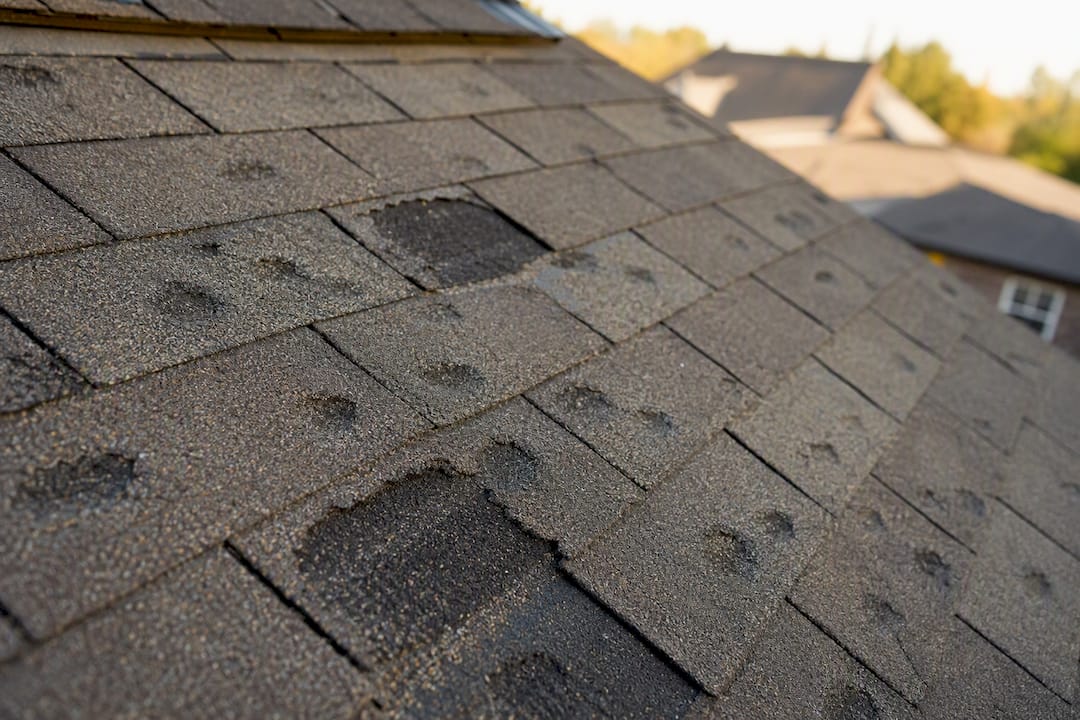
Pro Tip: Before you sign anything, ask your agent to spell out the wind/hail deductible in dollars, not just percentage. A 2% deductible sounds small until you realize it’s $10,000 on a $500,000 home.
How Much Coverage You Need Changes the Price Fast
Dwelling coverage is the single biggest lever in your quote, and carriers generally price per $1,000 of coverage rather than as a flat fee. That means your premium scales almost linearly with your rebuild cost, and replacement-cost inflation, driven by lumber, labor, and materials pricing, keeps nudging that number upward year over year.
Here’s how that plays out across common dwelling limits, using the statewide range as a baseline:
| Dwelling Coverage | Typical Annual Range | Typical Monthly Equivalent |
|---|---|---|
| $200,000 | $1,800 to $2,600 | $150 to $217 |
| $400,000 | $4,000 to $8,000 | $4,000 to $8,000 |
| $400,000 | $3,400 to $4,600 | $283 to $383 |
| $500,000 | $4,200 to $5,600 | $350 to $467 |
| $500,000 | $8,000 and up | $500 and up |
A few things to keep in mind when you use this table to estimate your own number:
- These ranges assume a standard HO-3 policy with typical liability and personal property limits, not a coastal TWIA add-on or a luxury-home endorsement package.
- Homes with upgraded roofing or recent renovations often land at the lower end of their bracket.
- If your ZIP code carries elevated hail or hurricane risk, expect to land above the range shown, sometimes well above it.
Regional Differences: Coast vs. Metro vs. West Texas
Texas is too large and too climatically varied for one statewide number to mean much on its own. Where your home sits changes the math more than almost any other factor.
- Gulf Coast counties (Galveston, Corpus Christi, parts of Houston): homeowners here often need a separate windstorm policy through TWIA because standard carriers exclude or limit wind/hail coverage in designated catastrophe areas. Annual premiums including windstorm coverage can be significantly higher on mid-size homes in coastal areas.
- Dallas Fort Worth hail corridor: this region sees some of the highest hail-claim frequency in the country, which keeps premiums elevated even without hurricane exposure. Premiums on a typical $400,000 home in certain regions are notably elevated due to hail claim frequency.
- Austin and Central Texas: moderate hail risk and wildfire exposure in the hill country push rates to the middle of the statewide range, generating premiums that fall in an intermediate range reflecting moderate hail and wildfire risk.
- West Texas and the Panhandle: lower hurricane and flood exposure but real tornado and hail risk, result in premiums at the lower end of the state’s risk spectrum.
City-level averages can mask what actually matters: two homes ten minutes apart, one in a floodplain and one on higher ground, can see premium differences of $1,000 or more. ZIP-code-level underwriting is why your neighbor’s quote rarely predicts yours.
What a Standard Texas Homeowners Policy Actually Covers
A standard HO-3 policy in Texas bundles five coverage types, and knowing what each one does helps you spot gaps before a claim, not after one.
- Dwelling (Coverage A): rebuilds the structure itself after a covered loss.
- Other structures (Coverage B): covers detached garages, fences, and sheds, typically at 10% of dwelling coverage.
- Personal property (Coverage C): covers belongings inside the home, usually 50% to 70% of dwelling coverage.
- Loss of use (Coverage D): pays for temporary housing if the home is uninhabitable after a covered event.
- Liability (Coverage E): protects against lawsuits for injuries or damage you’re responsible for.
What it doesn’t cover matters just as much. Flood damage is excluded from every standard homeowners policy in Texas, full stop, according to FEMA’s FloodSmart guidance. In many coastal and high-risk counties, wind and hail coverage may also be excluded from the standard policy and require a separate TWIA policy or endorsement.
Pro Tip: Read the declarations page for the phrase “named storm deductible.” If it’s there, ask your agent exactly how it’s calculated. It’s separate from your regular deductible and often larger.
How to Lower Your Premium Without Cutting Real Protection
Cutting corners on coverage to save money usually backfires the first time you file a claim. Smarter savings come from mitigation and shopping behavior, not from stripping out protection you’ll need later.
- Upgrade your roof: Class 4 impact-resistant shingles qualify for discounts with most Texas carriers and can cut premiums by a meaningful margin.
- Choose your deductible deliberately: raising your flat deductible from $1,000 to $2,500 often saves 10% to 15% annually, but weigh that against your actual cash reserves.
- Bundle home and auto: multi-policy discounts are among the most consistent savings available, often 5% to 15%.
- Shop at every renewal: Texas carriers reprice risk models constantly, and loyalty rarely earns you the best rate after year two or three.
- Work with an independent agent: one who can quote multiple carriers instead of a single captive insurer.
Don’t sacrifice wind/hail or flood protection just to hit a lower monthly number, especially if you’re in a coastal or floodplain ZIP code. A cheap policy that excludes your biggest actual risk isn’t savings, it’s a gap waiting to surface.
Pro Tip: Time roof replacements and other mitigation upgrades to land right before your renewal date. Carriers reprice based on current property condition, so the timing affects how quickly the discount shows up.
Getting Accurate, Comparable Quotes
Apples-to-apples comparison is the only way multiple quotes actually mean anything, and that starts with giving every carrier identical information.
Collect this before you call anyone:
- Year built, square footage, and construction type (frame, masonry, brick veneer).
- Roof age and material, plus any recent replacements or upgrades.
- Exact ZIP code and full replacement-cost estimate, not market value.
- Claims history for the past five years, ideally pulled from a CLUE report.
- Desired dwelling limit, liability limit, and deductible structure.
Ask every agent the same set of questions: what’s the wind/hail deductible in dollars, are there separate endorsements required for my area, is the quote based on replacement cost or actual cash value, and how does this carrier’s catastrophe model treat my specific ZIP code? The Office of Public Insurance Counsel offers consumer resources if you run into a dispute or need help interpreting policy language.
Do You Need Flood Insurance in Texas?
Standard homeowners policies exclude flood damage entirely, which means it’s a separate purchase decision, not an optional add-on to your existing policy. You’ll choose between NFIP coverage or a private flood policy, and both price based on similar risk factors.
- Mapped flood zone: FEMA flood zone designation is the single biggest pricing factor.
- Elevation: homes above base flood elevation typically pay significantly less than those below it.
- Community rating: some Texas municipalities qualify for discounts through FEMA’s Community Rating System.
FloodSmart notes that flood premiums vary widely by these factors, so get quotes from both NFIP and private carriers before closing, since private options sometimes beat NFIP pricing for lower-risk properties.
Wind/Hail Deductibles: What They Actually Cost You
A percentage deductible on a high-value home adds up fast, and the math surprises a lot of first-time Texas buyers. On a $400,000 dwelling, here’s what different wind/hail deductible percentages mean in real dollars:
- 1% deductible: $4,000 out of pocket before coverage kicks in.
- 2% deductible: $8,000 out of pocket.
- 5% deductible: $20,000 out of pocket.
Choosing a higher percentage lowers your premium, but stacking that against frequent small hail claims can leave you paying repair costs out of pocket year after year, which erodes any savings the lower premium delivered in the first place.
Insuring a Luxury or Custom-Built Texas Home
Custom homes complicate replacement-cost math in ways standard estimators don’t handle well. Imported stone, custom millwork, and specialty architectural features push rebuild costs well above what a generic per-square-foot calculator assumes, and underpricing that gap is one of the most common mistakes luxury buyers make.
- Get an appraisal-backed replacement-cost estimate rather than relying on a carrier’s automated valuation tool.
- Ask about agreed-value or guaranteed replacement-cost endorsements, which protect against underinsurance if rebuild costs spike after a loss.
- Schedule high-value personal property (art, wine collections, jewelry) separately rather than relying on standard personal property limits.
- Keep a contractor and materials-sourcing list on file so a rebuild can match the original finishes rather than a generic substitute.
Buyers evaluating properties covered in our luxury home buying guide should treat insurance as a line item to research during due diligence, not after closing.
Why Insurance Belongs in Every Austin Home Search
Working across Austin’s luxury market for over two decades has made one thing clear: buyers who ignore insurance until closing week almost always get an unpleasant surprise. Replacement cost on custom architecture rarely matches what a buyer assumes going in, especially on properties with unique materials or waterfront exposure.
Our practical advice: get a preliminary insurance quote during your option period, not after. Talk to an agent who understands custom-home valuation before you finalize your offer, and if you’re considering a property in a flood-prone or coastal-adjacent area, browse our current listings with insurance costs already factored into your budget conversation.
Where These Numbers Come From
Every figure in this guide traces back to public regulator and federal data, not marketing estimates.
- Texas Department of Insurance: official market overview and average-premium data.
- TWIA: windstorm eligibility and coastal coverage requirements.
- Texas FAIR Plan: last-resort coverage options for hard-to-place homes.
- NOAA’s NCEI: historical billion-dollar disaster data for Texas.
- FloodSmart: flood insurance pricing and coverage guidance.
This article is general information, not a substitute for advice from a qualified financial advisor. Consult a qualified financial professional about your own circumstances before acting on anything here.
Sources
FAQ
How much is home insurance for a $200,000 house in Texas?
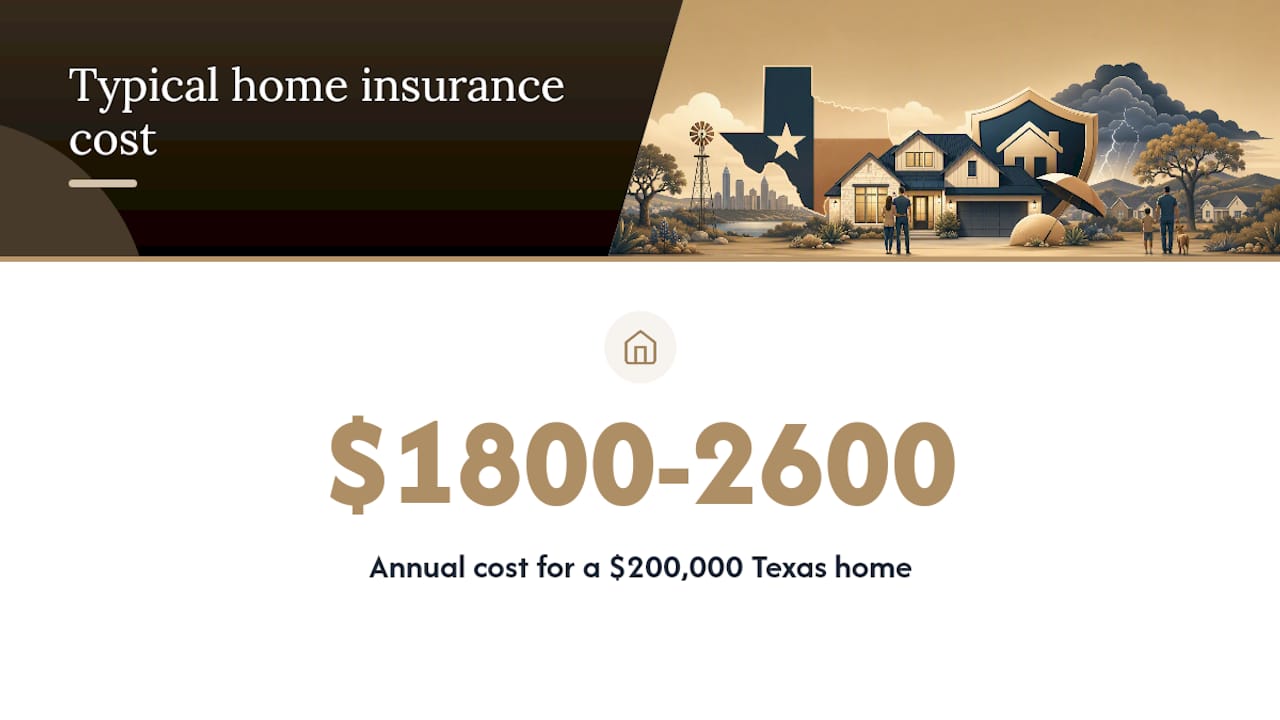
A $200,000 home typically insures for $1,800 to $2,600 a year, or roughly $150 to $217 a month, depending on ZIP code and roof condition.
How much is home insurance on a $400,000 house in Texas?
Expect $3,400 to $4,600 annually, or about $283 to $383 a month, with coastal and hail-corridor properties trending toward the higher end.
How much is home insurance on a $500,000 house in Texas?
A $500,000 dwelling generally runs $4,200 to $5,600 a year, or $350 to $467 a month, before accounting for separate wind/hail or flood coverage.
Does Texas homeowners insurance cover flood damage?
No. Flood is excluded from every standard homeowners policy in Texas, and coverage requires a separate NFIP or private flood policy.
Why is home insurance so expensive in Texas?
Frequent hail, hurricane, and severe wind events drive Texas premiums above the national average, and coastal counties often require additional TWIA windstorm coverage on top of a standard policy.
Recommended
- Must-have amenities in Austin homes for 2026 buyers | Mogavero Group Austin Real Estate
- How to Stage Your Austin Home to Boost Sale Price in 2026 | Mogavero Group Austin Real Estate
- Top Home Inspection Services Austin 2026 | Mogavero Group Austin Real Estate
- Top 4 Austin Home Listing Platforms in 2026 | Mogavero Group Austin Real Estate