Avoid DSCR Tax Traps: 4 Ways to Finance Austin Investment Property
Four financing paths for Austin investors, focused on DSCR math and how Travis County taxes and STR rules squeeze qualification. Includes a practical...
Avoid DSCR Tax Traps: 4 Ways to Finance Austin Investment Property

Four financing paths cover almost every Austin investor: conventional investor loans for W-2 buyers with clean income, DSCR loans for anyone who wants to qualify on rental income instead of personal tax returns, portfolio/non-QM lending once you’ve outgrown agency caps, and hard-money or bridge loans for speed and rehab deals. The catch is local: Austin’s property tax bill is steep enough to compress your DSCR ratio even on a property that looks profitable on paper. Before you fall for a listing, run the DSCR math with the actual Travis County or Williamson County tax rate, not a national average, or get a broker to run it for you.
TL;DR:
- Austin’s high property taxes significantly reduce DSCR ratios, making accurate local tax calculations essential for reliable financing assessments.
- DSCR loans are the primary option for scaling investors, but they require detailed rent and tax calculations, especially considering Austin’s HOA fees and insurance costs.
- Conventional loans remain the best rate but are limited by property caps and require extensive documentation, often disallowing LLC ownership at closing.
- Portfolio and non-QM loans provide flexible financing after hitting agency limits, with higher rates but fewer restrictions on entity structure and property count.
- Budget for 15-20% down payments, two to six months of reserves, and plan for timelines from one to two months, depending on the financing option chosen.
Table of Contents
- Investment Property Financing Austin: Overview Of Your Loan Options
- How DSCR Works And Why Austin Taxes Compress It
- Conventional And Portfolio Loans: When Each One Wins
- What To Budget: Costs, Reserves, And Realistic Timelines
- How To Choose Your Lender And Financing Path
- Austin Market Considerations And Local Insight
- Your 30 To 90 Day Action Plan
- An Austin Broker’s Take On Financing Strategy
- Get Investor-Ready Access To Austin’s Off-Market Inventory
- Sources
- FAQ
Investment Property Financing Austin: Overview Of Your Loan Options
Most Austin investors end up choosing between four structures, and the right one depends less on the property and more on your income documentation and your growth plans.
- Conventional investor loans: Fannie Mae and Freddie Mac backed loans underwritten on your personal tax returns, W-2s, and debt-to-income ratio. Best for buyers with one or two rentals and strong documented income.
- DSCR loans: Qualification based on the property’s rental income rather than your personal finances. This is the workhorse product for Austin rental property loans, especially for self-employed investors or anyone scaling past a handful of doors.
- Portfolio/non-QM loans: Held by the originating lender instead of sold to Fannie or Freddie, with more flexible underwriting. This becomes the practical route once you’ve hit agency limits on financed properties.
- Hard-money/bridge loans: Short-term, asset-based financing for fix-and-flip or fast-close deals where speed matters more than rate.
FHA and VA loans generally don’t apply here. The Federal Housing Administration and VA programs are built around owner-occupancy, with narrow exceptions like house hacking a multi-unit property you also live in.
How DSCR Works And Why Austin Taxes Compress It
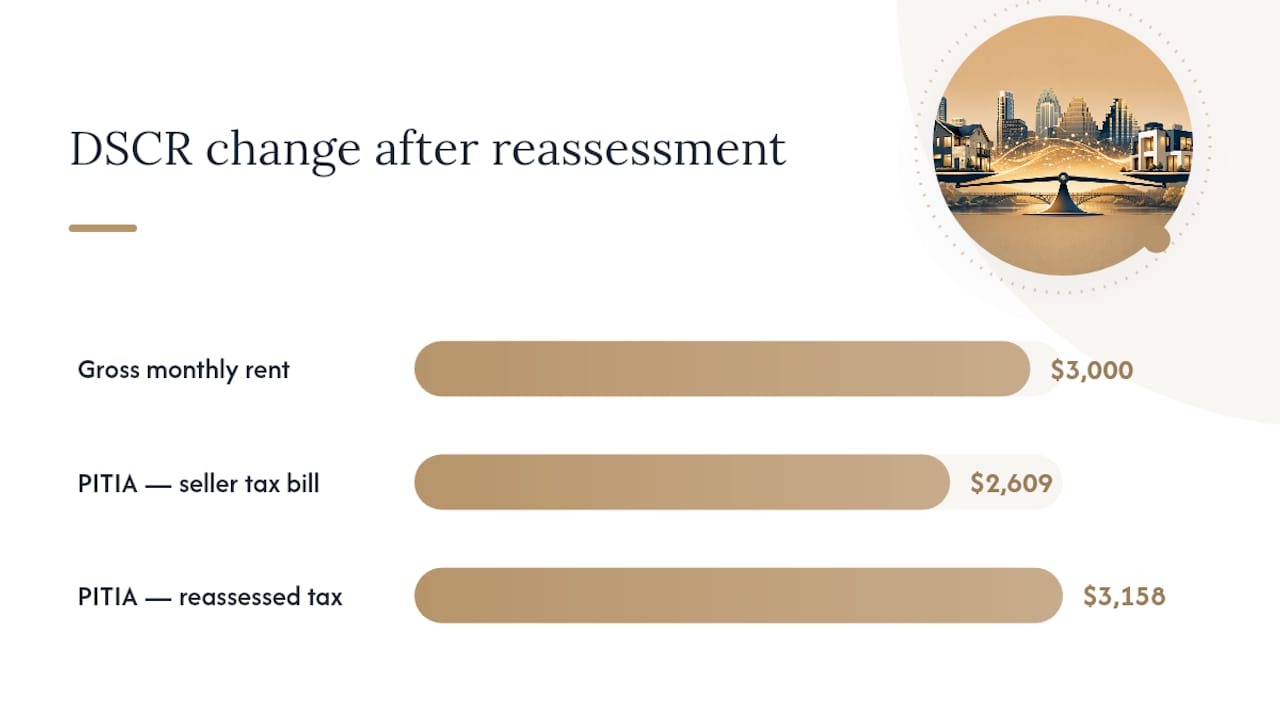
DSCR stands for debt service coverage ratio, and the formula is simple: gross monthly rent divided by PITIA (principal, interest, taxes, insurance, and association dues). A property renting for $3,000 a month against a $2,500 PITIA gives you a 1.2 DSCR. Most DSCR lenders want to see 1.0 to 1.25 as a baseline, with anything above 1.25 usually earning better pricing and lower reserve requirements.
Here’s where Austin trips up out-of-state buyers running the numbers on a spreadsheet built for a lower-tax market:
- Property tax load. Travis County effective rates are notably high among U.S. counties, which increases the “T” in PITIA significantly.
- Insurance creep. Hail and wind exposure across Central Texas has pushed premiums up, adding another line item that eats into the ratio.
- HOA dues. Many newer Austin developments and condo conversions carry HOA fees that get baked into PITIA and quietly drag DSCR below 1.0.
Down payments on DSCR loans typically run higher than primary residences, credit requirements are generally more stringent, and many lenders allow closing in an LLC without the ownership-seasoning hurdles conventional loans impose. Short-term rental income gets extra scrutiny. Lenders often want a market rent study or an AirDNA-style projection rather than taking your Airbnb estimate at face value.
Pro Tip: Run your DSCR twice, once with the seller’s tax bill and once with the reassessed value you’ll actually pay after closing. Austin appraisal districts reassess aggressively after a sale, and that gap alone can flip a 1.15 DSCR into a 0.95.
Conventional And Portfolio Loans: When Each One Wins
Conventional investor loans through Fannie Mae or Freddie Mac still offer the best rates available for rental property loans, but they come with real limits. Down payments typically start at around 15% for a single unit and can be higher for multi-unit properties, with lenders wanting several months of PITIA in reserves per financed property, full tax returns, and W-2s.
- Agency guidelines cap most investors at ten financed properties total, and many retail lenders stop underwriting well before that.
- Conventional loans usually require documentation depth that self-employed buyers find painful: two years of returns, profit-and-loss statements, and sometimes a CPA letter.
- LLC vesting at closing is often disallowed on conventional loans, so you may need to close personally and quitclaim into an entity afterward. Get your attorney involved before you assume this works cleanly for your situation.
Portfolio and non-QM lending fills the gap once you’ve hit those agency caps or your file has quirks a Fannie underwriter won’t touch, like mixed-use income or a recent bankruptcy discharge. Rates run higher, often a point or more above conventional, but flexibility on entity vesting and property count makes it the practical bridge for investors scaling past five or six doors.
What To Budget: Costs, Reserves, And Realistic Timelines
Every financing path shares a few common cost buckets, but the numbers shift depending on the program.
- Down payment: 15% to 20% for conventional single units, 20% to 25% for DSCR and multi-unit conventional, often 10% to 20% for hard-money depending on the after-repair value.
- Reserves: Most lenders want two to six months of PITIA in liquid reserves per property, with DSCR and portfolio lenders trending toward the higher end.
- Credit: 680 minimum is a realistic conventional floor; DSCR programs sometimes go as low as 660 with a rate penalty.
- Upfront costs: Appraisal ($500 to $800), inspection ($400 to $600), and origination or broker fees (often 1% to 2% of loan amount) are the standard budget items, and the CFPB’s home loan toolkit breaks down what disclosures you should expect to see before closing.
- Timeline: Hard-money can close in 7 to 10 days, DSCR and portfolio loans commonly close in 21 to 30 days, and conventional investor loans usually run 30 to 45 days given the documentation review.
How To Choose Your Lender And Financing Path
Working through this in order saves you from picking a program that doesn’t match your file.
- Run DSCR with your actual tax bill. Don’t trust a listing agent’s PITIA estimate. Pull the county appraisal district’s post-sale projected value.
- Check your personal DTI and financed-property count. If you’re near the agency cap or your DTI is stretched, skip straight to DSCR or portfolio conversations.
- Pick your channel. Brokers typically have wider access to wholesale DSCR products than retail banks do, since many DSCR programs are broker-only. Retail banks work fine for straightforward conventional deals. Portfolio lenders make sense for special-case files.
- Ask direct questions before you commit: Does this lender allow LLC vesting? What DSCR tier gets me the best pricing? Is short-term rental income eligible, and what documentation do you need? What reserves does your underwriting actually require, beyond the published minimum?
Pro Tip: Verify any broker or loan officer through NMLS Consumer Access before you sign a rate lock. It takes two minutes and confirms the license is active in Texas.
Watch for red flags: rent estimates that don’t match comparable leases in the same zip code, insurance quotes that seem too low for the coverage described, and HOA documents that restrict rentals or short-term stays entirely.
Austin Market Considerations And Local Insight
Core Austin and the surrounding suburbs behave differently once you run the DSCR math. Higher purchase prices inside the city often mean tighter rent-to-price ratios, while submarkets further out can post better DSCR numbers even with similar tax rates. Watching where Austin’s market is shifting helps you spot entry windows before they close.
- East Austin has drawn steady rental demand as prices in that corridor create a different DSCR profile than the lake-adjacent luxury segment.
- Off-market sourcing and a fast negotiation timeline pair naturally with DSCR or portfolio financing, since both close faster than a fully documented conventional loan.
- Confirm short-term rental licensing and any local ordinance restrictions before you count on Airbnb income in your DSCR calculation. Austin’s STR rules have shifted before and can again.
Your 30 To 90 Day Action Plan
- Week 1 to 2: Get pre-approved or have a broker run your file, and calculate DSCR using the actual local tax rate.
- Week 2 to 4: Gather bank statements, existing rent rolls, proof of reserves, ID, and any prior mortgage statements.
- Week 3 to 6: Choose your lender channel based on the decision framework above and lock in loan terms.
- Week 6 to 12: Sync your offer timeline with the lender’s stated closing window, especially if you’re competing on a fast-moving listing.
An Austin Broker’s Take On Financing Strategy
After more than 20 years working Austin’s market, the biggest mistake I see investors make isn’t picking the wrong loan program. It’s running numbers on a spreadsheet built somewhere else and assuming Austin’s taxes and insurance costs will behave the same way. They won’t. Our team spends as much time coordinating with mortgage brokers as we do finding off-market inventory, because the two problems are connected: a great deal with a mismatched financing plan falls apart at the finish line. If you’re weighing DSCR against portfolio lending for a specific address, that’s a conversation worth having before you write an offer, not after.
— Mike
Get Investor-Ready Access To Austin’s Off-Market Inventory
We can help you access deals that are less visible to other buyers, which can be important when you’re trying to hit a DSCR threshold on a competitive property. We coordinate directly with mortgage brokers and portfolio lenders while sourcing inventory, so your financing path and your property search move together instead of stalling each other out.

Our private listings give investors first access to off-market opportunities before they hit the open market, and our full property listings cover everything currently available across Austin. If you’re eyeing a specific submarket, our Lake Austin neighborhood page breaks down what that corridor offers for rental yield versus appreciation. Reach out to start matching your financing strategy to the right property before your next offer deadline.
Sources
The FRED 30-year mortgage rate series tracks the national rate environment shaping DSCR and conventional pricing. TREC’s contract form guidance covers Texas-specific transaction practices and timing.
FAQ
Is It Hard To Get A Loan For An Investment Property?
It’s harder than a primary residence loan because underwriting standards are tighter, but DSCR loans have made qualification far easier for self-employed and multi-property investors who can’t rely on personal income documentation.
What Is The 2% Rule For Investment Property?
The 2% rule is a rough screening tool suggesting monthly rent should equal roughly 2% of the purchase price. Very few properties inside Austin’s city limits hit that threshold given current prices, so most investors rely on DSCR math instead of this shortcut.
How Do I Avoid A 20% Down Payment On An Investment Property?
You generally can’t avoid it entirely on a true investment purchase since FHA and VA financing doesn’t apply to non-owner-occupied properties, but house hacking a multi-unit property you also live in can unlock lower down payment options through owner-occupant programs.
How Much Do I Have To Make To Afford A $400,000 House In Texas?
Lenders typically want your total housing payment, including Texas property taxes, to stay under roughly 28% to 31% of gross monthly income, which usually means a household income in the $95,000 to $110,000 range depending on your tax rate, insurance, and other debts.