Can You Do a Seller Leaseback in Texas Right Now?
Explore how a leaseback agreement in Texas can give sellers extra time after closing. Learn essential steps to ensure a smooth process.
Can You Do a Seller Leaseback in Texas Right Now?

Yes. Texas allows a seller leaseback, and the tool that governs it is TREC’s Seller’s Temporary Residential Lease, Form 15-7, which caps post-closing occupancy at 90 days. That single number shapes almost every decision that follows, from how you negotiate the offer to how the lender treats the buyer’s loan.
If you’re selling and want a few extra weeks to pack, or buying and willing to let the seller stay a bit longer for a stronger offer, here’s what needs to happen immediately:
- Negotiate the leaseback inside the purchase offer, not after you’re already under contract. Adding it late creates friction and can spook a lender.
- Confirm the buyer’s lender will accept the term length before everyone signs. Some loan programs balk well before the 90-day ceiling.
- Get rent and the security deposit itemized on the closing paperwork, so there’s no ambiguity about who owes what and when.
One more thing before you get deep into paperwork: if the seller stays past the agreed date, that’s a holdover, and Texas treats it seriously. Sellers should also line up renter’s insurance for the occupancy period, because the buyer’s homeowner policy typically doesn’t cover the seller’s belongings or liability once the seller no longer owns the house.
Key Takeaways
A Texas seller leaseback works when the TREC Form 15-7 term stays under 90 days, the lender confirms the arrangement in writing, and rent and deposit terms are documented at closing.
| Point | Details |
|---|---|
| Use TREC Form 15-7 for short stays | It covers temporary seller occupancy up to 90 days and must be attached to the purchase contract. |
| Confirm lender approval early | Some loan programs limit or scrutinize longer leaseback terms, so get written confirmation before ratification. |
| Calculate rent from buyer’s PITI | Daily rent is commonly the buyer’s monthly PITI divided by 30, though zero-rent or premium terms are negotiable. |
| Close the insurance gap | Sellers should carry renter’s insurance since the buyer’s homeowner policy typically won’t cover the seller’s stay. |
| Go long-term only with counsel | Leasebacks past 90 days fall under Texas Property Code Chapter 92 and need dedicated legal and tax review. |
Table of Contents
- What Is a Leaseback Agreement in Texas, and How Does TREC Form 15-7 Work?
- What Terms Actually Get Negotiated in a Texas Leaseback?
- How Does a Leaseback Affect the Buyer’s Financing and Closing?
- A Step-by-Step Checklist for Negotiating and Closing a Texas Leaseback
- What Are the Biggest Risks in a Texas Leaseback, and How Do You Protect Against Them?
- When Do You Need More Than 90 Days? Long-Term Sale-Leasebacks in Texas
- How Mogavero Group Handles Leasebacks for Luxury Austin Sellers
- Official Forms and Statutes to Consult
- Our Take on Texas Leasebacks
- Sources
- FAQ
What Is a Leaseback Agreement in Texas, and How Does TREC Form 15-7 Work?
A leaseback agreement, sometimes called seller leaseback Texas or a post occupancy agreement Texas, lets the seller remain in the home after closing as the buyer’s tenant. The buyer owns the property; the seller pays rent to stay a little longer. It solves a timing problem that trips up a huge share of Texas transactions: the seller’s new home isn’t ready, or their outbound closing is delayed, but the buyer’s purchase is ready to fund now.
TREC Form 15-7 is the standard vehicle for this in residential resale transactions. It’s a short, single-page addendum built specifically for temporary occupancy, and its defining feature is the short-term occupancy cap consistent with Texas regulations. It’s baked into the form’s purpose, and going beyond it pushes the arrangement out of “temporary occupancy” territory and into standard landlord-tenant law, which carries a different set of protections and obligations for both sides.
Here’s how it gets built into a deal:
- At the offer stage, the seller’s agent and buyer’s agent negotiate the leaseback term, daily rent, and deposit amount alongside price and closing date.
- The form is attached as an addendum to the One to Four Family Residential Contract, so it becomes part of the binding purchase agreement rather than a side handshake.
- At closing, the executed Form 15-7 gets signed alongside the deed and loan documents, and the rent or deposit amount is reflected on the settlement statement, usually credited or collected through the title company rather than exchanged privately between buyer and seller.
Why does the paperwork matter this much? Because both the title company and the buyer’s lender want documented proof of exactly what was agreed. A verbal understanding that “the sellers will stay a couple weeks” is unenforceable and, worse, it can complicate the buyer’s loan closing if the underwriter later asks who’s actually occupying the property. You can download Form 15-7 directly from TREC, and any Texas real estate agent involved in the deal should already have it in their transaction management software. If yours doesn’t, that’s worth asking about before you sign anything.
What Terms Actually Get Negotiated in a Texas Leaseback?
The form itself is simple, but the terms inside it are where deals get made or unwound. Five things matter most, and they’re all negotiable.
- Rent. The most common approach ties daily rent to the buyer’s monthly PITI (principal, interest, taxes, insurance) divided by 30, so the buyer isn’t out of pocket while the seller occupies a house they’re now paying for. Some sellers negotiate a token or zero-rent arrangement as a goodwill gesture in a competitive offer; others pay a premium rate above PITI when the buyer wants compensation for the inconvenience or added risk. There’s no single “right” number. It’s a negotiation, and it usually gets settled in the first round of offer talks.
- Security deposit. Typically held by the title company or listing brokerage, not the buyer directly, and refunded after a move-out inspection confirms the property’s condition matches what was documented at closing.
- Maintenance and utilities. The seller, as the occupying tenant, usually keeps paying utilities and handles routine upkeep, lawn care, and pool maintenance during their stay. Spell this out in writing. “Reasonable care” is a phrase that causes arguments; a specific checklist doesn’t.
- Insurance. This is the gap people miss most often. Once the sale closes, the seller no longer owns the home, and the buyer’s new homeowner policy generally does not cover the seller’s personal property or personal liability during the leaseback period. Texas landlord-tenant guidance consistently points sellers toward carrying their own renter’s insurance for the duration, and it’s inexpensive enough that skipping it isn’t worth the risk.
- Holdover penalties. Every leaseback should include a holdover clause: a daily penalty rate, often set well above the base rent, that kicks in automatically if the seller doesn’t vacate on schedule. It is a deterrent, not a punishment, and it is there because eviction is the fallback nobody wants. If a seller overstays and refuses to leave, the buyer’s only real remedy is a formal eviction action, which is slower and more expensive for everyone than a clean move-out ever would be.
Pro Tip: Put a specific move-out time on the calendar, not just a date. “Vacate by 5 p.m. on the 14th” avoids the awkward argument over whether “the 14th” means midnight or close of business.
How Does a Leaseback Affect the Buyer’s Financing and Closing?
This is the part sellers underestimate, and it’s the part that can blow up a deal at the worst possible moment: right before closing.
Loan programs aren’t uniform on how they treat post-closing occupancy by a seller. Some conventional and government-backed programs get more cautious as the leaseback term stretches out, because a long seller occupancy can look, on paper, like the buyer isn’t actually taking possession of their primary residence, which matters for certain loan classifications and owner-occupancy requirements. Lenders don’t always flag this early, and a verbal “should be fine” from a loan officer isn’t the same as written underwriting approval. Confirm it in writing, and confirm it before the option period ends, not the week of closing.
What happens if the leaseback jeopardizes the buyer’s financing? You have a few levers: shorten the term, restructure it as a lower-profile arrangement, or, in rare cases, restructure the rent so it doesn’t read as an income-producing rental to the underwriter. None of these are DIY fixes. They require a conversation between the lender, the title company, and the agents on both sides, ideally before earnest money is at risk.
Before you get to the closing table, confirm these items explicitly:
- The signed Form 15-7 is attached to the file and matches the terms in the purchase contract.
- Rent and security deposit amounts appear correctly on the settlement statement.
- Proof of the seller’s renter’s insurance is on file.
- The title company knows how the deposit will be held and released, and who authorizes its return.
When you’re unsure about any of this, three people should be in the loop: the buyer’s lender (to confirm the leaseback doesn’t jeopardize the loan), the title or closing officer (to confirm paperwork and disbursement), and a Texas real estate attorney if the term is unusual, the property is high value, or either side wants customized protections beyond the standard TREC language.
A Step-by-Step Checklist for Negotiating and Closing a Texas Leaseback
Running a leaseback well is mostly a sequencing problem. Do these in order and you avoid nearly every last-minute scramble.
- Raise the leaseback during offer negotiations. Don’t wait until you’re under contract. State the desired term, proposed rent, and deposit amount as part of the offer itself.
- Attach TREC Form 15-7 as a contract addendum. It becomes part of the binding agreement, not a separate side deal that’s easy to dispute later.
- Get written lender confirmation before contract ratification. If the buyer’s loan officer hasn’t signed off on the specific term length, don’t treat the leaseback as final.
- Itemize rent and deposit on the closing statement, and confirm with the title company exactly how the deposit will be held and under what conditions it’s released.
- Schedule movers well ahead of the move-out date, and photograph or video the property’s condition at both the closing walkthrough and the final move-out, dated and time-stamped.
- Set the final walkthrough date and deposit return timeline in writing, so nobody’s guessing about when the keys, and the money, actually change hands.
Pro Tip: Do the condition documentation twice, once at closing and once at final move-out, using the same angles and rooms. Side-by-side photos settle deposit disputes in minutes instead of weeks.
What Are the Biggest Risks in a Texas Leaseback, and How Do You Protect Against Them?
Most leaseback disputes trace back to one of four failures: the seller overstays, the property comes back damaged, an insurance gap surfaces at the worst time, or the buyer’s financing gets disrupted mid-process. None of these are exotic risks. They’re common enough that experienced Texas agents build protections against all four into every leaseback they negotiate.

For buyers, the protections that matter most are a security deposit sized to actual risk (not a token amount), a documented condition report signed by both parties before the seller moves back in, an enforceable holdover penalty, and proof of the seller’s renter’s insurance before keys change hands.
For sellers, the priorities run the other way: negotiate a term with a little breathing room built in, ask for an early-termination option if your outbound move happens faster than expected, agree on move-out condition standards in writing, and have a backup plan if the buyer’s financing hits a snag mid-lease.
The clause that prevents the most fights isn’t the rent amount. It is the holdover penalty and the documented condition report, because those are the two things people actually disagree about after the fact, not before.
Most disputes resolve through direct negotiation or a quick call from the title company, but if a seller genuinely won’t leave, eviction is the only enforceable path. It’s slow and it’s public, which is exactly why the smart move is preventing the standoff in the first place with clear terms up front.
One more line worth remembering: cross 90 days, and you’re no longer in TREC territory. At that point, standard Texas landlord-tenant law under Property Code Chapter 92 governs the arrangement, and that changes notice periods, eviction procedures, and the legal footing for both sides.
When Do You Need More Than 90 Days? Long-Term Sale-Leasebacks in Texas
Some sellers need months, not weeks, whether they’re relocating out of state, waiting on new construction, or restructuring how they hold real estate for financial reasons. That’s a fundamentally different transaction from the TREC temporary lease, and it’s not something you patch together with a longer version of Form 15-7.
A long-term sale-leaseback is exactly what it sounds like: the seller sells the property, then leases it back from the new owner for an extended term, often a year or more, under a standard residential lease. Here’s what changes:
- Governing law shifts. Once you’re past 90 days and outside the TREC form’s scope, the lease is governed by Texas Property Code Chapter 92, the standard residential landlord-tenant statute, with its own rules on notice, repairs, and eviction.
- Investor and lender involvement increases. Long-term sale-leasebacks often involve an investor-buyer rather than an owner-occupant, which brings different underwriting and different expectations about lease length and rent escalation.
- Tax treatment gets more complicated. Selling and immediately leasing back can affect how capital gains exclusions apply under rules like those in IRS Publication 523, and it can carry balance-sheet implications for sellers who hold real estate as part of a broader investment or business structure.
- Termination and return-of-property provisions matter more. The Texas Finance Code includes provisions addressing return of property in sale-leaseback transactions, which can affect how and when either party can unwind the arrangement.
If you’re contemplating anything past the 90-day window, don’t treat it as a bigger version of the same paperwork. Get a Texas real estate attorney and a tax professional involved before you sign, because the legal regime, the financing structure, and the tax consequences are all genuinely different animals.
How Mogavero Group Handles Leasebacks for Luxury Austin Sellers
High-net-worth sellers in Austin’s luxury market face a version of this decision that’s higher stakes but often more flexible, because these buyers and sellers frequently have more room to negotiate creative terms. A short-term TREC leaseback usually fits when a seller needs two to six weeks to finish a build-out or coordinate a cross-country move. A longer sale-leaseback structure comes into play when a seller wants to unlock equity now but isn’t ready, financially or emotionally, to leave the property yet.
A few things we prioritize when coordinating occupancy after a sale:
- Lock in lender confirmation early, before the term gets written into the offer, since luxury financing sometimes involves jumbo loans with their own occupancy quirks.
- Coordinate movers and storage well ahead of the closing date, so the transition doesn’t collide with the seller’s outbound move.
- Document property condition thoroughly, especially in homes with custom finishes, art installations, or specialized systems where “normal wear” is a much fuzzier line than in a standard resale.
- Confirm exactly where sale proceeds are held and disbursed at closing, since leaseback structures can affect timing on wire transfers and deposit releases.
Mike Mogavero has spent more than 20 years navigating Austin’s luxury market, and the pattern holds across nearly every leaseback deal: the ones that go smoothly are the ones where the term, the money, and the move-out standard were all nailed down in writing before anyone signed.
Official Forms and Statutes to Consult
Start with the primary sources rather than a secondhand summary, especially for anything involving your specific contract or timeline.
- TREC Seller’s Temporary Residential Lease (Form 15-7), the official form and instructions.
- Texas Finance Code § 342.009, covering return-of-property provisions in sale-leaseback transactions.
- SB 2349 legislative history, for recent statutory context affecting related disclosures.
- Texas State Law Library’s landlord-tenant guide, for broader occupancy and insurance guidance.
Our Take on Texas Leasebacks
The conventional advice on leasebacks spends too much time on the rent formula and not nearly enough on the lender conversation. Rent is easy to negotiate. A lender who gets nervous about occupancy classification three days before closing is not easy to negotiate, and it’s the single biggest failure point we see in these deals.
If you take one thing from this guide, make it this: treat lender confirmation as a gating item, not a formality. Get it in writing before you finalize the leaseback term, not after.
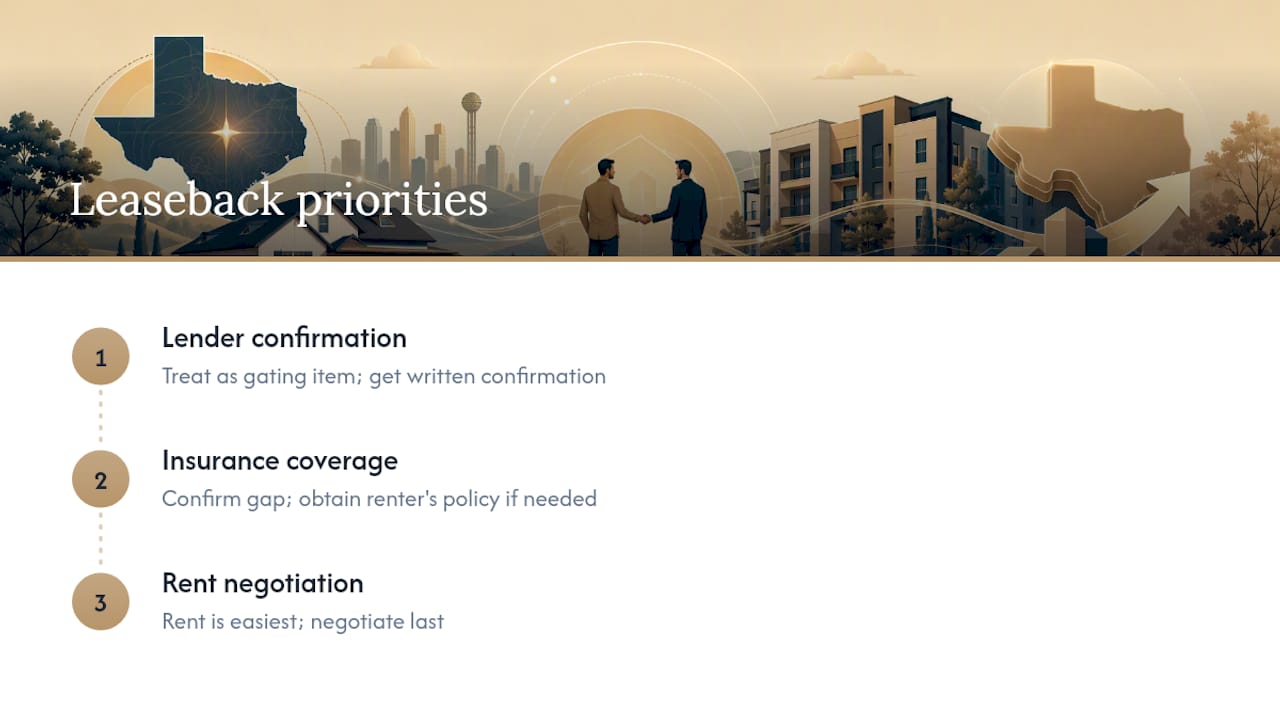
The second most overlooked issue is insurance. Sellers assume that because they just sold the house, someone else’s policy has them covered. It doesn’t, and a cheap renter’s insurance policy is genuinely the least expensive risk mitigation in the entire transaction. For sellers in the luxury bracket, where personal property values run higher, that gap matters even more.
Prioritize the lender conversation first, the insurance second, and the rent number last. That order gets deals closed without drama.
— Mike
Sources
- Seller’s Temporary Residential Lease - TREC
- Understanding Leaseback Agreements | TX - Cain & Kiel Law
- SB 2349 history — Texas Legislature
- Texas Finance Code § 342.009 — FindLaw
FAQ
How Does a Leaseback Work in Texas?
The seller sells the home, then rents it back from the new buyer under TREC Form 15-7, staying up to 90 days while paying agreed rent, typically the buyer’s monthly PITI divided by 30.
What Are the Advantages and Disadvantages of a Leaseback Agreement?
The advantage is timing flexibility for both sides: sellers avoid a rushed move, and buyers can win a competitive offer by accommodating the seller’s schedule. The disadvantage is added risk, including holdover potential, insurance gaps, and possible complications with the buyer’s loan approval if the term is too long.
How Long Can You Do a Leaseback in Texas?
Under TREC Form 15-7, the maximum is 90 days. Beyond that, the arrangement shifts into standard residential landlord-tenant law under Texas Property Code Chapter 92, which carries different rules entirely.
Do I Need a Real Estate Attorney for a Texas Leaseback?
For a standard short-term TREC leaseback, most transactions close fine with an experienced agent and title company handling the paperwork. For terms approaching 90 days, unusual conditions, or any long-term sale-leaseback structure, a Texas real estate attorney is worth the cost.
Who Pays Utilities During a Seller Leaseback?
The seller, as the occupying tenant, typically continues paying utilities and handling routine maintenance during the leaseback period, though this should always be spelled out explicitly in the addendum rather than assumed.
Recommended
- Austin Real Estate FAQs | Mogavero Group Austin Real Estate
- Austin Luxury Real Estate in 2026: Interest Rates, Buyer Power, and Strategic Advantages in Westlake and Lake Austin | Mogavero Group Austin Real Estate
- Seattle to Austin: The Tax Case for Moving Has Never Been Stronger | Mogavero Group Austin Real Estate
- Master the Home Buying Process Workflow in Austin | Mogavero Group Austin Real Estate