Expect $681k+ Homes: Living in Lakeway for Families and Buyers
Planning to live in Lakeway? Compare neighborhoods, commute times, A rated schools, and realistic home price ranges, plus off market tips that give buyers...
Expect $681k+ Homes: Living in Lakeway for Families and Buyers

Lakeway fits buyers who want Lake Travis frontage or views, top-tier Lake Travis ISD schools, and Hill Country scenery, and who can absorb a premium price tag for all three. The tradeoff is real: home values run well above the Austin metro average, and you’ll need a car for nearly everything since there’s no rail or reliable transit. Before you start touring, answer three questions honestly. Can you afford Lakeway’s housing? Does LTISD matter enough to shape your search? And is lake access a want or a need?
TL;DR:
- Lakeway housing prices typically range from mid $300,000s for condos to over $2 million for waterfront estates, with median home values between $681,000 and $832,000.
- Nearly all buyers will need a car due to limited public transit, with commute times to Austin averaging 30 to 45 minutes and heavy traffic on main routes.
- Lake Travis access greatly influences property value, especially for homes with deeded boat slips, which can command significantly higher prices than neighborhood access rights.
- The community’s top-rated schools are in LTISD, but school boundaries frequently change, so buyers should verify current zones before making offers.
- Most residents are high-income families or retirees prioritizing lake access, golf, and safety, with lower crime rates than the broader Austin metro area.
Table of Contents
- What Is It Like Living in Lakeway, Texas?
- What Makes the Lakeway Lifestyle Different?
- Which Lakeway Neighborhood Fits You Best?
- What Does It Cost to Live in Lakeway?
- How Good Are Lakeway Schools?
- How Long Is the Commute From Lakeway to Austin?
- Is Lakeway Safe, and Who Lives There?
- What Is Lake Life Actually Like Day to Day?
- How Do You Choose the Right Lakeway Neighborhood?
- A Buyer’s-Eye View of Lakeway
- Ready to Explore Lakeway Real Estate?
- Sources
- FAQ
What Is It Like Living in Lakeway, Texas?
Lakeway sits on the south shore of Lake Travis, roughly 25 miles west of downtown Austin, a 30 to 45 minute drive depending on traffic and which of the main roads you take. The City of Lakeway reported a 2020 population of about 15,138, and the community has grown steadily since, split across two ZIP codes and more than 20 distinct neighborhoods.
Lakeway didn’t start as a bedroom community. It began as a resort and retirement destination in the 1960s, and that history still shapes the place: country clubs, marinas, and golf courses came before most of the housing did. That heritage explains why amenity access, not just square footage, drives so much of the local real estate conversation.
The city runs its own police department, parks and recreation programs, and municipal utilities, and major employment nearby includes healthcare, professional services, and the broader Austin tech corridor within commuting range. Quick facts worth knowing before you dig deeper:
- Location: south shore of Lake Travis, about 25 miles from downtown Austin
- Population: approximately 15,138 as of the 2020 census, with continued growth since
- Governance: incorporated city with its own police force, parks department, and utilities
- Character: former resort town turned family and retiree community with a strong lake identity
What Makes the Lakeway Lifestyle Different?
Lake Travis access is the organizing feature of daily life here, and it shows up in ways that go beyond having water nearby. Several marinas serve boat owners directly, Lakeway City Park offers a public swim beach and boat ramp, and miles of hike-and-bike trails wind through the hills connecting neighborhoods to parks and overlooks. Golf and country club culture runs deep, with multiple private and semi-private courses, plus resort and spa amenities that residents treat as extensions of their own backyards.
The lifestyle splits by life stage in predictable but useful ways:
- Families gravitate toward neighborhoods near parks, trails, and top-rated schools, often trading direct waterfront for a shorter walk to a playground or elementary campus.
- Empty-nesters and retirees lean into country club living, golf memberships, and low-maintenance homes closer to the marinas.
- Young professionals and remote workers tend to prioritize newer construction and proximity to Highway 71 for the occasional office day in Austin.
Pro Tip: If lake access is a priority, ask specifically whether a listing includes a deeded boat slip or just neighborhood pool and clubhouse rights. The two get marketed almost identically, but the price difference can run into six figures.
Weekends here run on water and daylight. Boat mornings, trail walks before the heat sets in, dinner at a club or marina restaurant. Housing choices tend to follow that rhythm, with buyers paying real premiums for a five-minute drive to a boat ramp over a twenty-minute one.
Which Lakeway Neighborhood Fits You Best?
Lakeway’s neighborhoods split cleanly by amenity type, price point, and construction age, which makes matching your priorities to a short list fairly straightforward.
- Rough Hollow is the marquee master-planned community, with direct Lake Travis access, a private marina, and resort-style amenities. Homes start in the five hundred thousand dollar range and climb into multi-million dollar territory for waterfront estates. Best for buyers who want the full lake lifestyle package in one gated community.
- The Hills offers golf-course living built around a well-known country club, with an established feel and larger lots. Best for buyers prioritizing golf membership and privacy over walkable lake access.
- Flintrock Falls is a smaller, upscale enclave known for custom homes and a quieter, low-turnover feel. Best for buyers who want exclusivity without the scale of a larger master-planned community.
- Serene Hills attracts families with newer construction and strong proximity to top-rated LTISD elementary campuses. Best for households prioritizing schools and newer builds over lake frontage.
- Lakeway Highlands delivers a mix of newer single-family homes at more accessible price points relative to the waterfront communities, with easy access to shopping and Highway 71. Best for families who want space and updated construction without a marina-adjacent price tag.
- Old Lakeway is the original core of the community, close to the city’s founding golf courses and Lakeway City Park, with a range of home ages and prices. Best for buyers who want central location and character over brand-new construction.
- Cardinal Hills and North Lakeway Village offer the closest thing to entry-level access, including condos and townhomes in the mid $300,000s that still fall inside LTISD boundaries. Best for budget-conscious families or first-time Lakeway buyers who want the schools without the waterfront premium.
Retirees and second-home buyers tend to cluster around Rough Hollow and The Hills for the club amenities. Families often land in Serene Hills or Lakeway Highlands for the school proximity. Buyers with a tighter budget should start their search in Cardinal Hills or North Lakeway Village before assuming Lakeway is out of reach.
What Does It Cost to Live in Lakeway?
Lakeway is one of the pricier corners of the Austin metro, and the numbers back that up. Median home values across recent market data range roughly from $681,000 to $832,000 depending on the dataset and time of year, with entry-level condos in the mid $300,000s and waterfront estates stretching well past $2 million.
Median household income in Lakeway is relatively high compared to many neighboring Austin-area suburbs, which helps explain why the housing stock skews upscale even at the entry level.
Everyday costs outside housing tell a different story. BestPlaces data shows utility and grocery costs in Lakeway running close to or slightly below national averages, even though housing pulls the overall cost of living index up sharply. Texas has no state income tax, which offsets some of the property tax burden, though property tax rates and HOA or MUD fees vary significantly by neighborhood and should be confirmed on each specific listing.
A few cost signals worth budgeting around:
- Entry-level condos and townhomes: mid $300,000s to $500,000s
- Single-family homes in family-oriented neighborhoods: $600,000 to $1.2 million
- Waterfront and marina-access estates: $1.5 million and up
- Property taxes, HOA dues, and MUD fees: vary by neighborhood; confirm exact rates before making an offer
A realistic monthly housing budget for a $700,000 home, once you layer in property taxes, insurance, and a modest HOA fee, often lands well above what the same purchase price would cost in a non-lake Austin suburb. ABOR market data is worth checking regularly, since inventory and pricing shift with the broader Austin metro’s demand cycles.
How Good Are Lakeway Schools?
Lake Travis ISD is the primary reason many families choose Lakeway over comparably priced Austin suburbs. For the 2024 to 2025 school year, the district earned an A rating from the Texas Education Agency with a score of 90 out of 100, and more than 78% of graduates go on to college.

That reputation shapes buying decisions across every neighborhood in this article. Serene Hills and Lakeway Highlands feed into newer, highly regarded elementary campuses. Older sections like Old Lakeway and Rough Hollow zone into a mix of established and newer schools depending on the specific street.
Before writing an offer, confirm the exact attendance zone for any home you’re considering:
- School boundaries shift periodically as LTISD grows, so a home two streets over from your target can zone into a different campus.
- Contact LTISD directly or check current maps rather than relying on a listing description, since boundary data on real estate sites can lag behind district changes.
- Ask your agent whether a specific address has any pending rezoning discussions, which happen more often in fast-growing sections near Lakeway Highlands.
Families relocating from other strong districts, including those comparing Lakeway to Steiner Ranch schools under Leander ISD, generally find LTISD’s ratings and college matriculation numbers competitive with the best districts in the Austin area.
How Long Is the Commute From Lakeway to Austin?
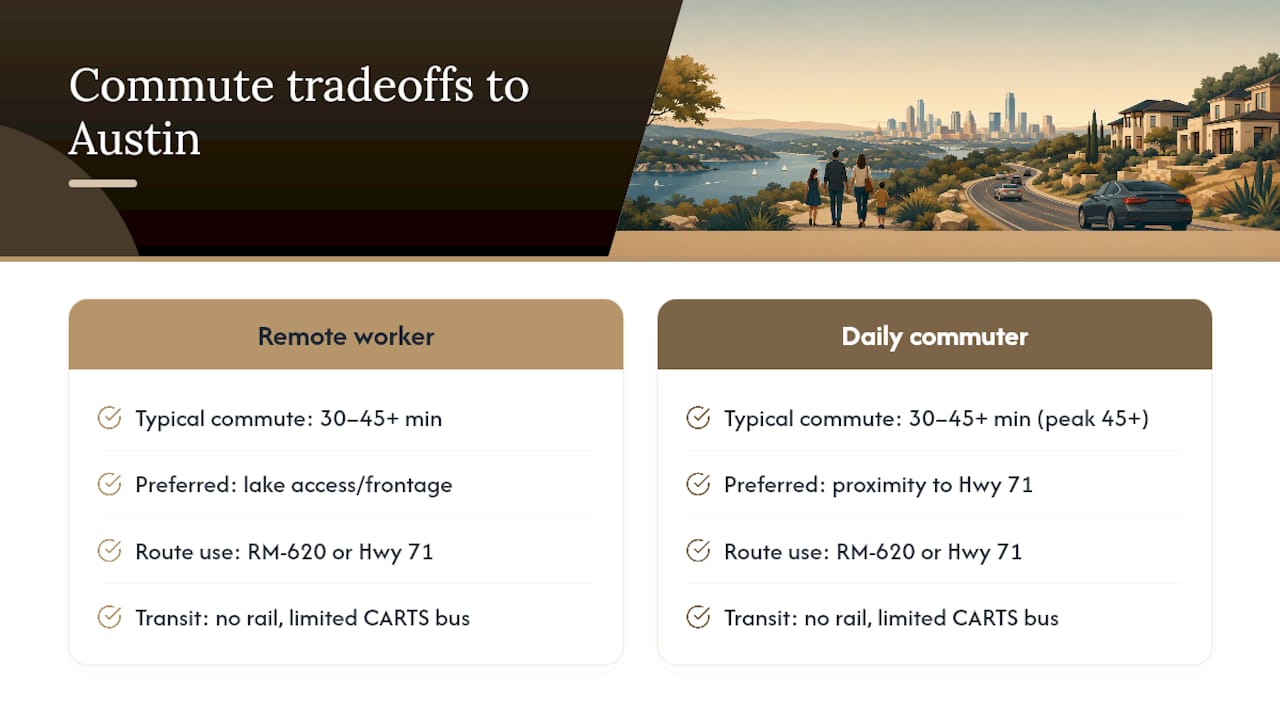
Expect 30 minutes to downtown Austin on a light traffic day, and 45 minutes or more during peak commute hours. The two main routes are RM-620 and Highway 71, both of which see heavy congestion during rush periods since they’re the primary arteries connecting the lake communities to the rest of the metro.
There’s no rail connection to Lakeway, and CARTS bus service is limited, so owning a car isn’t optional here. That single fact reshapes a lot of neighborhood tradeoffs: buyers who work remotely most of the week can justify a longer drive for better lake access, while those commuting daily often prioritize proximity to Highway 71 over waterfront frontage.
Is Lakeway Safe, and Who Lives There?
Lakeway consistently reports lower crime rates than the Austin metro average, a point that shows up often in relocation research and one reason families cite it as a top choice among Austin-area suburbs. Median household income sits near $165,000 to $170,000, well above regional norms, and the population skews toward established families, active retirees, and professionals who’ve chosen the lake lifestyle deliberately rather than landed there by commute convenience.
The city’s own police department handles local safety, while Travis County provides fire and rescue coverage alongside city parks and recreation staff who maintain the trail system and community programming. Growth trends show steady population increases since the last census, driven mostly by families drawn to LTISD and professionals relocating from other parts of Austin.
What Is Lake Life Actually Like Day to Day?
Boating defines a good chunk of the calendar here. Marina access, whether through a deeded slip or a public ramp at Lakeway City Park, dictates how often residents get on the water, and lake levels fluctuate seasonally with rainfall and Lower Colorado River Authority releases, which affects boat launch conditions in late summer some years.
Beyond boating, the city runs regular parks programming, seasonal markets, and community events that give newer residents an easy way into the social fabric. If you’re buying specifically for lake access, decide early whether you need a private slip or can rely on public ramps and marina rentals, since that decision alone can shift your neighborhood shortlist by hundreds of thousands of dollars.
How Do You Choose the Right Lakeway Neighborhood?
Start by ranking your non-negotiables, because Lakeway rarely lets you maximize schools, commute, lake access, and budget all at once.
- List your top three priorities in order: schools, lake access, commute time, lot size, or HOA restrictions. Most buyers can get two fully and compromise on the third.
- Ask sellers and agents pointed questions on every showing: current property tax rate, HOA and MUD fees, flood zone status, and any required seller disclosures specific to the neighborhood.
- Watch for red flags like unusually low HOA dues in an amenity-heavy community, which can signal deferred maintenance on shared facilities, or a listing that avoids specifying the exact school zone.
- Plan your visit across two days: tour neighborhoods and drive commute routes at rush hour on day one, then walk the specific streets and talk to neighbors on day two before making any offer.
Pro Tip: Some of the best-matched properties in Lakeway never hit the public market. Working with a team that has access to off-market and pre-construction listings often surfaces options that fit your exact priorities better than anything you’ll find on a public search.
A Buyer’s-Eye View of Lakeway
Most buyers underestimate how much the commute tradeoff actually matters until they’ve driven RM-620 at 5 p.m. on a Friday. The families who end up happiest in Lakeway are usually the ones who accepted that tradeoff upfront rather than convincing themselves it wouldn’t apply to them.
Mike Mogavero has spent more than 20 years navigating the Austin luxury market, with particular focus on off-market and pre-construction opportunities that rarely surface in a standard search. The buyers who come to the Lakeway market tend to fall into two camps: relocating families chasing LTISD, and second-home or retirement buyers chasing the marina lifestyle. Both groups benefit from the same advice: tour neighborhoods at the times you’d actually live your life there, not just on a quiet Sunday afternoon. If you want a straight answer on which Lakeway pocket fits your situation, a short consultation beats weeks of scrolling listings alone.
— Mike
Ready to Explore Lakeway Real Estate?
Buyers often find access to off-market and pre-construction properties before they’re marketed to everyone else provides advantages over most public listing searches. That matters most in a market like this one, where the best marina-access homes and club-adjacent lots often sell through relationships before they ever hit a public search.
Whether you’re chasing LTISD boundaries, a deeded boat slip, or a quieter retirement setting near the golf courses, the right fit in Lakeway usually comes down to detail a listing photo won’t show you. Mogavero Group’s private listings include exclusive Lakeway and Lake Travis inventory not available to the general public, and the full property search covers everything currently on the market across the area. If you’re ready to narrow down a neighborhood or want a firsthand tour of Rough Hollow, The Hills, or Serene Hills, reach out to schedule a consultation and start with a shortlist built around your actual priorities, not a generic search filter.
Sources
- About Lakeway | City of Lakeway, TX - Official Website
- Moving to Lakeway TX? Everything You Need to Know (2026)
- BestPlaces: Lakeway, TX cost of living
FAQ
Is Lakeway a Good Place to Live?
Lakeway suits buyers who want Lake Travis access, an A-rated school district, and Hill Country scenery, and who can afford housing that runs well above the Austin metro median. It’s less suited to buyers who need a short car-free commute or a tight budget below the mid $300,000s.
Is Lakeway a Wealthy Area?
Yes. Median household income in Lakeway sits near $165,000 to $170,000, and median home values range roughly from $681,000 to $832,000, both well above typical Austin-metro figures.
What Part of Austin Should You Avoid?
This varies block by block and depends entirely on your priorities around schools, commute, and safety, so it’s worth researching specific Austin neighborhoods individually rather than relying on general reputation; Lakeway itself reports lower crime than the broader metro average.
What Is the Average Income in Lakeway, Texas?
Median household income in Lakeway is estimated near $165,000 to $170,000, roughly double the income levels seen in many neighboring Austin-area communities.