Buyers: Insist on CEDIA Integration to Protect Luxury Smart Home Value
2026 buyers' checklist for luxury smart home features: insist on CEDIA grade integration, wired infrastructure, full documentation, and a transferable...
Buyers: Insist on CEDIA Integration to Protect Luxury Smart Home Value
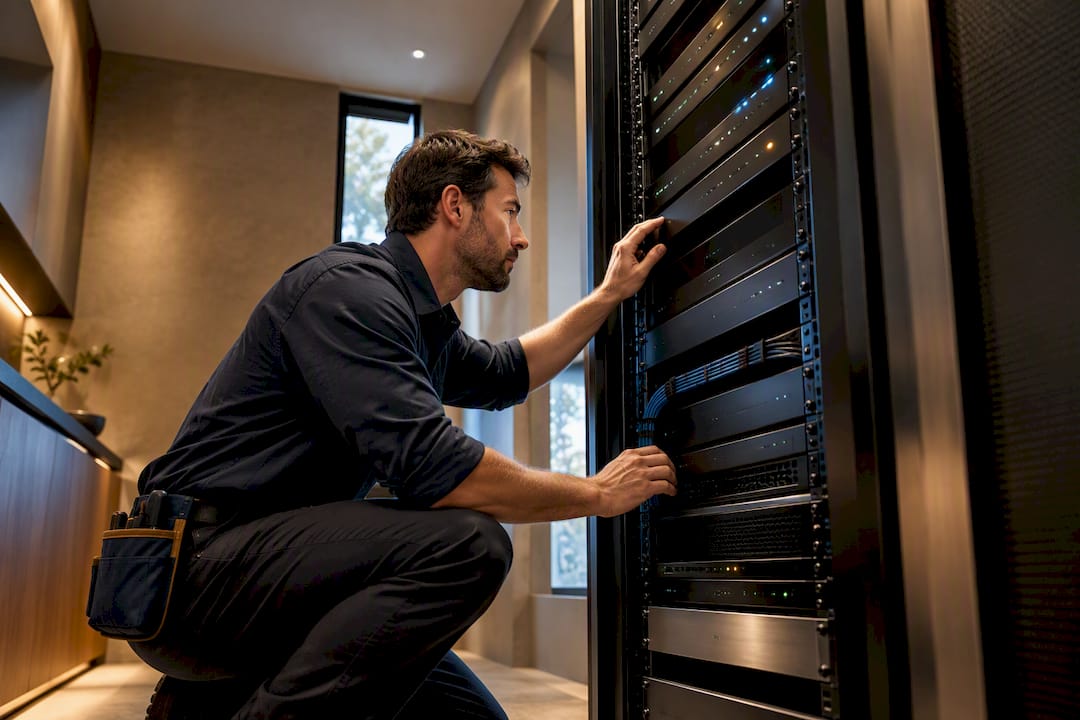
The highest-impact luxury smart home features fall into eight groups: a professionally tiered control hub, integrated security with biometric entry, tunable circadian lighting, zoned climate and air-quality control, whole-house audio and theater integration, motorized shades, solar-battery-EV energy systems, and a wired network backbone. None of these gadgets matter without the right infrastructure and a certified integrator behind them. That’s the part buyers skip, and the part that determines whether the system still works in five years.
TL;DR:
- Selecting a professionally integrated or hardwired Tier 2 or Tier 3 system is crucial, as consumer-level Tier 1 solutions often lack reliability and scalability.
- Be sure to verify system documentation, such as wiring diagrams, programming details, and maintenance agreements, before purchasing or finalizing any luxury automation.
- Biometric security requires a backup method and privacy safeguards, with integrators demonstrating AI false-positive rates to ensure reliable detection.
- Smart lighting should be integrated into electrical plans with circadian design, not just standalone bulbs, to achieve wellness and aesthetic benefits.
- Investing in energy systems with submetering, batteries, and automated load shifting can significantly reduce operational costs and increase resale value.
Table of Contents
- Central Automation and Platform Tiers: Where the Real Decisions Happen
- Integrated Security and Access Control Worth Paying For
- Smart Lighting and Circadian Design for Wellness
- Climate Control That Learns Your Household
- Whole-Home Audio and Video Done Right
- Dedicated Home Theater vs. Everyday Living-Room AV
- Motorized Shades and Solar Control That Pull Their Weight
- Smart Appliances and the Connected Kitchen
- Energy Management: Solar, Batteries, EV Charging, and Real Savings
- Networking and Infrastructure: The Part Nobody Sees
- Installation, Maintenance, and Why the CEDIA Integrator Matters
- Cost Tiers, ROI, and What Buyers Should Expect at Resale
- Smart Health Monitoring and Wellness Features
- Concierge Services and Remote Management for Absentee Owners
- Advanced AI and Personalization: Separating Real Value From Marketing
- Interoperability and Future-Proofing Your Investment
- Privacy and Data Security in a Connected Luxury Home
- Prioritizing Features for Lifestyle, Privacy, and Resale
- Sources
- FAQ
Central Automation and Platform Tiers: Where the Real Decisions Happen
Every luxury automation system falls into one of three tiers, and picking the wrong one is the single most expensive mistake a buyer makes. Tier 1 is consumer and cloud based: think Amazon Alexa or a basic Wi-Fi hub controlling a handful of devices through an app. It’s cheap, replaceable, and fine for a condo. Tier 2 is professionally integrated: a licensed installer configures a platform like Control4 or Savant to run lighting, security, and AV from one interface, usually with some hardwired backbone mixed in. Tier 3 is architectural: hardwired from the studs, engineered around a rack of processors, and built to run hundreds of endpoints without lag.
The trade-off is permanence versus flexibility. A Tier 1 device swaps out in minutes. A Tier 3 system is a design-stage decision that has to happen before drywall goes up, because the wiring runs through walls the owner will never open again.
At handover, request:
- A full system diagram showing every device, wire run, and control point
- Programming documentation, not just a login and password
- A written service agreement naming who maintains the system after the installer’s team moves on
- Confirmation of which protocols (Matter, Thread, Zigbee) the system supports for future expansion
Integrated Security and Access Control Worth Paying For
Professional-grade security starts with pan-tilt-zoom cameras running encrypted feeds and AI-assisted detection that tells the difference between a delivery driver and a person lingering at a side gate. Consumer doorbell cameras can’t do that reliably, especially in low light or at long range across an acre lot.
Biometric entry, fingerprint or facial recognition at the front door, is becoming standard in new luxury construction, but it needs a backup. Sensors fail, faces get scanned wrong in bright sun, and you don’t want to be locked out of your own house because of a software glitch. Every biometric system should have:
- A physical key or code override
- Privacy settings that limit facial data storage and sharing
- Integration with arrival and departure scenes (unlock, disarm, adjust lighting automatically)
- Perimeter lighting that triggers on motion before someone reaches the door
Pro Tip: Ask your integrator to demonstrate the false-positive rate on AI detection before you sign off. A system that pings your phone every time a raccoon crosses the driveway will get ignored within a week.
Smart Lighting and Circadian Design for Wellness
There’s a real difference between screwing in a smart bulb and installing an architectural lighting system. Platforms like Lutron and Ketra integrate directly into the electrical plan, giving smooth, flicker-free dimming and color temperature shifts that a $40 bulb can’t replicate. Stand-alone smart bulbs are fine for a rental. They’re the wrong call for a primary residence where lighting quality affects how the whole house feels.
Circadian lighting adjusts color temperature through the day, cooler and brighter in the morning, warm and dim by evening, mimicking natural daylight patterns tied to sleep and alertness cycles. It’s one of the more measurable wellness upgrades available, and it runs on LED technology that’s already the efficiency standard for smart lighting strategies.
Design considerations that keep it from looking like a control panel showroom:
- Keyless in-wall dimmers instead of visible switch banks
- Recessed sensors instead of exposed motion detectors
- Scene presets programmed to specific rooms, not blanket whole-house settings
Climate Control That Learns Your Household
A single smart thermostat is a start, not a solution. Zoned HVAC paired with occupancy sensors lets one wing of the house stay cool while another warms up, based on who’s actually in the room rather than a fixed schedule.
Add air-quality sensors tracking VOCs, carbon dioxide, and humidity, tied into whole-home filtration, and the system starts managing health, not just temperature. This matters more than most buyers realize: indoor air quality affects everything from allergy symptoms to sleep quality, and static filtration schedules miss the swings that happen when a house fills up for a dinner party or empties out for a week of travel.
Contract terms worth insisting on:
- Sensor calibration schedules, not “set it and forget it” installs
- Written reporting on air-quality trends, not just raw sensor data
- Occupancy-learning features clearly explained, since some vendors overstate how “smart” the learning actually is
Global smart-home adoption keeps climbing, and Statista’s household tracking shows connected climate features have moved from novelty to expectation among affluent buyers.
Whole-Home Audio and Video Done Right
Distributed audio in a luxury home means architectural speakers built into ceilings and walls, driven by professional amplification, not a scattering of Sonos speakers plugged in room by room. The difference shows up the moment you walk from the kitchen into the living room and the music follows without a beat dropped.
High-resolution streaming sources paired with room acoustic treatment, angled surfaces, absorptive panels in the right spots, make the system sound as good as it looks on paper. Skip the acoustics and even a $50,000 speaker package sounds flat in a room full of hard surfaces and glass.
What separates a good install from a great one:
- Hardware hidden in walls, ceilings, or dedicated equipment closets
- Centralized source management so every room pulls from the same control app
- Volume and zone control integrated into the main automation platform, not a separate app per brand
Recent hardware refresh cycles have pushed noticeable audio quality gains into 2026’s best smart speakers and hubs, which is one more reason to insist on a system built around open protocols instead of a single locked-in brand.
Dedicated Home Theater vs. Everyday Living-Room AV
A true home theater earns its name through acoustic treatment, a calibrated projector or display matched to screen size and seating distance, and automated scene recall that dims lights, drops shades, and powers on the system with one button. That’s different from a nice television in a family room, and buyers touring luxury homes should know which one they’re getting.
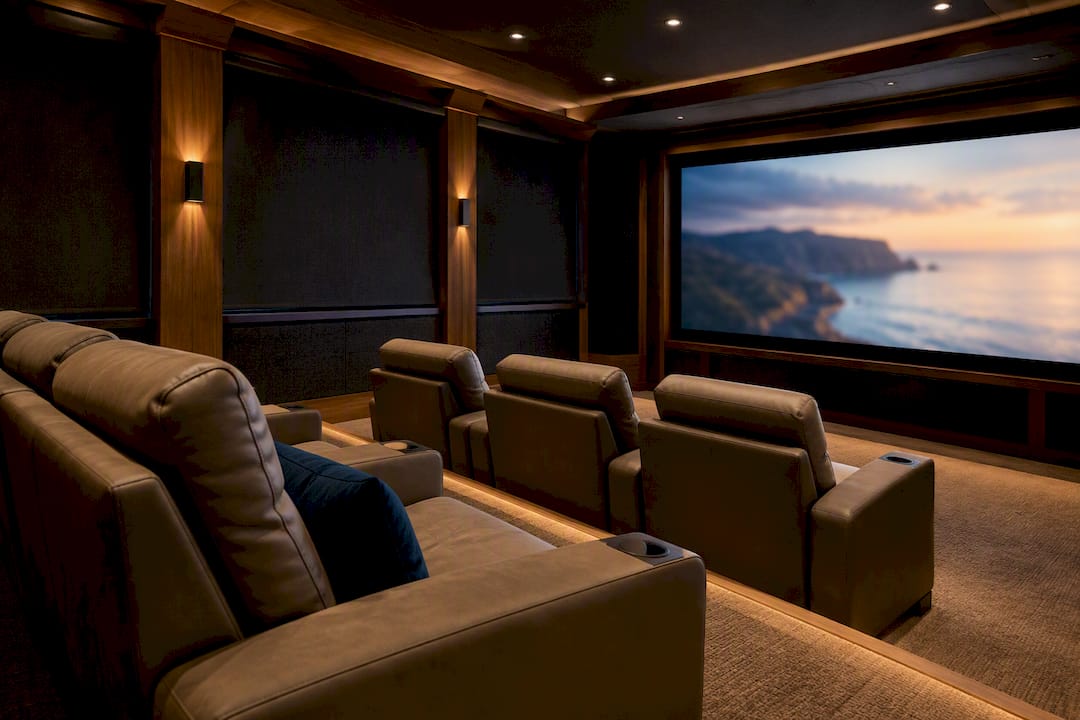
Behind the screen, rack design matters more than people expect. Poor ventilation kills amplifiers and processors early. A well-built theater rack has dedicated cooling, cable management, and centralized control tied into the home’s broader automation scenes, so “movie night” isn’t a separate system to learn.
Motorized Shades and Solar Control That Pull Their Weight
Motorized shades do more than look impressive when they glide down at sunset. Tied into lighting and climate scenes, they cut glare during video calls, reduce solar heat gain in summer, and add privacy on a schedule instead of a reminder to close the blinds.
Getting this right means planning pre-wire and mounting points before construction finishes, since retrofitting motorized tracks into finished window casings is expensive and often visually compromised. Key integration points:
- Solar-gain scheduling that closes shades on the sun-facing side during peak afternoon heat
- Privacy scenes triggered automatically at dusk
- Coordination with lighting scenes so shade position and light level move together
Smart Appliances and the Connected Kitchen
Inventory-aware refrigeration, appliances that track what’s inside and flag when staples run low, has moved from gimmick to genuinely useful in the past few product cycles. Integrated wine storage with app-based temperature and humidity control protects a serious collection without the owner checking a gauge in the basement. App-programmable steam showers let someone start warming up a bathroom from bed.
The feature that matters more long term is data reporting: appliances that feed energy use back into a whole-home monitoring dashboard let owners see which systems are actually driving the utility bill. When specifying appliances, confirm they support the same connectivity protocol as the rest of the system and that a local service technician can actually repair them, not just the manufacturer’s call center three states away.
Energy Management: Solar, Batteries, EV Charging, and Real Savings
Whole-home energy monitors that track usage at the circuit level turn a mystery utility bill into an actionable dashboard. Instead of a “your house used 800 kilowatt-hours” summary, owners see exactly which zone, appliance, or system is driving costs.
Level 2 EV chargers scheduled to run during off-peak hours, paired with solar and battery storage, shift demand automatically rather than relying on someone to remember to plug in at midnight. This kind of circuit-level monitoring tied to demand-response automation is where the real operating-cost reduction happens, not from any single gadget but from the systems talking to each other.
What to specify:
- Submetering on major circuits, not just a whole-house average
- Battery storage sized to cover peak-hour usage, not just emergency backup
- Automated load shifting that moves flexible loads (EV charging, pool pumps) to low-rate windows
Homes with strong energy features tend to carry both lower bills and a marketing edge at resale, a pattern that shows up clearly in Austin’s own energy-efficient listings.
Networking and Infrastructure: The Part Nobody Sees
A wired backbone is the reason a Tier 3 system stays responsive when twenty devices try to stream, monitor, and communicate at once. Wireless-only setups buckle under that load in a large house; hardwired systems built around a central rack don’t.
Network segmentation matters just as much as raw bandwidth. VLANs separate guest Wi-Fi, security cameras, and personal devices so a compromised smart plug can’t become a path into the home office network. Add a firewall and basic endpoint hardening, and the attack surface shrinks considerably.
- Locate the equipment rack somewhere with active cooling and easy service access, not a closet that doubles as storage
- Pre-wire every likely camera, sensor, and access point location during construction
- Build in network redundancy (a cellular failover, at minimum) so security cameras stay online if the main connection drops
Pro Tip: Ask for the network diagram before closing on a pre-wired luxury home. If the seller’s integrator can’t produce one, assume the wiring is undocumented and budget for a partial rebuild.
Installation, Maintenance, and Why the CEDIA Integrator Matters
A certified CEDIA integrator does more than install hardware. That certification signals the installer follows industry standards for integration and design-friendly placement, which keeps wiring hidden and systems reliable long after the crew leaves.
What to require in any service contract:
- A defined service level agreement with response-time commitments for outages
- Scheduled software and firmware updates, not “we’ll get to it eventually”
- Annual training sessions so household staff can operate the system without calling for help on basic tasks
- Documented handover of all programming, passwords, and network diagrams
Annual service contracts on Tier 2 and Tier 3 systems typically run into the low thousands of dollars a year, a real number to budget for, not an afterthought. The most common failure mode isn’t hardware breaking. It’s undocumented programming that only one installer understands, so when that person leaves the company, the system becomes a black box nobody can safely modify.
Cost Tiers, ROI, and What Buyers Should Expect at Resale
Budget brackets vary widely, but a rough map helps: entry-level automation (lighting and a security app) often runs in the low tens of thousands. Mid-range whole-home integration, lighting, climate, AV, and security tied together, lands in the moderate five figures to low six figures. Full Tier 3 architectural systems, the kind built into new construction from the ground up, commonly run into the hundreds of thousands.
Operational costs matter too: budget for annual service contracts, periodic firmware and hardware updates, and occasional sensor replacement. Some insurers offer modest premium reductions for monitored security and leak-detection systems, worth asking about directly.
The resale story is where documentation pays off. Properly documented Tier 2 and Tier 3 systems have sold at a measurable premium in prime markets specifically because buyers could see the system was serviceable and transferable, not a mystery box of unlabeled wires. A $200,000 to $400,000 automation investment only holds value five years out when training, documentation, and a working service contract come with it.
Smart Health Monitoring and Wellness Features
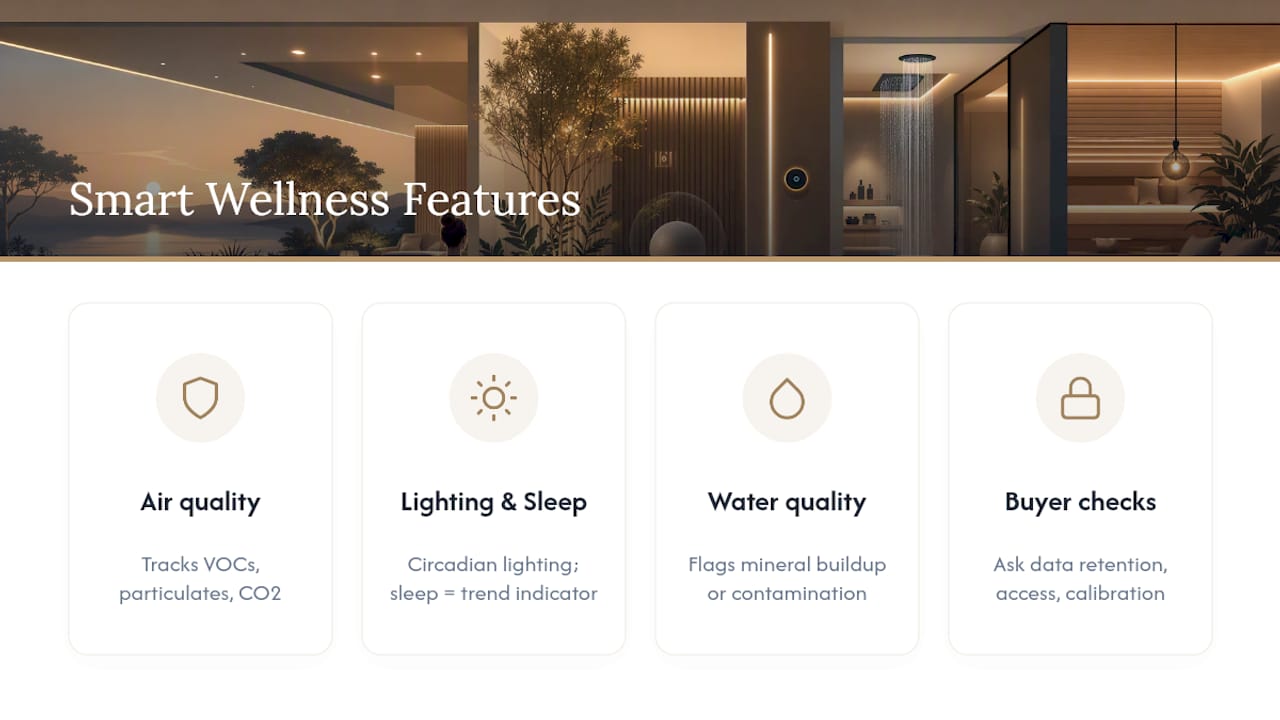
Air-quality sensors that track VOCs, particulates, and CO2 have moved from a climate-control add-on to a wellness feature in their own right, feeding dashboards that flag problems, like a spike from new furniture off-gassing, well before anyone notices a smell. Paired with circadian lighting schedules, they form the backbone of a genuinely health-oriented smart home rather than a marketing label.
Sleep tracking has followed a similar path. Bedroom systems now integrate ambient temperature, light dimming schedules, and sometimes bed-based sensors that estimate sleep quality without a wearable. The honest caveat: consumer sleep-tracking accuracy varies a lot by device and placement, so treat the data as a trend indicator, not a clinical readout.
Water quality monitoring is the quieter addition. Whole-home filtration paired with sensors that flag mineral buildup or contamination gives an added layer of confidence, especially in homes on well water or older municipal lines.
The practical advice for a buyer touring a home with these features: ask what happens to the historical data, who can access it, and whether the sensors get calibrated on a schedule or just installed and forgotten. A wellness system that nobody maintains is decoration, not infrastructure.
Concierge Services and Remote Management for Absentee Owners
Luxury buyers who split time between multiple properties increasingly expect a concierge layer sitting on top of the automation platform, a service that lets an integrator or property manager remotely check system status, troubleshoot alerts, and adjust settings before the owner even lands at the airport.
This usually works through the same platform (Control4, Savant, or a comparable Tier 2/3 system) that runs daily operations, with permissions granted to a trusted third party. Remote management can mean:
- Pre-arrival scenes that warm the house, adjust lighting, and stock the fridge order ahead of a visit
- Automated alerts routed to a property manager instead of, or in addition to, the owner
- Seasonal system checks (irrigation winterization, HVAC filter swaps) scheduled and confirmed remotely
The value here is less about any single feature and more about reducing the mental overhead of owning a home you’re not always in. For buyers considering a second home or investment property in Austin, this kind of remote oversight often determines whether the property actually gets used or sits idle between visits.
Advanced AI and Personalization: Separating Real Value From Marketing
The AI conversation around smart homes in 2026 has two very different tracks, and buyers need to know which one they’re actually paying for. Occupancy learning, systems that quietly notice when a household member usually adjusts the thermostat and starts doing it automatically, delivers real, measurable value. So does predictive maintenance, where sensors flag a failing HVAC compressor or a water heater trending toward failure before it breaks.
Natural-language voice assistants marketed as “AI-powered” are a different story. Some AI features advertised for luxury homes still fall short of the reliability buyers expect, stumbling on accents, background noise, or requests slightly outside their scripted range. The gap between the demo and daily use is real, and it’s exactly where buyer complaints tend to cluster.
The practical rule: test any AI or natural-language feature yourself before accepting the system at handover. Don’t take the installer’s demo as proof it works in your house, with your voices, on your network. Ask specifically how the system handles occupancy learning and predictive maintenance, since that’s where the genuine value sits, rather than in how well it chats.
Interoperability and Future-Proofing Your Investment
The biggest risk to a six-figure smart-home investment isn’t a broken sensor. It’s a platform that stops getting updates and leaves an owner locked out of expansion five years later. That’s why interoperability standards matter more now than they did a decade ago.
Matter and Thread have emerged as cross-platform standards designed to let devices from different manufacturers talk to each other without a proprietary bridge. A system built around open standards can add a new lock, thermostat, or sensor from a different brand later without ripping out the existing setup. A closed, single-vendor system can’t.
Ask your integrator directly which standards the proposed system supports and get it in writing. Future-proofing isn’t about buying the newest gadget. It’s about avoiding a system that becomes an island the moment the manufacturer moves on to a new product line.
Privacy and Data Security in a Connected Luxury Home
More sensors and cameras mean more data, and luxury homes are higher-value targets for both digital and physical intrusion. Encrypted video feeds and network segmentation, discussed earlier for reliability, do double duty as privacy protection: a compromised guest Wi-Fi network shouldn’t have a path to a security camera feed or a biometric database.
Facial recognition and biometric entry systems raise a specific question every buyer should ask: where is that biometric data stored, and who else can access it? Some platforms store data locally on a home server. Others send it to a cloud service, which introduces a third party into what should be a private security decision. Local storage, with cloud backup handled separately and encrypted, is the safer default.
Household staff, guests, and service technicians all touch these systems at some point, so access should be tiered. A cleaning service doesn’t need the same system permissions as a homeowner. Review privacy practices specific to luxury properties before finalizing any system that touches biometric or camera data, and insist your integrator document exactly what gets logged, stored, and shared.
Prioritizing Features for Lifestyle, Privacy, and Resale
If you’re touring or listing a luxury home this year, the temptation is to get dazzled by gadgets. Resist it. Infrastructure and a serviceable integrator matter more than any single feature on the spec sheet. A house full of impressive tech with no documentation is a liability disguised as an amenity.
When you tour, ask to see the network demarcation point, the service logs, and the maintenance contract. If the seller can’t produce them, assume you’re buying a black box. Ask who programmed the system and whether that person or company is still reachable.
Invisible integration, controls that don’t scream “smart home,” and tight privacy controls on biometric data matter enormously to buyers who value discretion, which is why real estate SEO services can help showcase these unique smart home features. The best systems disappear into daily life. That’s the standard worth holding every property to, whether you’re buying or preparing to sell.
— Mike
Sources
The tier definitions, cost brackets, and resale-premium figures throughout this guide come from luxury real estate technology reporting on 2026 automation trends. Guidance on CEDIA integrators and design-friendly installation draws from the National Association of Realtors. Lighting efficiency claims reference Energy.gov’s LED lighting guidance, adoption trends come from Statista’s smart-home household data, and infrastructure recommendations follow technical comparisons of hardwired versus wireless systems.
- Smart Home Technology: The Intelligence Infrastructures Redefining Luxury Real Estate in 2026
- Smart Home Tech for the Luxury Market
- Smart home households worldwide (Statista)
- Hardwired vs wireless smart home systems
FAQ
What Makes a Smart Home “Luxury” Versus Just Automated?
A luxury smart home runs on Tier 2 or Tier 3 architecture, professionally integrated or fully hardwired, rather than a collection of consumer Wi-Fi gadgets. The distinction comes down to reliability, scale, and design integration, not the number of devices installed.
Do I Need a CEDIA-Certified Integrator?
For any Tier 2 or Tier 3 system, yes. Certified integrators follow installation standards that keep systems reliable and design-friendly, and their documentation is what protects the system’s value at resale.
How Much Should I Budget for a Full Home Automation System?
Costs range from low tens of thousands for basic integration to the hundreds of thousands for full architectural systems built during new construction. A properly documented $200,000 to $400,000 system can still deliver value five years later, but only with training and a transferable service contract in place.
Does a Smart Home System Actually Increase Resale Value?
Documented, professionally installed systems have sold at a premium in prime markets because buyers could verify serviceability. Undocumented or single-vendor locked systems tend to add far less, since new owners inherit the risk without the paperwork to manage it.
Should I Trust AI-Powered Features Marketed in New Systems?
Test them yourself before accepting the system. Occupancy learning and predictive maintenance tend to deliver real value, while natural-language voice features often underperform their demos in daily use.
What’s the First Thing to Check When Touring a Smart-Enabled Home?
Ask for the network diagram, service logs, and maintenance contract. If a seller can’t produce them, the system is likely undocumented, and you should budget for a partial rebuild before relying on it.