Save $7,500 to $13,500 When Moving From California to Austin in 2026
A 2026 move guide for Californians: housing and tax comparisons, neighborhood trade offs, moving costs, and local agent off market tactics.
Save $7,500 to $13,500 When Moving From California to Austin in 2026

For most California households with home equity or a coastal-level salary, moving from California to Austin still pays off financially in 2026, though the math depends heavily on your situation. The biggest lever is no state income tax, but rising property taxes and summer electricity bills eat into that windfall. If you have equity to deploy, want more square footage, or care more about school options than beach proximity, keep reading.
TL;DR:
- Buyers moving from California to Austin benefit from lower housing costs, larger homes, and no state income tax, but must account for rising property taxes and utility bills.
- Neighborhood choice significantly impacts affordability and lifestyle, with distinct areas offering urban nightlife, family-friendly suburbs, or quiet rural-like settings.
- Renting first for three to six months is recommended if job certainty or neighborhood familiarity is unclear, while confirmed job stability favors immediate buying with longer hold times.
- Moving logistics involve 7 to 14 days transit, with extra charges for building access issues, and booking early helps avoid delays and manage furniture downsizing.
- Austin’s healthcare infrastructure is growing but less specialized than California’s, making it important to verify local providers and insurance networks before moving.
Table of Contents
- Austin By The Numbers: What Housing, Rent, And Taxes Actually Cost In 2026
- Housing And Neighborhoods: Where Should You Actually Look?
- Should You Rent First Or Buy Right Away?
- What Interstate Movers Should Budget And Expect
- Life After The Move: Commute, Weather, Bills, And Insurance
- Schools And Family Life: Where To Focus Your Search
- Your Austin Relocation Checklist
- How A Local Agent Cuts Relocation Risk
- How Far Does Your Paycheck Really Go In Austin?
- Where Are The Jobs For New Austin Residents?
- Comparing Healthcare Access Between The Two Markets
- Building A Social Life And Community After The Move
- Legal And Administrative Differences You Need To Handle
- What I’ve Learned Watching Californians Make This Move
- Work With A Team That Knows Austin’s Off-Market Inventory
- Sources
- FAQ
Austin By The Numbers: What Housing, Rent, And Taxes Actually Cost In 2026
The Austin metro’s median home price sits around $440,000, with roughly 4.2 months of inventory on the market. That inventory level matters more than the price tag. Anything above three months typically signals a buyer-favorable market, and 4.2 months puts Austin firmly in that zone. Compare that to the 2021-2022 frenzy, when homes sold in days with a dozen competing offers, and you get a sense of how much leverage has shifted back toward buyers.
Rent tells a similar story of relative affordability. A one-bedroom apartment in many central Austin listings runs $1,400 to $1,700 a month, while two-bedrooms average within an expected rental range. If you’re coming from Los Angeles or the Bay Area, that’s often half of what comparable square footage costs at home.
Pro Tip: Before you fall in love with a listing photo, check the price per square foot, not just the sticker price. Austin homes tend to be larger than California homes at the same price point, which skews simple dollar comparisons.
The tax math is where things gets interesting, and it’s worth running your own numbers rather than trusting a headline. A household earning $150,000 a year can save somewhere between $7,500 and $13,500 annually in state income tax alone by relocating from a high-tax state to Texas. That’s real money, often enough to cover a car payment or a chunk of a mortgage payment. But Texas recoups some of that through property taxes, which run higher than California’s capped rates. On a $440,000 home, annual property tax bills can land in the $8,000 to $11,000 range before any exemptions, depending on the local taxing jurisdiction.
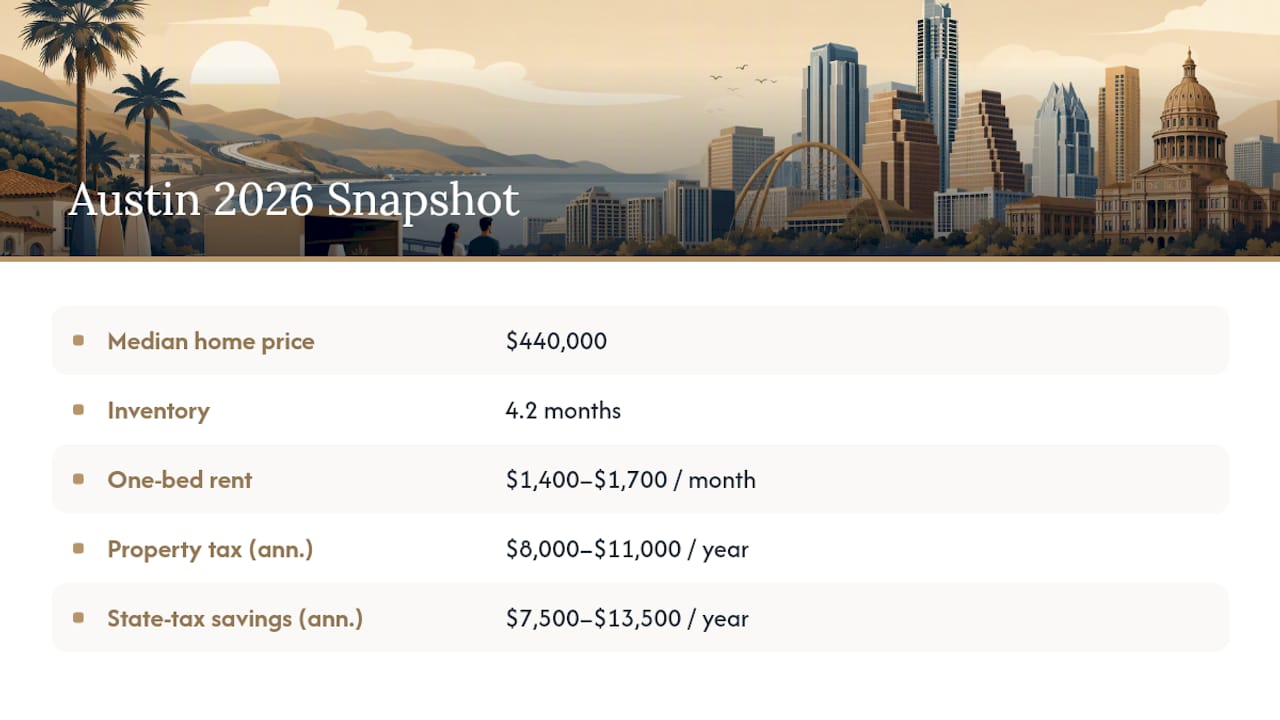
Here’s a simplified snapshot for planning purposes:
Beyond housing and taxes, budget for the monthly cost of getting around. Between car payments, insurance, fuel, and maintenance, most households spend $400 to $600 a month on transportation, a category many Californians underestimate because they’re used to shorter commutes or transit alternatives.
Space is where the comparative value really shows up: buyers moving equity out of Los Angeles or the Bay Area routinely find they can afford twice the square footage in Austin for the same budget, sometimes with a pool or a proper yard thrown in. That space advantage is the single biggest reason Californians keep making this move despite the heat and the traffic.
Housing And Neighborhoods: Where Should You Actually Look?
Austin isn’t one market. It’s a collection of distinct pockets, each with its own price band, commute profile, and lifestyle fit, and treating it as a single homogeneous city is the fastest way to end up in the wrong zip code.
- Downtown, East Austin, and South Congress (SoCo): Walkable, dense, and full of restaurants and nightlife, but rents and home prices run at a premium. Best for buyers who want an urban lifestyle and don’t mind paying for it.
- North Austin, Cedar Park, and Round Rock: More suburban, generally lower median prices, strong school districts, and shorter commutes to the tech corridor along US-183 and MoPac. A common landing spot for families.
- Hill Country and Georgetown: Larger lots, more privacy, a slower pace, and increasingly popular with buyers who want acreage or a quieter setting without giving up proximity to Austin proper.
- Southwest Austin: A middle ground of established neighborhoods, mature trees, and solid schools, often overlooked by out-of-state buyers who don’t know the area yet.
School-district and tax-jurisdiction lines can shift affordability dramatically even between neighborhoods that look identical on a map. Two homes a mile apart can carry different school assignments and different taxing entities, which changes both your annual bill and your resale pool down the road. Always confirm the exact district and jurisdiction attached to a specific address, not just the neighborhood name.
Before committing to any pocket, test it the way a local would. Drive the commute at actual rush hour, not on a quiet Sunday afternoon. Visit on a weekend to see how the neighborhood feels when it’s full of life. Check a walkability score if you’re considering a central location, since walkability and nightlify access often carry a rent premium worth weighing against a quieter suburb with more space. If waterfront living is on your list, Lake Austin deserves a look for its combination of privacy and proximity to the city, and East Austin is worth touring if you want walkability without the downtown price ceiling. A neighborhood fit guide can help narrow the list before you start touring in person.
Should You Rent First Or Buy Right Away?
The right answer depends on how certain you are about your job, your neighborhood, and your timeline, not on what the market is doing that particular week.
- Rent first if your job is remote or uncertain, or you don’t know Austin well. Most relocation guides recommend a three to six month rental window to test neighborhoods before committing to a purchase. Austin is genuinely a “city of pockets,” and what looks perfect online can feel wrong once you’re living the daily commute.
- Buy immediately if you have a confirmed local job, your finances are in order, and you’re ready to deploy California equity. With inventory sitting at 4.2 months, you’re not racing a bidding war the way you might have in 2021. Plan to hold the property at least five years to comfortably absorb transaction costs.
- Use California equity strategically. A larger down payment can qualify you for a rate buydown, and cash reserves give you standing to pursue off-market listings that never hit the public market, which matters most in competitive pockets like SoCo or Lake Austin.
Pro Tip: If you’re renting first, sign a lease that ends in early spring. That puts you in position to buy during the slower late winter selling season, when sellers are often more open to negotiating credits.
What Interstate Movers Should Budget And Expect
Door-to-door transit from California to Austin typically runs 7 to 14 days, though summer months bring both longer waits and higher rates as demand peaks alongside school-year timing.
Watch for these common add-on charges before they surprise you on the final invoice:
- Long-carry fees, charged when the truck can’t park close to your door and crew has to haul items an extra distance.
- Shuttle service fees, applied when a full-size truck can’t access a narrow street or driveway and a smaller vehicle has to bridge the gap.
- Elevator and freight scheduling costs, common in mid-rise buildings where you need a reserved time slot and sometimes a certificate of insurance for the building.
You can avoid most of these by flagging building access issues at the survey stage, before the crew shows up on moving day. Tell your mover about narrow driveways, HOA restrictions, or elevator requirements when they walk your current home, not the morning of the move.
Book your moving company eight to twelve weeks ahead, especially if you’re targeting a summer date. That lead time also gives you room to sell or donate bulky furniture that won’t fit your new floor plan, which cuts your shipment weight and your bill at the same time.
Life After The Move: Commute, Weather, Bills, And Insurance
Austin runs on cars. Commutes along I-35 and MoPac can stretch well past 30 minutes during peak hours, and public transit remains limited outside a handful of corridors, so factor drive time into any neighborhood decision, not just price per square foot.
- Living within a few miles of your office changes your quality of life more than almost any other single variable in this move.
- Summer electricity bills spike hard: expect $150 to $220 a month in cooler months, jumping to $250 to $350 during peak summer heat.
- A programmable thermostat set a few degrees higher during work hours, along with basic attic insulation upgrades, can meaningfully soften that summer spike.
- Homeowners insurance in Central Texas factors in wind and hail risk differently than California policies price earthquake and wildfire exposure, so get quotes early rather than assuming your old premium as a baseline.
- Property taxes hit your monthly payment directly if you escrow them, which is why the exemption steps covered later in this guide matter so much for your actual carrying cost.
None of this is a dealbreaker for most transplants, but it does mean your monthly budget looks different than it did in California, shifted away from state income tax and toward utilities, insurance, and property tax.
Schools And Family Life: Where To Focus Your Search
Families relocating with kids tend to gravitate toward a short list of suburbs for good reason. Round Rock, Cedar Park, and Georgetown consistently show up as top picks, each offering established school districts, family-oriented amenities, and more predictable commute patterns than the urban core.
- Round Rock offers a mix of established and newer developments with strong district reputations and relatively accessible pricing.
- Cedar Park leans slightly more suburban and quiet, popular with families who want larger lots and a shorter drive to the northwest tech corridor.
- Georgetown trades a bit more distance from downtown for larger properties and a slower pace, appealing to families prioritizing space over proximity.
School district and jurisdiction lines matter more than most out-of-state buyers expect. Two houses on the same street can occasionally fall into different districts, and that boundary affects both your annual property tax bill and your home’s resale appeal years down the road. Confirm the exact assigned school for a specific address before you get emotionally attached to a listing, not just the general district name advertised in the listing description.
For research, check the school ratings tied to the exact address you’re considering, not the zip code average, since ratings can vary block by block near boundary lines. Local parent Facebook groups and community forums for each suburb are also worth joining before you move. They tend to surface the practical details that never show up in a listing, like which elementary school pickup line moves fastest.
Your Austin Relocation Checklist
Breaking the move into three phases keeps the process manageable instead of overwhelming.
- Before you move: Research neighborhoods and school districts, get mortgage pre-approval if buying, downsize bulky furniture that won’t fit your new floor plan, and schedule your moving company’s in-home survey.
- First 30 to 90 days: Register your vehicle with the Texas DMV, get a Texas driver’s license, schedule your required vehicle inspection, set up electricity and water service, and file your homestead exemption as soon as your purchase closes.
- Move-in and settling in: Reserve building elevators or loading zones in advance, schedule furniture and appliance deliveries, enroll your kids in school, and confirm your homestead exemption filing went through with the county appraisal district.
The homestead exemption deserves extra attention. It reduces your home’s school-taxable value, with a common baseline exemption around $100,000, and it caps how much your assessed value can rise each year. Skip the filing and you’ll pay more in property taxes than you need to, year after year.
How A Local Agent Cuts Relocation Risk
Mike Mogavero and the Mogavero Group have spent more than 20 years watching what actually trips up California buyers versus what smooths the process, and most of it comes down to access and timing rather than luck.
Off-market access matters most in competitive pockets. Private listings let buyers skip public bidding wars entirely in neighborhoods like SoCo or Lake Austin, where a listed home can attract multiple offers within days even in a buyer-favorable market overall.
Remote buying is now genuinely workable. Video tours, mobile notaries, and title-company closings mean California buyers can complete a purchase without repeated cross-country flights. Texas closings run through title companies rather than attorneys, which keeps the process faster once you’re set up remotely.
Negotiation tactics shift with the market. In a market carrying 4.2 months of inventory, it’s reasonable to ask for closing-cost credits, rate buydowns, or repair credits, tools that simply weren’t on the table during the 2021 seller’s market. A structured home-buying workflow helps you know exactly when to push and when to hold.

How Far Does Your Paycheck Really Go In Austin?
Housing gets most of the attention in relocation math, but groceries, healthcare, and everyday services shift the picture too, usually in Austin’s favor for anyone coming from a major California metro.
Grocery prices in Austin generally run below Los Angeles and San Francisco Bay Area averages, particularly for produce, dairy, and dining out. That gap won’t transform your budget on its own, but it compounds month over month alongside the income tax savings.
Healthcare costs and insurance premiums tend to run somewhat lower in Texas than in California, though the gap varies by provider network and plan type, so it’s worth comparing your specific employer plan rather than assuming a blanket discount.
Everyday services, haircuts, auto repair, childcare, and home maintenance, generally cost less in Austin than in coastal California cities, though Austin’s rapid growth has pushed some service prices up faster than the rest of Texas over the past several years. Childcare in particular has become less of a bargain than it once was, so budget for it carefully rather than assuming Texas-wide averages apply to a booming metro.
The overall pattern holds: Austin remains meaningfully cheaper than the Bay Area or Los Angeles across nearly every category, but the gap is narrower than it was five years ago, and it keeps closing as more people make this same move.
Where Are The Jobs For New Austin Residents?
Austin’s job market centers heavily on technology, with a dense concentration of software, semiconductor, and hardware employers anchored by long-standing operations from major chipmakers and a growing bench of startups. That concentration is precisely why so many California tech workers find the transition easier than they expect. Many employers already have Bay Area or Los Angeles offices and understand the relocation calculus firsthand.
Beyond tech, Austin’s economy leans on state government, the University of Texas system, healthcare, and a fast-growing creative and music economy that supports everything from live events to production studios. That diversity matters if your household includes a partner or spouse working outside software, since a single-industry town creates real risk if that industry hits a rough patch.
Remote work has changed the calculus for a lot of transplants too. If your paycheck already comes from a California employer and travels with you, the job market question becomes less about finding new work and more about whether your income still lands you in a strong position once state income tax disappears from the equation. For dual-income households, though, it’s worth confirming that both careers have a realistic path in Austin before committing to a purchase, since one spouse’s job search sometimes takes longer than expected in a market still absorbing new arrivals every month.
Comparing Healthcare Access Between The Two Markets
California’s major metros carry a deep bench of hospital systems and specialist networks built up over decades, and that density is hard to match anywhere. Austin’s healthcare infrastructure has expanded fast to keep pace with population growth, but it’s still catching up in certain specialty areas, particularly highly specialized subspecialties concentrated in academic medical centers.
For general and family care, Austin now supports a solid network of hospital systems and urgent care clinics spread across the metro, including newer facilities built specifically to serve the fast-growing suburbs like Cedar Park and Round Rock. If you have an ongoing relationship with a specialist in California, ask about telehealth continuity before you move, since many practices now support remote follow-up visits that can bridge the gap while you establish local care.
Insurance network coverage is the detail people miss most often. Your current health plan’s network almost certainly doesn’t extend into Texas, so confirm in-network providers in your new zip code before your move date, not after your first appointment gets billed out of network. If you’re moving with a chronic condition requiring specialist management, research the specific Austin-area providers and hospital systems that handle your condition well in advance, rather than assuming you’ll find equivalent care once you arrive.
Building A Social Life And Community After The Move
The single biggest complaint from California transplants isn’t the heat. It’s the loneliness of the first few months, especially for people used to a built-in social circle from years in one place.
Austin’s neighborhood associations and community groups tend to be genuinely active, and joining one early, even before you’ve fully unpacked, gives you a faster path to local friendships than waiting for connections to happen organically. Suburbs like Round Rock and Cedar Park in particular run robust community calendars full of markets, festivals, and youth sports leagues that double as informal networking for parents.
Austin’s live music and outdoor culture also makes for an easy social on ramp. Regular events at places like Zilker Park, along with the city’s dense calendar of free outdoor concerts, give newcomers low-pressure ways to meet people without the forced awkwardness of a networking event.
If you’re relocating for work, don’t underestimate your employer’s local presence. Companies with an established Austin office often have informal transplant networks, sometimes literally a Slack channel for people who made the same California-to-Texas move, which can shortcut months of figuring things out alone. Local Facebook groups organized by neighborhood are also worth joining before your move date, since they tend to surface the practical, unglamorous details, best pediatricians, reliable contractors, which store has the shortest checkout line, that never show up in official relocation guides.
Legal And Administrative Differences You Need To Handle
Moving between California and Texas triggers a handful of legal changes beyond the obvious tax shift, and missing them can cost you time or money later.
Voter registration doesn’t transfer automatically. You’ll need to register in Texas and, per Texas requirements, deregister or let your California registration lapse to avoid any confusion at election time. Texas also has different voter ID requirements than California, so bring an eligible photo ID to your first in-person vote.
Vehicle registration and licensing need attention early. Texas generally requires new residents to register their vehicle and obtain a Texas driver’s license within a set window after establishing residency, along with passing a state vehicle inspection.
Property and estate law differ in meaningful ways. Texas is a community-property state like California, but the specific rules around asset division, homestead protection, and probate differ enough that it’s worth reviewing your estate plan and any existing trust documents with a Texas-licensed attorney rather than assuming your California paperwork transfers cleanly.
Employment law is notably different too. Texas is an at-will employment state with fewer worker protections codified than California law provides, which matters if you’re negotiating a new offer or reviewing a contract for the first time in this market.
What I’ve Learned Watching Californians Make This Move
The biggest mistake I see isn’t financial, it’s emotional. Buyers fall for a house on a Saturday tour and skip the step of actually living in the neighborhood first. They underbudget for property taxes and summer electricity bills because those categories didn’t exist the same way back home, and then feel blindsided by their first July utility bill.
What works consistently: clients who rent for a few months when they’re unsure about a neighborhood almost always end up happier with where they eventually buy. And our high-net-worth buyers who lean on off-market access tend to skip the bidding-war stress entirely, closing on homes that fit their architectural taste without ever competing against ten other offers.
If you’re weighing this move and want a candid read on whether a specific neighborhood or price point makes sense for your situation, that conversation is worth having before you fly out for a weekend of showings, not after.
— Mike
Work With A Team That Knows Austin’s Off-Market Inventory
Mogavero Group gives California buyers something a public listing search can’t: access to Austin’s private and pre-construction inventory before it ever reaches the open market, which matters most in the tight, high-demand pockets covered throughout this guide.

If you’re a busy professional or a high-net-worth buyer who needs architectural fit as much as square footage, that access changes your entire search timeline. Instead of competing against every other transplant scrolling the same public listings, you get first look at homes that never hit a public search, backed by remote tour coordination and closing support if you’re not ready to fly out yet. That combination of private inventory and remote logistics is built specifically for out-of-state buyers navigating this exact move.
Ready to see what’s available before it’s public? Browse current Austin listings or explore private off-market homes and schedule a consultation to talk through your specific timeline and budget.
Sources
- Moving From California to Austin in 2026 | International Van Lines
- Renting in Austin in 2026? Compare top neighborhoods for walkability, nightlife, families, students, outdoor access, commute, and budget
- Moving to Austin, TX: Complete Relocation Guide for 2026
FAQ
Is It A Good Idea To Move To Texas From California?
For households with home equity, a coastal-level income, or a preference for more space over beach proximity, it generally makes financial sense. The trade off is higher property taxes, car dependence, and hotter summers, so weigh those against the state income tax savings before committing.
Is $70,000 A Good Salary In Austin?
$70,000 covers a comfortable single-person or shared-household lifestyle in Austin, especially once you factor in the absence of state income tax, though it leaves limited room for a solo home purchase near downtown given the metro’s roughly $440,000 median price.
What Is The Number One State People Are Moving Out Of?
California has consistently ranked among the top states for outbound domestic migration in recent years, with Texas as one of the most common destinations, largely driven by housing costs and state income tax differences.
Is $100,000 A Good Salary In Austin?
Yes, $100,000 supports a solid middle-market lifestyle in Austin, including a home purchase in many suburban pockets like Round Rock or Cedar Park, and it stretches further than the same salary would in most major California metros once state income tax is removed from the equation.