Moving from New York to Austin: A Guide for New Yorkers
Thinking of moving from New York to Austin? Discover tips for a smoother relocation, including cost comparisons and neighborhood insights.
Moving from New York to Austin: A Guide for New Yorkers

For most New Yorkers, relocating to Austin means more square footage, a heavier paycheck, and a slower pace — but also a car in the driveway, a brutal summer, and a property-tax bill that can surprise first-time Texas buyers. If that trade-off sounds workable, here are three things to do today: (1) run a side-by-side net-pay comparison accounting for Texas’s zero state income tax, (2) shortlist two or three Austin neighborhoods that match how you actually live, and (3) request at least three binding quotes from long-distance movers, since the NYC→Austin corridor runs roughly 1,750 miles and prices vary widely.
Quick-action checklist for this week:
- Pull your last NYC pay stub and calculate what you keep without state and city income tax
- Identify whether you prioritize schools, walkability, nightlife, or affordability (one primary filter makes neighborhood shortlisting faster)
- Confirm your NYC building’s COI (Certificate of Insurance) requirements for movers before booking anyone
- Set a target move date — October through April avoids peak summer heat and typically lower mover demand
Key Takeaways
Moving from New York to Austin typically increases take-home pay and living space, but requires a car, demands preparation for intense summers, and carries higher property taxes for buyers that must be factored into any financial comparison.
| Point | Details |
|---|---|
| Tax savings are real but partial | Texas has no state income tax, but property tax rates of 1.8–2.2% offset gains for buyers. |
| Rent first, then buy | A 6–12 month rental trial lets you test neighborhoods before committing to a purchase. |
| Moving costs vary widely | Full-service movers on the 1,750-mile corridor run $1,000–$9,500; book 4–8 weeks out. |
| Car is non-negotiable | Austin’s transit is limited; budget $400–$600/month for car ownership costs from day one. |
| Mogaverogroup | Mogavero Group provides local agent expertise, off-market listings, and school-zone guidance for out-of-state buyers. |
Table of Contents
- How does the cost of living change when you move from New York to Austin?
- Which Austin neighborhoods match your New York lifestyle?
- What does an 8–12 week moving timeline look like?
- Should you rent first or buy right away in Austin?
- What everyday life actually feels like after the move
- What does a realistic first-month budget look like?
- What local agents know that the internet doesn’t tell you
- Your first 30–90 days in Austin: what to handle and when
- How does Austin’s job market compare to New York’s?
- What are the legal and tax steps when you move states?
- What the conventional relocation advice gets wrong
- Mogavero Group knows Austin’s market from the inside
- Sources
- FAQ
How does the cost of living change when you move from New York to Austin?
The financial case for moving from New York to Austin is real, but it is not as simple as “everything is cheaper.” Housing costs drop sharply; other line items creep back up.
Statistic callout: Renters moving from Manhattan to central Austin commonly cut their monthly housing payment by a substantial amount — even after adding a car payment and insurance.
The Tax Foundation confirms Texas levies no state income tax, which is the single largest paycheck gain for most New Yorkers. A household earning $150,000 in New York City can recover $10,000–$15,000 annually just from eliminating state and city income taxes. Property taxes offset some of that, especially for buyers, but renters pocket nearly the full benefit immediately.
Pro Tip: Run a full salary-equivalence check: take your NYC gross pay, subtract New York state and city income taxes, then subtract housing and transit costs. Do the same for your Austin offer. The gap is usually larger than people expect, and it shows up in month one.
Which Austin neighborhoods match your New York lifestyle?
Austin’s neighborhoods vary more than most newcomers expect — the right fit depends on whether you are chasing walkability, top schools, affordability, or lake access.
Families and top schools
- Westlake Hills / Eanes ISD: Consistently ranked among Texas’s best school districts; larger lots, quieter streets, and a suburban feel that suits families leaving Brooklyn or Queens. Housing skews toward $800,000 and up.
- Round Rock / Cedar Park: More affordable family options 20–30 minutes north; newer construction, strong schools, and easy access to major employers.
Walkability and nightlife
- East Austin: The closest Austin gets to a Brooklyn-style neighborhood — murals, independent restaurants, coffee shops, and a dense rental market. Median rents are rising but still well below Manhattan. The East Austin neighborhood attracts creative professionals and young couples.
- South Congress (SoCo) / South Lamar: Lively, pedestrian-friendly strips with bars, boutiques, and weekend markets. Not as walkable as the West Village, but among Austin’s best.
Commute-friendly
- Domain / North Austin: Tech-corridor hub near Apple, Dell, and Amazon offices. Shorter commutes for tech workers; newer apartment stock with on-site amenities.
- Mueller: A planned urban neighborhood near downtown with bike lanes, a farmers market, and mixed-use density — one of Austin’s most transit-adjacent options.
Affordability
- Pflugerville / Manor: Eastern suburbs with significantly lower rents and home prices; the trade-off is a longer drive to downtown.
Luxury lakeside
- Lake Austin: Waterfront estates, private docks, and a level of privacy that no NYC borough can match. The Lake Austin area suits buyers relocating with significant equity from a New York sale. Explore the full Lake Austin relocation guide for current inventory and pricing.
What does an 8–12 week moving timeline look like?
Long-distance moves from New York to Austin reward early planning. Summer bookings fill fast and carry premium pricing — aim for an October–April window if your schedule allows.
Weeks 1–4: Plan and book
- Decide on full-service movers, a container/PODS service, or a DIY rental truck. Full-service movers on the NYC→Austin corridor typically run $1,000–$9,500 depending on home size; PODS or container services fall in the middle range; a rental truck is cheapest but requires driving roughly 1,750 miles.
- Get at least three binding quotes; confirm each mover carries the COI your NYC building requires.
- Book temporary housing in Austin (furnished apartment or extended-stay hotel) for your first 30–60 days.
- Schedule a freight elevator reservation with your NYC building — most Manhattan buildings require 48–72 hours’ notice minimum.
Weeks 5–8: Logistics and records
- Transfer school and medical records; request sealed copies from your children’s current school.
- Notify your employer’s HR department of your new Texas address for payroll tax purposes.
- Forward mail through USPS (usps.com) and update subscriptions, banks, and insurance policies.
- Arrange vehicle transport or plan your drive — Austin requires a car, so factor in transport cost or a post-arrival purchase.
Weeks 9–12: Final prep and move
- Confirm utility setup in Austin (electricity, internet, gas) to start on move-in day.
- Pack strategically: NYC apartments often hold furniture that does not fit Austin homes or that you can replace cheaply. Sell or donate bulky pieces rather than paying to ship them.
- Complete the move; do a final walkthrough of your NYC apartment and document its condition.
- Arrive, collect keys, and begin your 30-day settling-in checklist (see below).
Pro Tip: *Book movers at least 8 weeks out for a summer move, and 4–6 weeks for fall or winter.
Should you rent first or buy right away in Austin?
Renting for 6–12 months before buying is the right call for most New Yorkers. Austin’s neighborhoods feel very different from each other, and a neighborhood that looks great on a map can feel wrong once you are commuting from it daily. A short-term rental gives you time to test the commute, meet neighbors, and understand which zip codes are genuinely walkable versus car-dependent.
If you decide to buy from out of state, here is how to do it efficiently:
- Get pre-approved by a Texas-based lender before you start touring; local lenders know Austin’s appraisal norms and can close faster.
- Work with a local buyer’s agent who can attend showings in person and flag issues a virtual tour misses (drainage, traffic noise, HOA restrictions).
- Schedule two or three days of in-person tours before making an offer — flying in for a focused weekend is worth the cost.
- Build in a standard 30–45 day closing timeline; Texas uses title companies rather than attorneys for closings, which is different from New York’s attorney-based process.
- Review the home buying process workflow in Austin to understand each step before you sign anything.
Lease details to watch for in Austin:
- Most Austin leases run 12 months; short-term (3–6 month) options exist but carry a 15–25% premium.
- Utilities are often separate from rent — confirm what is included before signing.
- Parking is not guaranteed in central neighborhoods; ask specifically.
- Pet deposits and monthly pet fees are standard; confirm both amounts upfront.
Pro Tip: Bring your NYC lease termination letter and last three pay stubs to every Austin rental application. Austin landlords are not used to applicants with no Texas credit history, and documentation speeds approval.
What everyday life actually feels like after the move
Austin’s population sits near 993,000, compared to New York City’s roughly 8.4 million. That gap shows up everywhere: shorter lines, faster service, and a pace that feels almost disorienting for the first few weeks.
Climate
Summers are genuinely intense. Average August highs reach near 97°F, and the heat runs from late May through September. Budget $200–$300 per month for electricity during peak summer months — AC runs constantly. Winters are mild, and spring and fall are genuinely beautiful. Most New Yorkers find the climate trade-off acceptable once they stop fighting the summer and start planning around it (early morning runs, afternoon pools, evening patios).

Getting around
Austin has limited public transit. CapMetro covers the basics, but most residents drive. Budget for a car payment, insurance (~$150–$200/month), gas, and parking. The upside: a 20-minute commute in Austin covers the same distance as a 45-minute subway ride in New York.
Culture and community
Austin’s identity runs on live music, outdoor recreation, and a genuinely friendly community culture. Barton Springs Pool and Lady Bird Lake are central to weekend life for families and singles alike. The Congress Avenue Bridge bat colony — listed by Texas Parks and Wildlife — draws crowds every evening at dusk and is a good first outing for newcomers.

Schools and healthcare
School quality varies sharply by district. Eanes ISD (Westlake) and Round Rock ISD consistently rank among Texas’s strongest. Austin ISD covers the city proper with more variation by campus. For healthcare, St. David’s Medical Center and Ascension Seton are the two major hospital systems; most specialists are available, though wait times for new patients can run longer than in New York.
Pro Tip: Join a neighborhood Facebook group or Nextdoor community before you arrive. Locals share everything from contractor recommendations to school waitlist tips, and it is the fastest way to feel oriented.
What does a realistic first-month budget look like?
Moving costs and first-month expenses hit simultaneously. Plan for both.
Statistic callout: Renters who move from Manhattan to Austin typically save $1,500 or more per month on housing alone — but first-month costs including movers, deposits, and a car purchase can reach $15,000–$40,000 depending on household size and what you bring.
The car line is the one that catches people off guard. If you sold your vehicle years ago (common in NYC), factor in either a purchase or a multi-month rental while you shop.
What local agents know that the internet doesn’t tell you
Three neighborhoods stand out for New Yorkers with specific priorities:
- East Austin for culture-seekers: independent restaurants, art studios, and a rental market that still offers relative value compared to central Manhattan equivalents.
- Westlake Hills for families: Eanes ISD schools, larger lots, and a community that skews toward established professionals and families with children.
- Lake Austin for luxury buyers: waterfront access, privacy, and a caliber of property that competes with the Hamptons at a fraction of the carrying cost.
A local agent also handles the logistics that trip up out-of-state buyers: confirming school-zone boundaries (which do not always match neighborhood names), flagging flood-plain issues that online listings understate, and accessing off-market and private listings that never hit Zillow. For the Austin housing market, that last point matters more than most buyers realize.
Your first 30–90 days in Austin: what to handle and when
Immediate (Days 1–14)
- Apply for a Texas driver’s license at a DPS office within 90 days of establishing residency (bring your NY license, proof of Texas address, and Social Security card).
- Register your vehicle with the Texas DMV; you have 30 days from establishing residency.
- Set up electricity (Oncor or Austin Energy depending on your address), internet, and gas.
- Update your address with USPS, your bank, employer, and health insurance provider.
First month (Days 15–30)
- Register to vote in Texas at vote.texas.gov — you must re-register even if you were registered in New York.
- Enroll children in school; bring immunization records, birth certificates, and proof of address.
- Find a primary care physician and pediatrician; new-patient waits can run 4–8 weeks, so call early.
- Transfer any prescriptions to a local pharmacy.
First 90 days
- Get a Texas homeowner’s or renter’s insurance policy; flood coverage is separate and worth evaluating by neighborhood.
- Find an emergency vet if you have pets — locate the nearest 24-hour clinic before you need it.
- Get a library card at Austin Public Library (austintexas.gov/library) — free and useful for community event listings.
- Attend one neighborhood association meeting or local event; Austin’s community culture rewards showing up.
How does Austin’s job market compare to New York’s?
Austin’s tech sector has grown fast enough that the city now competes directly with New York for software engineers, product managers, and finance professionals. Apple, Tesla, Dell, Oracle, and Amazon all maintain significant Austin operations. The healthcare and education sectors are also large employers through UT Austin, St. David’s, and Ascension Seton.
The honest comparison: New York still leads in finance, media, fashion, and law. If your career is in investment banking, publishing, or high-end legal work, Austin’s market is thinner. For tech, engineering, real estate, construction, and entrepreneurship, Austin is genuinely competitive — and the absence of state income tax means a lower Austin salary can net more than a higher New York one.
Remote workers have the cleanest case for the move: same salary, lower cost of living, and no commute penalty.
What are the legal and tax steps when you move states?
The tax benefit of leaving New York is real, but the paperwork matters. New York is aggressive about auditing former residents who claim to have moved; you need to demonstrate a genuine domicile change.
Key steps:
- Establish Texas domicile clearly: Get your Texas driver’s license, register to vote, update your bank and investment accounts, and spend more than 183 days per year in Texas. New York auditors look at where you sleep, where your doctor is, and where your social ties are.
- File a part-year return for New York: In the year you move, you owe New York income tax on income earned while you were still a resident. File Form IT-203 (New York Nonresident and Part-Year Resident Income Tax Return).
- No Texas income tax return: Texas has no personal income tax, so there is no state return to file.
- Update your employer’s payroll: Notify HR immediately so withholding switches to Texas. If you work remotely for a New York employer, confirm whether New York’s “convenience of the employer” rule applies to your situation — it can extend New York tax liability even after you move.
- Property tax in Texas: If you buy, apply for the homestead exemption with your county appraisal district as soon as you establish primary residency. It caps annual appraisal increases and reduces your effective tax rate.
This is general information, not tax or legal advice. Confirm your specific filing obligations with a CPA or tax attorney familiar with both New York and Texas residency rules.
What the conventional relocation advice gets wrong
Most NYC-to-Austin guides lead with the tax savings and stop there. That framing is incomplete in a way that costs people money.
The property-tax reality deserves equal billing. A buyer who sells a $900,000 Brooklyn co-op and purchases a $600,000 Austin home can easily face $12,000+ in annual property taxes — a carrying cost that has no equivalent in a rent-stabilized New York apartment. The net financial gain is still often positive, but it is not automatic, and it depends heavily on whether you rent or buy and which neighborhood you choose.
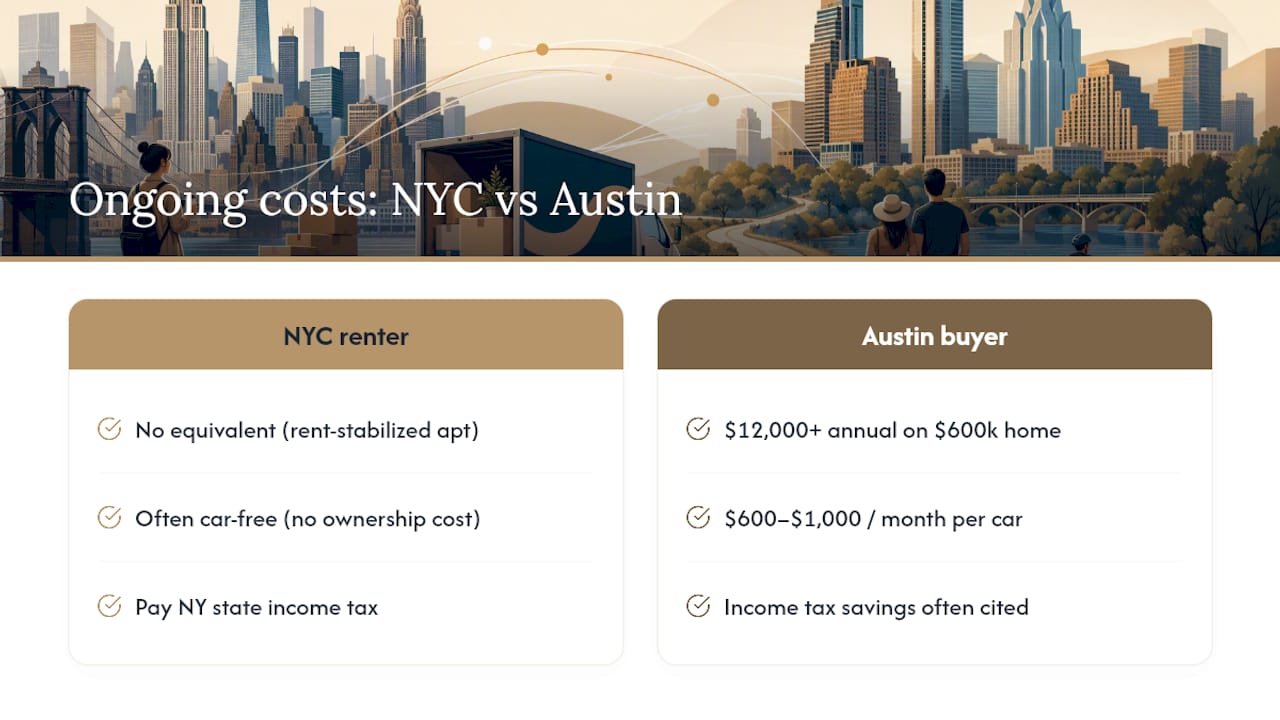
The second thing guides understate is the car cost. New Yorkers who have not owned a vehicle in a decade are genuinely surprised by the total: purchase, insurance, registration, gas, and maintenance add up to $600–$1,000 per month for a single car. That is real money that belongs in any honest cost-of-living comparison.
What actually matters most, in order: (1) nail the neighborhood choice before you sign anything, because Austin’s neighborhoods are not interchangeable and a wrong pick means a second move within 18 months; (2) get your Texas domicile paperwork right in year one, because New York will audit you if you earn above a certain threshold; (3) treat the car budget as a fixed cost from day one, not an afterthought.
The move is worth it for most New Yorkers who do the math honestly. The ones who struggle are those who underestimate the car, overestimate the tax savings without accounting for property taxes, and pick a neighborhood based on a weekend visit rather than a real commute test.
Mogavero Group knows Austin’s market from the inside
Relocating buyers who work with Mogavero Group skip the learning curve that costs most out-of-state buyers time and money. Mike Mogavero and the team bring over 20 years of Austin market experience, access to off-market and private listings that never appear on public portals, and the kind of school-zone and neighborhood intel that only comes from being on the ground every day.

For New Yorkers moving with significant equity or looking at the luxury end of the Austin market, the difference between a good agent and the right agent shows up at the negotiating table and in the properties you even get to see. Mogavero Group’s private listing access means you are not competing for the same inventory as every other buyer on Zillow. Browse current Austin luxury properties or reach out directly to schedule a consultation and get a personalized neighborhood shortlist built around your priorities.
Sources
- Location Matters: Texas — Tax Foundation
- Climate Summary — Austin (NOAA / NWS San Antonio / EWX office)
- Austin Population (World Population Review)
- Barton Springs Pool — City of Austin
FAQ
Is $100,000 a good salary in Austin?
Yes, for most households. With no Texas state income tax, $100,000 in Austin nets significantly more than the same gross salary in New York City, and median rents in Austin run well below Manhattan levels.
What salary do you need to live comfortably in Austin?
A single person can live comfortably on $65,000–$80,000 annually in Austin; a family of four typically needs $110,000–$140,000 to cover rent or a mortgage, a car, childcare, and standard expenses without financial stress.
Is it cheaper to live in Texas or New York?
Texas is substantially cheaper for most households. The combination of lower rents, no state income tax, and lower overall cost of living makes Austin considerably more affordable than New York City, though property taxes and car costs narrow the gap for buyers.
Why are some people leaving Austin?
Rising property taxes, summer heat, and traffic congestion are the most common reasons long-term Austin residents cite for leaving. Home prices have also risen sharply over the past several years, pushing some buyers to smaller surrounding cities like Georgetown or Buda.
How long does a move from New York to Austin take to plan?
Eight to twelve weeks is a realistic planning window. Book movers at least 4–6 weeks out for a fall or winter move, and 8 weeks minimum for a summer move when demand and prices peak on the NYC→Austin corridor.
Recommended
- How to choose Austin neighborhoods for your lifestyle | Mogavero Group Austin Real Estate
- Why Move to Austin: Upscale Living and Investment | Mogavero Group Austin Real Estate
- Lake Austin Relocation Guide: Luxury Real Estate 2026 | Mogavero Group Austin Real Estate
- Advantages of Living in Austin: Lifestyle & Housing 2026 | Mogavero Group Austin Real Estate