Texas Option Period: Your Timeline, Fees, and Rights Guide
Discover the ins and outs of the Texas option period, ensuring you understand your rights, key deadlines, and how to protect your investment.
Texas Option Period: Your Timeline, Fees, and Rights Guide

The option period in Texas gives you an unrestricted right to walk away from a home purchase for any reason, as long as you follow three rules exactly. The window starts on the Effective Date, which counts as Day 0, and every day after that counts as a calendar day, including weekends and holidays. Your option fee has to reach the title company’s escrow account within three days of the Effective Date, and if you want out, your termination notice has to arrive by 5:00 p.m. local time on the last day of the period.
Miss any one of those three, and you lose leverage you didn’t know you were spending.
Here’s what matters most, distilled:
- Definition: A negotiated number of days during which you can terminate the contract for any reason, no explanation required.
- Day counting: Effective Date = Day 0; every subsequent day counts, including weekends.
- Deadline: Termination notice is due by 5:00 p.m. local time (the property’s time zone) on the final day.
- Fee delivery: The option fee must reach escrow within three days of the Effective Date.
- Fee status: The option fee is nonrefundable but credited toward the purchase price at closing if you proceed.
Pro Tip: Call the title company the day after you sign to confirm they have wiring instructions ready and know your option fee is coming. Don’t wait for a confirmation email that might not arrive until after your deadline has passed.
Key Takeaways
The Texas option period gives buyers an unrestricted right to terminate, but only if the option fee reaches escrow within three days and termination notice arrives by 5:00 p.m. local time on the final day.
| Point | Details |
|---|---|
| Effective Date starts the clock | Effective Date counts as Day 0; every day after, including weekends, counts toward your total. |
| Option fee delivery is strict | The fee must reach the title company’s escrow account within three days of the Effective Date. |
| Deadline is absolute | Termination notice is due by 5:00 p.m. local (property location) time on the last day, no exceptions. |
| Fee ranges and typical lengths | Most option periods run 5 to 10 days with fees between $100 and $500, negotiable by market. |
| Broker coordination reduces risk | Mogavero Group sequences inspections, escrow confirmations, and repair negotiations to protect your deadlines. |
Table of Contents
- What Is the Texas Option Period and How Does the Timeline Work?
- Option Fee vs. Earnest Money: Who Keeps What
- What to Do During the Option Period Before Time Runs Out
- Extensions, Amendments, and the 3-Day Trap
- How Long Should Your Option Period Be, and What Should You Pay?
- A Broker’s View on Managing Tight Option Windows
- Your Day-by-Day Option Period Checklist
- What Sellers Can and Can’t Do During the Option Period
- Common Option Period Disputes and How They Get Resolved
- How the Option Period Shapes Your Closing Timeline
- How the Option Period Shifts Negotiating Power
- What the Option Period Really Protects, and What It Doesn’t
- How Mogavero Group Helps You Navigate Your Option Period
- Sources
- FAQ
What Is the Texas Option Period and How Does the Timeline Work?
The option period exists because Texas contracts don’t automatically let buyers back out after signing. Paragraph 5 of the TREC One to Four Family Residential Resale Contract creates that right by treating your option fee as consideration, a small payment that buys you the freedom to terminate for any reason during the agreed window. Without it, you’re locked in except for a handful of contract contingencies.
Day counting trips up more buyers than any other part of this process. The Effective Date counts as Day 0, not Day 1, and every day after that, including Saturdays, Sundays, and holidays, counts toward your total. Say your contract is fully executed on a Monday, and you negotiated a 10-day option period. Monday is Day 0. Your option period runs through the following Thursday, and your termination notice is due by 5:00 p.m. that Thursday, not the following Monday, even if Thursday falls on a holiday.
“Local time” means the time zone where the property sits, not wherever you happen to be sitting when you send the notice. If you’re relocating from California and forget the two-hour difference, you could think you have until 5:00 p.m. Pacific when the contract actually cuts you off at 3:00 p.m. your time.
Three things have to happen inside strict windows:
- Deliver the option fee to the title company’s escrow account within three days of the Effective Date.
- Complete your inspections and due diligence before the final day of the option period, not on it.
- Deliver termination notice, if you’re walking away, by 5:00 p.m. local time on the last day.
Title companies follow good-funds rules before disbursing any money, which means a check that bounces or a wire that arrives late can undo your delivery even if you technically sent it on time. If the option fee never arrives within that three-day window, you technically remain under contract, but you no longer have the unrestricted right to terminate. You haven’t been let off the hook. You’ve just lost your easiest way off it.
Option Fee vs. Earnest Money: Who Keeps What
The option fee and earnest money look similar on a closing statement, but they serve entirely different purposes and get treated differently if the deal falls apart. The option fee, typically $100 to $500, pays for your right to terminate during the option period. Earnest money, usually a larger amount, signals you’re serious about the purchase and gets held by the title company as a good-faith deposit.
Here’s the financial split that matters:
- If you terminate during the option period: the seller keeps your option fee, but you get your earnest money back in full.
- If you close on the home: both the option fee and earnest money get credited toward your purchase price.
- If you terminate after the option period expires: you’ll likely forfeit earnest money too, unless another contingency in the contract protects you.
Combined payments create a common point of confusion. When buyers write one check covering both the option fee and earnest money, the title company applies funds to the option fee first, then earnest money. Underestimate the total and write a check that’s short by even a few dollars, and you risk the option fee portion falling short of the three-day delivery requirement.
Pro Tip skip — instead, a practical fix: write two separate checks, one for the option fee and one for earnest money, and hand-deliver or overnight both directly to the title company rather than mailing them. A short check discovered on Day 4 is a problem you can no longer fix.
What to Do During the Option Period Before Time Runs Out
Every day of your option period should have a job attached to it. The single biggest reason buyers lose their termination rights isn’t a legal technicality. It’s a scheduling failure, waiting too long to book inspectors who are already booked solid for the next two weeks.
Work through inspections in this order:
- General home inspection, booked the same day you sign. This is your foundation for everything else and typically takes 2 to 4 hours on-site.
- Specialty inspections, scheduled immediately once the general inspector flags a concern, whether that’s foundation movement, roof age, or an aging HVAC system.
- Septic or well inspections, if the property isn’t on municipal utilities. These often require a separate licensed inspector and longer lead times.
- Environmental checks, when relevant, such as radon or well-water testing in areas known for contamination.
- Contractor estimates, if the general inspection turns up repair items you’d want quantified before deciding whether to negotiate or walk.
Don’t schedule your inspection for the final day of your option period. Book it within 48 hours of the Effective Date, so you have buffer time if the report reveals something that needs a second opinion or a specialist follow-up. Working with a reliable inspection service in Austin that can turn around a written report within 24 hours of the site visit protects that buffer.
Once reports are in hand, you’ve got three paths: accept the property as-is, request repairs or a price credit through a formal amendment, or terminate. If you’re leaning toward negotiating repairs or credits, put the request in writing well before your deadline, since sellers need time to respond and you need time to react to their answer.
Pro Tip: Photograph and date-stamp everything during your inspection walkthrough, even the seemingly minor stuff. If negotiations get contentious later, timestamped photos are worth more than your memory of what the inspector said.

If you decide to terminate, TREC’s Notice of Buyer’s Termination of Contract form is the standard vehicle, and it needs to reach the seller or the seller’s agent, not just get drafted, before your 5:00 p.m. cutoff.
Extensions, Amendments, and the 3-Day Trap
Wanting more time doesn’t get you more time. If your inspector needs another week, or a contractor estimate is delayed, you can’t just ask verbally and assume you’re covered. Extending the option period requires a written amendment signed by both buyer and seller, and Texas practice typically expects an additional option fee as consideration for the extension. Leave that fee blank or list it as zero, and you risk the entire amendment being unenforceable, which means you never actually got the extra days you thought you negotiated.
The “3-day trap” catches buyers in a few predictable ways:
- Confusing calendar days with business days. The three-day option fee delivery window includes weekends. A contract signed Friday afternoon has its option fee due by Monday, not the following Wednesday.
- Relying on delivery methods that don’t confirm receipt. A check mailed on Day 1 that arrives on Day 5 is a late delivery, full stop, regardless of when you dropped it in the mailbox.
- Assuming holidays extend deadlines. They generally don’t, since the contract counts calendar days, and unless the contract explicitly says otherwise, Thanksgiving weekend doesn’t buy you extra time.
- Treating email as guaranteed delivery. An email sent at 4:58 p.m. that the seller’s agent doesn’t open until the next morning can create a dispute over whether notice was timely.
Paragraph 5’s “time is of the essence” language isn’t decorative legal boilerplate. It means deadlines are treated as absolute, not approximate, and courts and title companies generally won’t extend grace for a buyer who assumed close enough was good enough.
Pro Tip: Set your termination or amendment deadline reminder for 2:00 p.m., not 5:00 p.m. That three-hour cushion is the difference between calmly delivering notice and scrambling to find a fax machine at 4:52 p.m.
How Long Should Your Option Period Be, and What Should You Pay?
Most Texas contracts land somewhere between 5 and 10 days for the option period, with older homes, homes with known issues, or rural properties needing septic and well inspections often justifying a request closer to 10 or even 14 days. A newer home in a well-documented subdivision might reasonably get by on 5 to 7 days if your inspector can turn around fast.
Fee ranges follow a similar pattern:
- Typical range: $100 to $500, though this is fully negotiable between buyer and seller.
- Hot markets: Sellers in competitive neighborhoods often expect fees at the higher end, sometimes beyond $500, as a signal of buyer seriousness.
- Waived or shortened periods: In multiple-offer situations, some buyers shorten the option period to 3 days or waive it entirely to compete, but that trade-off means giving up your safety net entirely if something’s structurally wrong with the house.
Buyers who feel pressure to shorten their window can offset some risk with tactical moves: scheduling a pre-inspection before writing the offer, lining up an inspector on standby who can be on-site within 24 hours of acceptance, or keeping a backup property in mind if the numbers on this one don’t work out after a short review.
A Broker’s View on Managing Tight Option Windows
Coordinating a 5 or 7-day option period is a logistics exercise as much as a legal one. An experienced agent typically starts working the phone before the ink dries, confirming with the title company that escrow account details are ready and calling inspectors to lock a slot within the first 24 to 48 hours rather than waiting for the buyer to ask.
- Sequence, don’t stack. Book the general inspection first, then line up specialists (foundation, roof, HVAC) to follow within a day or two based on what the general inspector flags.
- Confirm receipt, don’t assume it. A wire initiated on Day 2 isn’t the same as a wire the title company has actually posted. Good agents call escrow directly to verify funds landed, rather than trusting a transaction log.
- Know your three exits. Repair requests work best for fixable, moderate-cost items. Price credits make sense when the seller won’t do the work but will adjust the number. Termination is the right call when the inspection reveals something structural or expensive enough to change your entire calculation.
Buyers who treat the option period as a formality, rather than the single most protective clause in their contract, are the ones who end up either forfeiting a fee they didn’t need to lose or closing on a house they didn’t fully vet. The fix isn’t more paperwork. It’s better sequencing from Day 0 forward.
Mike Mogavero has spent over two decades navigating Austin’s real estate market, and Mogavero Group’s approach leans heavily on this kind of proactive coordination for buyers pursuing off-market and pre-construction properties, where inspection logistics can be even more complex than a standard resale.
Your Day-by-Day Option Period Checklist
A tight option period rewards buyers who move fast on Day 0 and never leave anything for the final 24 hours. Here’s a workable sequence:
- Day 0 (Effective Date): Confirm the Effective Date in writing with your agent. Contact the title company to get wiring instructions or check-delivery details for the option fee.
- Day 1: Deliver or wire the option fee. Book your general home inspection for the earliest available slot, ideally within the next 2 to 3 days.
- Day 2 or 3: Confirm the title company has received and posted your option fee. This is your legal deadline for delivery, so treat confirmation as non-negotiable.
- Days 3 through 5: Complete the general inspection. Book any specialty inspectors the report flags as needed, and request contractor estimates for anything expensive.
- Days 5 through 8 (or your final 2 days): Review all reports. Decide whether to accept the property, submit a repair request or amendment, or prepare a termination notice.
- Final day: Deliver your decision, whether that’s a signed amendment or a Notice of Buyer’s Termination of Contract, to the seller’s agent before 5:00 p.m. local time.
If an inspection runs late or a contractor can’t get you an estimate in time, don’t wait until the last day to react. Request a written amendment extending the option period, with an additional option fee attached, as soon as you know you’ll need more time, not after your original deadline has already passed.
| Day | Task |
|---|---|
| Day 0 | Confirm Effective Date; contact title company for escrow instructions |
| Day 1 | Deliver option fee; book general inspection |
| Day 2–3 | Confirm title company has posted the option fee |
| Day 3–5 | Complete inspections; gather contractor estimates |
| Final day | Deliver termination notice or signed amendment by 5:00 p.m. |
For a broader view of how this fits into the full purchase timeline, Mogavero Group’s home buying process guide walks through what happens before and after the option period closes out.
What Sellers Can and Can’t Do During the Option Period
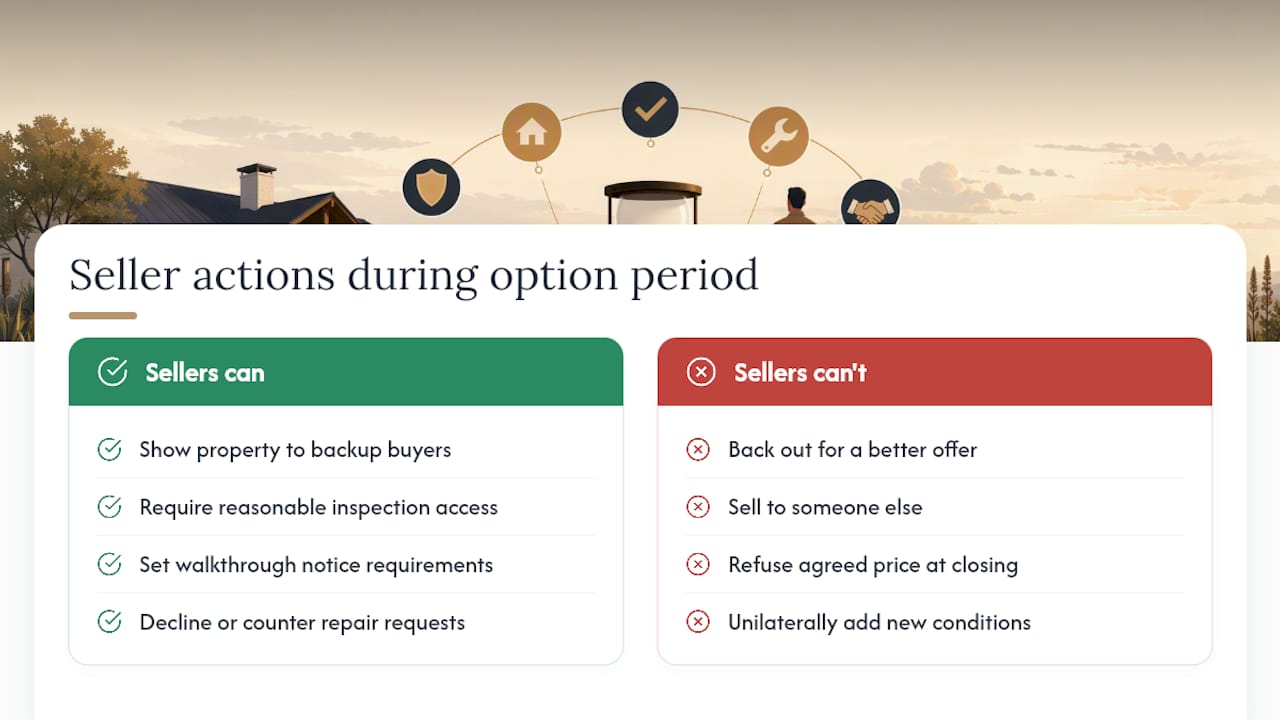
Sellers aren’t passive during your option period, but their leverage is limited by design. Once the contract is signed, a seller generally can’t back out just because a better offer comes along, sell to someone else, or refuse to honor the agreed price if you decide to close. The contract binds them the moment it’s executed, even though it doesn’t bind you the same way until the option period ends.
Sellers do retain a few practical rights. They can continue showing the property to backup buyers, since a pending contract with an active option period doesn’t guarantee a closing. They can also require you to allow reasonable access for the inspections you’re scheduling, and most contracts specify how much notice you owe them before a walkthrough. If you request repairs, the seller has the right to decline, counter with a price credit instead, or offer to fix only some of the items you flagged.
Where sellers run into trouble is when they interfere with access, ignore a legitimate repair or amendment request without responding, or attempt to add new conditions not in the original contract. None of that is enforceable unilaterally. If a seller stonewalls your inspector’s access during the option period, that delay works in your favor procedurally, since it’s the seller’s failure to cooperate, not yours, that pushed your timeline.
Common Option Period Disputes and How They Get Resolved
Most option period disputes trace back to timing, not substance. A buyer claims they delivered a termination notice by 5:00 p.m.; the seller’s agent says it arrived at 5:04 p.m. A title company shows the option fee posted on Day 4 instead of Day 3. These disagreements often hinge on delivery method and documentation, which is exactly why experienced agents push clients toward hand delivery, confirmed email receipts, or courier services with timestamps rather than a mailed check.
Disputes over repair requests are the second most common category. A buyer submits a list of 12 items after inspection; the seller agrees to fix three and rejects the rest. If negotiations stall, the buyer’s cleanest option is usually to terminate before the deadline rather than argue past it, since once the option period closes, that unrestricted right disappears and the buyer needs a different contractual basis to walk away.
When disputes escalate beyond agent-to-agent negotiation, they typically go to the title company first, since good-funds documentation and delivery timestamps often settle the factual question. Contracts that end up in real disagreement can move to mediation, which many Texas contracts require before litigation, or in rarer cases to the Texas Real Estate Commission if a licensed agent’s conduct is in question. Most disputes never reach that point, because clear written records from the option period, timestamps, delivery confirmations, inspection reports, resolve the disagreement before it becomes a legal fight.
How the Option Period Shapes Your Closing Timeline
Decisions made during the option period ripple through every date that follows. A termination on Day 8 of a 10-day period sends both parties back to square one, but a repair negotiation that drags to the final hour can compress your remaining timeline before closing, since financing, appraisal, and title work are often still running in parallel on their own clocks.
Lenders typically don’t pause their underwriting timeline just because you’re negotiating repairs during the option period. If your loan approval and your option deadline are converging around the same week, a late repair fight can force an uncomfortable choice: accept the seller’s counter quickly, or terminate and lose momentum you’d already built with your lender. Buyers who resolve inspection issues early, rather than waiting until the last 48 hours, protect the rest of their timeline instead of compressing everything into a stressful final stretch.
A clean, early resolution, whether that’s acceptance, a quick repair agreement, or a prompt termination, keeps your closing date intact and your lender’s clock running smoothly. A messy, last-minute negotiation can push closing dates, strain lender rate locks, and in worst cases unravel financing altogether if delays extend past a rate-lock expiration.
How the Option Period Shifts Negotiating Power
The option period is the one stretch of the transaction where a buyer holds real leverage, and smart sellers know it. Once you’re under contract with an active option period, a seller who wants certainty has an incentive to negotiate reasonably on repairs rather than risk losing the deal entirely over a few thousand dollars in fixes. That dynamic flips the moment your option period expires, when your unrestricted exit disappears and your negotiating position weakens considerably.
Sellers understand this timing too, which is why some resist granting long option periods in competitive markets. A 15-day option period gives a buyer more time to find something wrong and more leverage to use it, while a 5-day period limits how much a buyer can realistically uncover and negotiate. This is part of why buyers and sellers treat the option period length itself as a negotiating chip before the contract is even signed, not just a logistical detail settled after the fact.
What the Option Period Really Protects, and What It Doesn’t
Most advice on the option period treats it like a formality, a box to check between signing and closing. That undersells what’s actually happening. The option period is the only point in a Texas transaction where you can walk away for a bad feeling, a gut check, a number that doesn’t sit right, without justifying yourself to anyone.
Where conventional advice falls short is treating the option fee as a minor cost rather than what it actually is: the cheapest insurance policy in the entire transaction. Buyers fixate on inspection line items and forget that the real risk is a missed deadline, not a cracked foundation. A cracked foundation gets negotiated. A missed 5:00 p.m. cutoff gets you nothing.
If you take one thing from this, prioritize the calendar before the clipboard. Confirm your Effective Date, confirm your fee delivery, and only then start worrying about what the inspector finds. Buyers who reverse that order tend to lose the fight before it starts.
— Mike
How Mogavero Group Helps You Navigate Your Option Period
Coordinating inspections, confirming escrow receipts, and negotiating repairs inside a tight window is exactly the kind of logistics problem Mogavero Group handles daily for Austin buyers, particularly on off-market and pre-construction properties where standard timelines don’t always apply cleanly. Rather than leaving you to track down inspectors and chase title company confirmations solo, the team sequences your entire option period from Day 0 forward, so nothing slips past a deadline because of a scheduling gap.

That coordination extends to contractor referrals when inspection reports flag repair items, and to drafting the repair or price-credit conversation with the seller’s agent so you’re negotiating from information, not guesswork. If you’re actively searching, browse Mogavero Group’s current Austin listings or ask about private, off-market inventory not listed publicly. Reach out for a consultation, and the team will map out a realistic option-period timeline for your specific contract before you’re locked into deadlines you didn’t plan for.
Sources
- Option Period Basics | Texas Real Estate Research Center (PDF)
- TREC One to Four Family Residential Resale Contract (Form 20-17 / 20-18) — Paragraph 5
- Option Fee in Texas: Typical Cost + the 3-Day Trap (Creekstone)
FAQ
Is an Option Period Required in Texas?
No. The option period is negotiated between buyer and seller and isn’t legally mandatory, though most Texas contracts include one because it’s the buyer’s primary tool for due diligence before losing the right to walk away freely.
Can a Buyer Back Out After the Option Period in Texas?
Only under specific circumstances, such as a financing, appraisal, or title contingency written into the contract. Once the option period ends, the unrestricted right to terminate for any reason disappears.
What Time Does the Option Period End in Texas?
The option period ends at 5:00 p.m. local time, meaning the time zone where the property is located, on the final calendar day of the negotiated period.
What Happens During an Option Period?
Buyers typically schedule and complete inspections, review seller disclosures, gather contractor estimates for any repair concerns, and decide whether to close as-is, negotiate repairs or credits, or terminate the contract before the deadline.
What’s the Difference Between the Option Fee and Earnest Money?
The option fee pays for your unrestricted right to terminate and is nonrefundable if you walk away, while earnest money is a good-faith deposit that’s returned to you if you terminate within the option period.
Recommended
- Seattle to Austin: The Tax Case for Moving Has Never Been Stronger | Mogavero Group Austin Real Estate
- Austin Real Estate FAQs | Mogavero Group Austin Real Estate
- The Tax Advantages of Buying a Short-Term Rental in Austin Under the “Big Beautiful Bill” | Mogavero Group Austin Real Estate
- Master the Home Buying Process Workflow in Austin | Mogavero Group Austin Real Estate