How to File a Property Tax Protest in Austin
Want to lower your property taxes in Austin? Learn how to file a protest online or by mail and take control of your appraisal today!
How to File a Property Tax Protest in Austin

File your protest online at TCAD’s e-File portal or submit Form 50-132 by the usual protest deadline (May 15 or 30 days from the date on your Notice of Appraised Value, whichever is later). Those two steps, the right deadline and the right form, are what determine whether your Austin property tax appeal moves forward at all.
Here is what to do in the next 24–72 hours:
- Locate your Notice of Appraised Value (mailed by TCAD each spring). The protest deadline is printed on it.
- Find your property owner ID and PIN from the notice or your TCAD account.
- Log into the TCAD e-File portal or download Form 50-132 from the TCAD protests page.
- Upload or attach your initial evidence (even basic comps or photos work at this stage).
- Submit and save your confirmation number.
For in-person filing or help with your owner ID, contact TCAD directly: phone (512) 834-9317, office at 850 E. Anderson Lane, Austin, TX 78752. The Travis County Tax Office can also point you to the right resources if you are unsure where to start.
Key Takeaways
Filing via TCAD e-File before the May 15 deadline, with tight local comps from the same school attendance zone, gives Austin property owners the strongest foundation for a successful protest.
| Point | Details |
|---|---|
| File before May 15 | Use TCAD e-File or submit Form 50-132 by May 15 or 30 days from your notice date, whichever is later. |
| E-File is the best route | It provides immediate confirmation, lets you upload evidence, and allows you to accept settlement offers online. |
| Comps must match your school zone | TCAD weights school attendance zone heavily; use three to five closed sales from the same zone. |
| Most protests settle informally | Prepare your evidence for the informal conference first; the ARB hearing is a fallback, not the default. |
| Missing the ARB hearing ends your protest | A no-show results in dismissal; the four-day reopening window for good cause is rarely granted. |
Table of Contents
- How does a property tax protest work in Travis County?
- What are the filing deadlines and who can file?
- How to file your protest: e-File steps, Form 50-132, and contact info
- How informal TCAD conferences and settlement offers work
- What to expect at a formal ARB hearing
- What are your options after an ARB decision?
- When should you hire a lawyer, appraiser, or tax consultant?
- Mogaverogroup’s local perspective on Austin property values
- Sources
- FAQ
How does a property tax protest work in Travis County?
TCAD, the Travis Central Appraisal District, is responsible for listing every property in Travis County, estimating its value, and assisting property owners through the protest process. What you are actually disputing when you file is one of three values that appear on your notice.
Market value is TCAD’s estimate of what your property would sell for on the open market. Taxable value is what remains after exemptions, and it is the figure your tax bill is actually calculated from. Reducing market value is the most common protest goal, but homestead and other exemptions reduce taxable value separately and must be applied for on their own, typically by May 1.
The protest path has two tiers. First, an informal conference with a TCAD appraiser, where most disputes get resolved through a settlement offer. If you cannot reach agreement there, you proceed to a formal Appraisal Review Board (ARB) hearing, where an independent panel reviews the evidence and issues a binding order for that tax year.
Filing via e-File is faster and creates a digital record. Mailing Form 50-132 works too, but you lose the instant confirmation and the ability to track your status online.
What are the filing deadlines and who can file?
The usual protest filing deadline is May 15 or 30 days after the appraisal district mails the notice of appraised value, whichever is later. Miss that window and your protest is gone for the year, with very limited exceptions.
Who has standing to file:
- The property owner of record
- A lessee with a qualifying lease that makes the lessee responsible for taxes
- An authorized agent appointed via Form 50-162 (Appointment of Agent for Property Tax Matters)
Deadline exceptions worth knowing:
- Active-duty military personnel and certain offshore workers may qualify for late-filing relief under Texas law
- The ARB has discretion to accept a late protest for “good cause,” though this is rarely granted
- If TCAD mails a corrected or amended notice, a new 30-day window opens from that mailing date
Per Texas Comptroller guidance, the 30-day rule from the notice date is the one that most often extends the deadline past May 15 for owners who receive notices late in the season. Check the postmark date on your envelope and keep it.
How to file your protest: e-File steps, Form 50-132, and contact info
E-filing through TCAD is the recommended route. It gives you immediate confirmation, lets you upload evidence directly, view the district’s evidence packet, and accept settlement offers without a single phone call.
Step-by-step e-File workflow:
- Go to traviscad.org/efile and create or log into your account using your property owner ID and PIN from the notice.
- Select the property you want to protest and choose your reason (unequal appraisal, market value over actual value, or both).
- Upload your evidence files (PDFs of comps, photos, recent appraisals).
- Submit the protest and save the confirmation number that appears on screen.
- Log back in periodically to check for TCAD’s evidence packet and any settlement offer.
Using Form 50-132 instead: Download the form from the TCAD protests page, complete every field including the specific reason for protest, and mail or deliver it to 850 E. Anderson Lane, Austin, TX 78752. Include a copy of your notice and any supporting documents. If you are appointing someone else to represent you, attach a completed Form 50-162.
Pro Tip: If you mail Form 50-132, send it via USPS certified mail with return receipt. The postmark date is your legal filing date, and that green card is your proof if a deadline dispute ever arises.
For questions about your owner ID or PIN, call TCAD at (512) 834-9317 during business hours.
How informal TCAD conferences and settlement offers work
The informal conference is your first real shot at a property tax reduction in Austin, and it is where the majority of protests get resolved. A TCAD appraiser reviews the evidence you submitted, compares it against the district’s own data, and typically issues a settlement offer by phone or through the e-File portal.
These reviews are often conducted by telephone. The appraiser is not your adversary; they are working through a caseload and will settle quickly if your evidence is tight and local. What moves the needle at this stage:
- Closed comparable sales from the same school attendance zone, dated within the past 12 months. TCAD weights school zone heavily when evaluating comps, so a sale two miles away in a different zone carries far less weight than one three streets over in the same zone.
- Condition photos that document deferred maintenance, foundation issues, or anything that would reduce a buyer’s offer price.
- A recent independent appraisal if you have one, particularly for higher-value properties.
Vague market statements (“the market has softened”) do not move appraisers. Specific closed sales with addresses and price-per-square-foot figures do.
When TCAD sends a settlement offer, you have a limited window to accept or reject it through the e-File portal. Accepting locks in the reduced value for that tax year. Rejecting moves you to the formal ARB hearing. One thing owners often overlook: a settlement reduction in one year does not automatically carry forward. TCAD reappraises annually, so a win this year is not a permanent fix.

Pro Tip: Pull your comps from the same school attendance zone and sort them by price per square foot. Present three to five sales, not ten. A focused, tight packet is more persuasive than a thick stack of loosely related data.
What to expect at a formal ARB hearing
If the informal conference does not produce an acceptable offer, your protest moves to the Appraisal Review Board. The ARB is an independent panel, separate from TCAD, that hears evidence and issues a binding order for the current tax year.
TCAD must send you a hearing notice at least 15 days in advance, and the district’s evidence packet must arrive at least 14 days before your scheduled hearing. Review that packet carefully before you walk in.
The ARB’s authority is limited to the current tax year’s value. It cannot retroactively adjust prior years, waive penalties, or change exemption status. Know what you are asking for before you sit down.
Hearing checklist:
- Your hearing notice letter (bring the original)
- Five copies of your evidence packet (one for each ARB panel member, one for TCAD, one for yourself)
- Comparable sales sorted by school zone, with addresses and price-per-square-foot
- Condition photos, labeled and dated
- Any independent appraisal report
- Form 50-162 if an agent is representing you
Missing your hearing is costly. Per TCAD’s e-File guidance, a no-show results in dismissal of the protest. You then have a four-day window to write to the ARB chairperson requesting reopening for “good cause,” and that request is rarely granted. Set a calendar reminder the moment you receive the hearing notice.
What are your options after an ARB decision?
If the ARB order does not satisfy you, three appeal routes exist under Texas Comptroller rules. Each has its own deadline, cost, and threshold requirements.
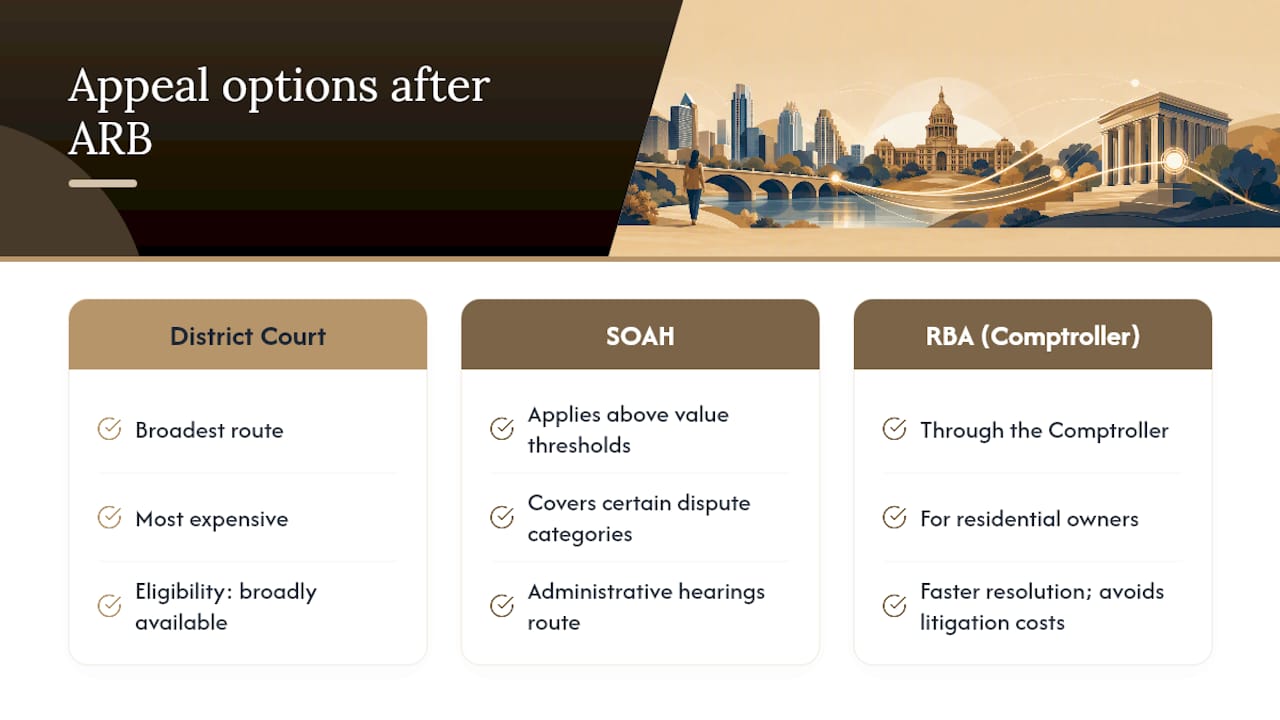
District court is the broadest route but also the most expensive. SOAH applies to properties above specified value thresholds and certain dispute categories. RBA through the Comptroller is worth considering for residential owners who want a faster resolution without full litigation costs. If the ARB order reduces your value and you already paid taxes, keep your payment records and follow up with the relevant taxing jurisdictions about a potential refund.
When should you hire a lawyer, appraiser, or tax consultant?
Most residential protests under $1 million in appraised value can be handled by the owner, especially with e-File and a solid set of comps. The calculus shifts when the dollar exposure or complexity rises.
Scenarios where professional help typically changes the outcome:
- Your appraised value jumped more than 20% in a single year and the informal offer does not close the gap
- The property is valued above $2 million and the tax savings from a successful protest exceed any professional fee
- You own commercial, industrial, or income-producing property where TCAD uses an income approach to value, which requires a credentialed appraiser to rebut effectively
- You are disputing an exemption denial, not just the value
- You are considering a SOAH appeal or district court petition, where legal representation is effectively required
Contingency-based tax consultants typically charge a percentage of the first year’s tax savings, with no upfront fee. Independent appraisers charge flat fees, often $300–$600 for a residential report, and their credentialed opinion carries more weight at a formal ARB hearing than a consultant’s comparable analysis. For high-dollar disputes or complex valuation methodologies, an independent appraiser or valuation expert usually improves outcomes more than a general consultant.
Before hiring anyone, ask: What is your success rate for properties like mine in Travis County? Do you attend ARB hearings in person? What do you charge if the protest produces no reduction?
Mogaverogroup’s local perspective on Austin property values
One thing worth saying plainly: a property tax protest is not just a paperwork exercise. It is a direct challenge to TCAD’s estimate of what your home is worth, and the strongest protests are grounded in real market evidence from your specific neighborhood.
That is where Mogaverogroup’s local knowledge becomes useful in a non-legal way. Mike Mogavero and the team have spent over 20 years tracking sales, values, and micro-market shifts across Austin neighborhoods. They know which school zones carry premium pricing, where values have softened, and how to read a comp the way an appraiser does. If you need help pulling recent closed sales, understanding how your neighborhood’s pricing trends compare to TCAD’s assessment, or finding an inspection resource to document condition issues, that is exactly the kind of support a local real estate team can provide.
For owners of higher-value properties, having a clear picture of what comparable homes are actually selling for, not just what TCAD thinks they are worth, can be the difference between a dismissed protest and a meaningful reduction. Mogaverogroup’s private listings and neighborhood data give clients a real-time view of the Austin luxury market that is hard to replicate with public MLS data alone.
If you want a conversation about your property’s value or need a referral to a credentialed appraiser in Travis County, reach out to the Mogaverogroup team directly.

Sources
- The Protest Process | Travis Central Appraisal District
- Appraisal protests and appeals | Texas Comptroller of Public Accounts
- Property tax, appraised value protests | Travis County Tax Office
Evidence packets and ARB hearing procedures are available through the TCAD protests page once your protest is filed. Log into your e-File account to view what the district plans to present at your hearing.
This article is general information, not a substitute for advice from a qualified financial advisor. Consult a qualified financial professional about your own circumstances before acting on anything here.
FAQ
What is the deadline to file a property tax protest in Austin?
The deadline is May 15 or 30 days from the date TCAD mails your Notice of Appraised Value, whichever is later. Check the postmark on your notice envelope to confirm your personal deadline.
Can I file a property tax protest online in Travis County?
Yes. The TCAD e-File portal lets you file, upload evidence, view TCAD’s evidence packet, and accept settlement offers entirely online, with immediate confirmation upon submission.
What evidence works best at an informal TCAD conference?
Three to five recent closed comparable sales from the same school attendance zone, condition photos, and a recent independent appraisal carry the most weight. Vague market claims without specific sales data rarely move appraisers.
What happens if I miss my ARB hearing?
Missing the hearing results in dismissal of your protest. You have four days to request reopening from the ARB chairperson by showing good cause, but per TCAD guidance, this is rarely granted.
What are my options if I disagree with the ARB’s decision?
You can appeal to district court within 60 days of the ARB order, pursue a SOAH appeal if your property meets the applicable thresholds, or file for Residential Binding Arbitration through the Texas Comptroller, also within 60 days.
Recommended
- Seattle to Austin: The Tax Case for Moving Has Never Been Stronger | Mogavero Group Austin Real Estate
- How to Price Austin Property for Maximum Seller Value | Mogavero Group Austin Real Estate
- 5702-1 Penick DR, Austin, TX 78741 | $1,964,999 | Mogavero Group
- The Tax Advantages of Buying a Short-Term Rental in Austin Under the “Big Beautiful Bill” | Mogavero Group Austin Real Estate