Can You Really Close on a House Remotely in Texas?
Discover how you can close on a house remotely in Texas. Learn about options, benefits, and what to check with your lender.
Can You Really Close on a House Remotely in Texas?

Yes, you can close on a house remotely in Texas, and state law has allowed it since 2018. Most purchases, sales, and rate-and-term refinances qualify for full remote online notarization (RON) or a hybrid signing. The one major exception: Section 50(a)(6) home-equity cash-out loans generally require in-person signing. Before you plan anything else, call your lender and confirm whether they accept electronic promissory notes. That answer, more than anything in state law, determines your closing experience.
TL;DR:
- Most Texas loan types, including purchases and refinances, qualify for full remote online notarization if the lender accepts electronic promissory notes.
- Section 50(a)(6) home-equity cash-out loans usually require in-person signing regardless of remote notarization laws.
- The main barrier to fully remote closings is lender policy on eNote acceptance, not state law or technology limitations.
- Preparing your device, verifying wire instructions, reviewing key documents, and testing technology beforehand can prevent delays.
- Remote closing sessions typically last 15 to 45 minutes, but in-person or hybrid steps may extend the overall process.
Table of Contents
- Remote Closing Texas Options: Full RON, Hybrid, and In-Person
- Does Texas Law Allow Remote Notarization for Home Sales?
- Who Handles What in a Texas Remote Closing?
- What Do You Need to Prepare for a RON Session?
- How Long Does a Remote Closing in Texas Actually Take?
- What Goes Wrong in a Remote Closing (and How to Fix It)
- How Mogavero Group Coordinates Remote Closings for Out-of-State Clients
- Key Resources for Verifying Texas Closing Rules
- The Real Bottleneck Isn’t the Law. It’s the Lender.
- Ready to Buy or Sell in Austin Without the Logistics Headache?
- Sources
- FAQ
Remote Closing Texas Options: Full RON, Hybrid, and In-Person
Not every remote closing looks the same. Texas gives you three real paths, and which one you land on usually depends on your lender and loan type more than your own preference.
Full RON (Remote Online Notarization) lets you sign everything, including the deed and note, from your laptop through a live audiovisual session with a commissioned online notary. The notary verifies your identity through a government photo ID and knowledge-based authentication (KBA) questions pulled from public and credit records, then applies an electronic seal once you e-sign. The entire session gets recorded, which protects both you and the notary if anything is ever disputed.
Hybrid closings split the difference. You sign most disclosures and lower-stakes documents electronically ahead of time, but the promissory note (and sometimes the deed of trust) still needs a wet-ink signature, often in front of a traditional notary. This happens when a lender’s investor or secondary-market buyer won’t accept an eNote, even though Texas law would otherwise allow it.
In-person e-notarization covers situations where you’re physically present with the notary, but the documents themselves are handled electronically. A mobile notary fills this role for sellers or buyers who can’t manage a video session, don’t have reliable internet, or fall into a loan category that requires in-person signing.
Here’s how transaction types typically sort out:
- Standard purchases — usually eligible for full RON if the lender participates.
- Rate-and-term refinances — frequently RON-eligible, though timing rules differ from purchases.
- Investment property purchases — often flexible, since investor guidelines vary less on eNotes.
- Section 50(a)(6) home-equity cash-out loans — generally excluded from RON and require in-person signing.
A title company experienced in digital closings will usually flag which category your deal falls into before you ever schedule an appointment.
Does Texas Law Allow Remote Notarization for Home Sales?
Texas was one of the earlier states to legalize remote online notarization, and the law covers most real estate transactions without much friction. That’s the baseline. The complications start once you layer lender policy and loan-specific rules on top of it.
The clearest statutory exception involves home-equity loans under Section 50(a)(6) of the Texas Constitution, the rule governing cash-out refinances secured by a homestead. These loans typically require in-person signing, regardless of how comfortable your lender is with RON elsewhere in their portfolio. If you’re pulling cash out of your home equity, assume you’ll need to show up somewhere in person and plan your schedule accordingly.
Beyond that carve-out, the real gatekeeper is rarely the state. It’s the lender.
Lender policy, not state law, is usually what limits your options. Even when Texas permits full RON, a lender’s internal policy on accepting electronic promissory notes (eNotes) often forces a hybrid closing instead. Some lenders sell loans to secondary-market investors who won’t purchase a loan closed with an eNote, so the lender simply won’t offer one.
FHA and VA loans generally defer to state notarization law, meaning Texas’s RON framework applies. But individual lenders originating those loans can still add their own restrictions on top. A few practical patterns show up again and again:
- Large national banks are often slower to adopt full RON than regional lenders or credit unions.
- Portfolio lenders (those who keep loans rather than sell them) tend to have more flexibility.
- Government-backed loans (FHA, VA) follow state law but inherit lender-specific overlays.
Ask your loan officer directly: “Does your investor accept an eNote for this loan type?” That single question saves more headaches than anything else in the process.
Who Handles What in a Texas Remote Closing?
A remote closing involves more moving parts than a traditional one, mostly because responsibilities that used to happen in one room now happen across several systems. Knowing who owns which piece keeps you from chasing the wrong person when something needs confirming.
- The title company builds and manages the document packet, coordinates the platform used for signing, and handles recording with the county clerk once everything is executed. Title companies with real RON experience tend to catch formatting or sequencing problems before they become delays.
- The lender decides which documents can be signed electronically and whether an eNote is acceptable. They also control when funds get released, so any last-minute change on their end can ripple through your entire timeline.
- The RON notary verifies your identity through ID scanning and KBA, hosts the live audiovisual session, applies the electronic notary seal, and ensures the recording is properly stored per state requirements.
- You, the buyer or seller, need to have your ID ready, confirm wiring instructions independently, review the Closing Disclosure before the session, and show up on time for the video appointment (yes, being late to a remote closing still delays everything).
Modern e-closing platforms are built so you literally cannot skip a required field or signature line, which is one reason missing-signature problems have dropped compared to paper closings. If you’re unsure who to call about a specific question, the title company’s closer is usually your best single point of contact, since they interact with the lender, the notary platform, and you throughout the process.
What Do You Need to Prepare for a RON Session?
Most remote closing delays trace back to something that could have been fixed the day before. A little preparation eliminates most of the risk.
Device and connection. Use a laptop or desktop with a working webcam rather than a phone or tablet. A wired ethernet connection beats Wi-Fi if you have the option, since a dropped connection mid-session can force a restart. Platforms commonly recommend Microsoft Edge or Chrome for the smoothest experience.
Identification and identity proofing. You’ll need a valid, unexpired government-issued photo ID. The KBA questions can trip people up if you’ve moved recently, have a thin credit history, or share a name with a relative, since the questions pull from public and credit-header data. If you suspect this might be an issue, flag it with your title company ahead of time rather than discovering it mid-session.
Documents to review beforehand. Don’t wait until the live session to read these for the first time:
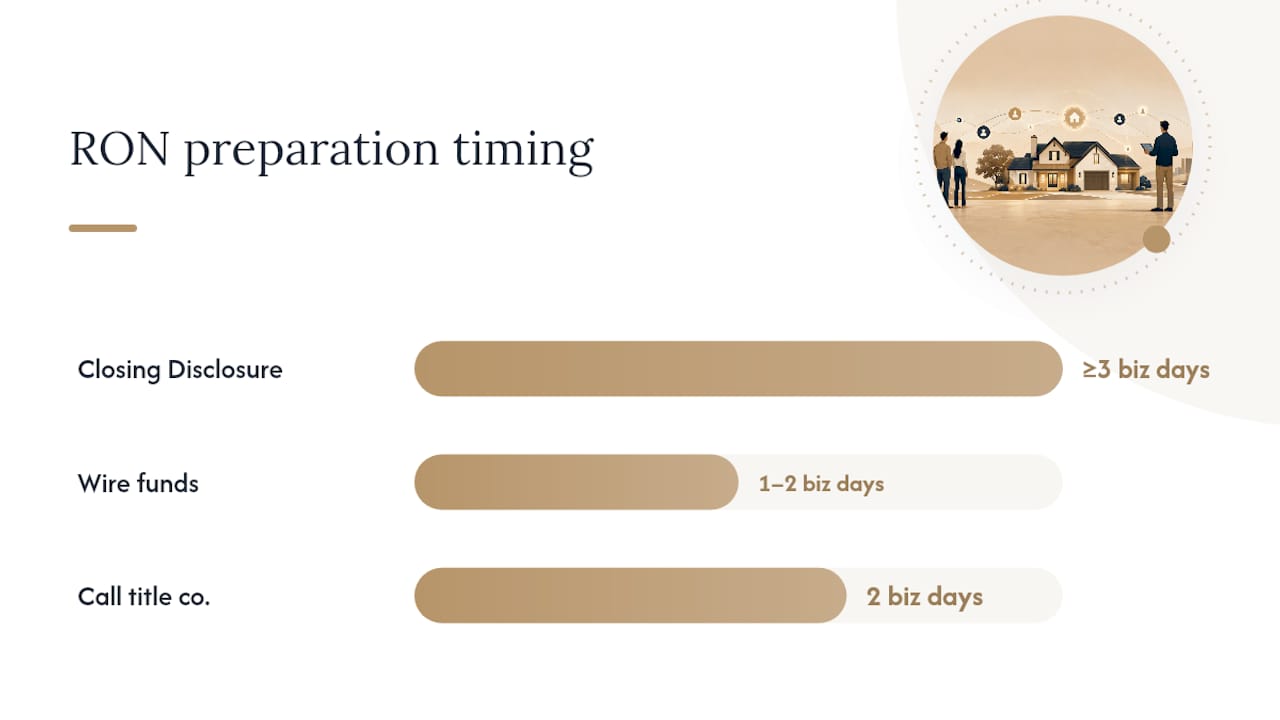
- Closing Disclosure (federal rules require you receive this at least three business days before closing)
- Title commitment and any exceptions listed
- Proof of homeowner’s insurance
- Wire instructions for any funds you’re sending
Wire timing and verification. Funds typically need to be sent one to two business days before closing to clear in time. Always verify wiring instructions by calling the title company at a number you look up independently, never one provided only in an email.
Pro Tip: Call your title company two business days before your session and ask them to walk through the document list with you line by line. Catching a wrong name spelling or an outdated address before the live session takes five minutes; catching it during the session can cost you the whole appointment.
How Long Does a Remote Closing in Texas Actually Take?
A full RON signing session usually runs 15 to 45 minutes once everything is properly prepared. Hybrid closings take longer, since they combine the video session with a separate in-person signing for the note, sometimes adding another 20 to 30 minutes plus travel or mobile notary scheduling.
Signing isn’t the same as closing, though. Your deed transfers upon acceptance of a properly signed and delivered document, but the transaction becomes public record only once the county clerk records it. Recording turnaround varies significantly by county, from same-day in smaller counties to a few business days in high-volume urban counties like Travis or Harris.
Expect a few fee lines you might not have seen on a traditional closing statement:
- RON or e-closing platform fees, typically charged by the title company for the technology and notary session.
- Notary fees, which can run higher for RON given the identity verification requirements.
- Mobile notary travel fees, if part of your closing requires an in-person signature.
Ask your title company to itemize these separately on your closing statement rather than folding them into a generic “closing fee.” It’s a fair question, and any experienced closer will answer it without hesitation.
What Goes Wrong in a Remote Closing (and How to Fix It)
Most remote closing problems are predictable, which means they’re also preventable if you know what to watch for.
- The lender doesn’t accept eNotes. This is the single most common surprise. If your lender’s investor won’t purchase eNote-closed loans, you’re getting a hybrid closing whether you planned for one or not. Confirm this early, not the week of closing.
- Technical failures during the session. A frozen webcam or a lost connection can force a restart of the entire signing. Run a test session with your title company beforehand, and keep a backup device charged and ready.
- Wire fraud attempts. Scammers target real estate closings specifically because large wire transfers happen on tight deadlines. Never trust wiring instructions received only by email. Call your title company at a verified number and confirm every digit before you send funds.
- Failed identity verification. If KBA questions fail because of a recent move or thin credit file, ask your title company about alternative credential analysis or schedule an in-person notarization as a backup rather than scrambling the day of closing.
Pro Tip: Ask your closer, by name, how many RON closings they’ve personally handled. A closer who’s run dozens of these sessions spots problems before they derail your appointment; one who’s done two or three might be learning on your transaction.
How Mogavero Group Coordinates Remote Closings for Out-of-State Clients
Mike Mogavero has spent more than 20 years navigating Austin’s real estate market, including a growing share of clients who are buying or selling from another state, or another country, entirely. Two recent examples show the range: a relocating executive who closed on a Lake Austin property without setting foot in Texas until move-in day, and an investor who completed a pre-construction purchase entirely through hybrid signing while overseas.

The practical work happens well before the closing date. That means confirming the lender’s eNote policy and the title company’s RON readiness in the same phone call, scheduling a test session so nobody discovers a webcam problem live, and personally verifying wire instructions with the title company before a dollar moves. For clients who need an in-person signature on a home-equity document, Mogavero Group arranges the mobile notary and handles the logistics so it doesn’t become the client’s problem to solve.
Discretion matters just as much as logistics for high-net-worth buyers who don’t want a transaction showing up in casual conversation. Mogavero Group treats privacy as part of the service, not an afterthought, from how documents are shared to how showings are scheduled.
- Pre-confirms lender and title RON eligibility before you’re locked into a contract
- Schedules test sessions to catch tech problems in advance
- Personally verifies wire instructions with the title company
- Coordinates mobile notary logistics for any required in-person signing
- Handles communication discreetly for clients who value privacy
Key Resources for Verifying Texas Closing Rules
Before you finalize anything, it’s worth checking a few primary sources yourself rather than relying solely on what your lender or agent tells you.
- eClosing’s Texas RON overview explains the state’s legal framework and adoption timeline.
- Old Republic Title’s digital closing page details identity-proofing and session recording standards.
- The National Notary Association covers remote notary requirements and identity verification practices nationally.
- Texas American Title’s VirtualClose page shows how one Texas title company implements eClosings in practice.
Your lender and title company remain the best source for how these rules apply to your specific loan.
The Real Bottleneck Isn’t the Law. It’s the Lender.
Most articles on remote closing treat Texas law as the main obstacle, when it’s usually the least of your problems. Texas cleared the legal path for RON back in 2018. What actually determines your experience is whether your specific lender, and more precisely, their secondary-market investor, will accept an electronic promissory note. That’s a business decision, not a legal one, and it varies wildly even between two lenders offering the same loan product.
The overlooked variable is your closer’s experience, not your notary’s technology. A title company that’s run dozens of RON closings will catch a KBA problem or a lender eNote restriction before it becomes a crisis. One that’s still figuring out the platform will let you find out the hard way, usually a day before your appointment.
If you take one thing from this: ask about eNote acceptance before you fall in love with a closing date. Everything else, the browser you use, the fees on your statement, the length of your video session, is a logistics problem. That one question is the actual gate.
— Mike
Ready to Buy or Sell in Austin Without the Logistics Headache?
Coordinating a remote closing yourself means juggling your lender, your title company, and a notary platform on top of everything else involved in buying or selling a home. Mogavero Group handles that coordination as part of representing you, confirming eNote acceptance, scheduling test sessions, and verifying wire instructions before you ever sit down for your signing appointment.

That matters most for out-of-state buyers and sellers who can’t easily fly in to fix a problem that surfaces two days before closing. Whether you’re eyeing a home in Lake Austin or exploring off-market listings not available to the general public, Mogavero Group manages the closing logistics alongside the search itself. Browse current available properties and reach out to start a conversation about your timeline, your lender, and what a remote or hybrid closing would look like for your specific transaction.
This article is general information, not a substitute for advice from a qualified lawyer. Consult a qualified legal professional about your own circumstances before acting on anything here.
Sources
- Can You Close on a House Remotely in Texas? What to Know - LegalClarity
- eClosing — eClosing in Texas
- Digital Closing | Old Republic Title
- VirtualClose | Texas American Title Company
- National Notary Association — How to become a remote online notary
FAQ
Can I close on a house remotely in Texas?
Yes. Texas has permitted remote online notarization since 2018, and most purchases and refinances qualify for full RON or a hybrid closing. Section 50(a)(6) home-equity cash-out loans are the main exception and generally require in-person signing.
Is remote closing legal in Texas?
Remote closing is legal under Texas law for most real estate transactions, though your lender’s policy on accepting electronic promissory notes often determines whether you get a fully remote or hybrid experience.
Can a real estate closing be done entirely online?
For many transaction types, yes, through full RON, where you sign the deed and other documents in a recorded, live audiovisual session with an online notary. Some loans still require at least one document signed in person, depending on lender and investor requirements.
How long does a remote closing take?
The signing session itself typically runs 15 to 45 minutes for full RON, with hybrid closings taking longer due to the added in-person signing step. Actual property transfer and public recording can take additional time depending on your county’s processing speed.
Does Mogavero Group help coordinate remote closings?
Yes. Mogavero Group confirms lender eNote acceptance and title company RON readiness early, schedules test sessions, and verifies wire instructions directly with the title company for buyers and sellers, particularly those closing from out of state.
Recommended
- Austin Real Estate FAQs | Mogavero Group Austin Real Estate
- Master the Home Buying Process Workflow in Austin | Mogavero Group Austin Real Estate
- Negotiating in Real Estate – Maximizing Value in Austin | Mogavero Group Austin Real Estate
- Private Luxury Listings Austin | Mogavero Group Off-Market Homes