Austin Private Listings Playbook for Texas Non Disclosure Real Estate
Austin playbook for high net worth buyers and sellers navigating Texas non disclosure real estate. Learn broker verification checks, legal musts, and when...
Austin Private Listings Playbook for Texas Non Disclosure Real Estate

In Austin’s luxury segment, “Texas non disclosure real estate” refers to off-market and private listings, homes sold quietly through broker networks rather than public MLS exposure. If you’re a seller who values discretion or a buyer chasing inventory that never hits Zillow, the move is the same: retain a broker with verified private dealflow before you do anything else.
TL;DR:
- Off-market homes in Austin typically fetch around 1.7% higher prices and close faster than public listings, but the premium has decreased due to policy changes.
- Access requires verified relationships with brokers who can demonstrate recent off-market closings, often through private networks or invitation-only groups.
- Serious buyers should prepare proof of funds, confidentiality agreements, and reliable comparables before viewing or negotiating private deals.
- Sellers need to establish clear confidentiality rules, set a firm price early, and understand that private transactions may be less competitive, affecting final sale prices.
- The private deal market in Texas is substantial, with trusted brokers playing a key role in sourcing inventory and verifying transaction legitimacy, especially in high-tier luxury segments.
Table of Contents
- What Is Off-Market Real Estate and Why Does It Matter to Austin’s Wealthy Buyers and Sellers?
- How Does Off-Market Access Actually Work in Austin?
- What Should Buyers and Sellers Prepare Before an Off-Market Deal?
- How Long Does an Off-Market Deal Take, and What Does It Cost?
- How Do NAR Rules and Local MLS Mechanics Shape What You Can Access?
- What Legal Obligations Apply to Private Real Estate Deals in Texas?
- What Risks Should Buyers and Sellers Watch For in Private Deals?
- How Do You Verify a Property and Avoid Fraud in Off-Market Deals?
- Why Vetting Matters More Than Access Itself
- Ready to Access Austin’s Private Listings?
- Sources
- FAQ
What Is Off-Market Real Estate and Why Does It Matter to Austin’s Wealthy Buyers and Sellers?
Sellers go off-market for reasons that have nothing to do with price alone. A CEO doesn’t want employees, competitors, or the press learning an $8 million estate is for sale. A family navigating a divorce or an inheritance wants the transaction handled without a public listing timestamp. Privacy, reduced foot traffic, and control over who walks through the door are the real motivations, and industry commentary on the luxury segment consistently points to privacy and targeted buyer matching as the top reasons sellers choose this route over a traditional listing.
Buyers benefit differently. Access to a curated pipeline means you’re not competing in a bidding war with a hundred strangers who found the listing on their phone. You get a warm introduction instead of a cold showing.
The data complicates the romantic version of this story, though. A preprint analysis of more than 700,000 Dallas-Fort Worth transactions found that homes sold off-market and then entered the MLS with zero days on market carried roughly a 1.7% price premium over traditionally listed homes, plus faster closings. That premium was higher before NAR’s Clear Cooperation Policy tightened the rules and declined substantially afterward.
That’s a modest number, not a windfall, and it comes with trade-offs:
- Reduced buyer competition often means fewer bidding wars, which can work against sellers chasing top dollar.
- Off-market inventory concentrates in the highest price tiers, where privacy concerns run deepest.
- A public listing with full MLS exposure sometimes still nets a stronger final price if the seller doesn’t need discretion.
For a seller weighing $50,000 in privacy against $50,000 in extra buyer competition, the calculus depends entirely on what matters more.
How Does Off-Market Access Actually Work in Austin?
Off-market inventory doesn’t sit in a hidden database waiting for you to search it. It moves through relationships, and those relationships form a layered structure that luxury brokerages elsewhere have mapped out clearly. The three-layer channel architecture documented in high-end markets like the Bay Area applies just as well to Austin’s luxury corridor:
- Brokerage internal pools. Large firms keep pre-MLS listings within their own agent roster before any public marketing begins.
- Agent-to-agent networks. Trusted brokers share pocket listings with a small circle of peers who represent qualified buyers.
- Personal broker relationships. The deepest layer runs on reputation. A broker with 20 years of closings in Austin’s West Lake Hills or Tarrytown corridors gets called before a listing ever becomes public.
Access to each layer scales with price. At lower price points, off-market share is thin.
How do you know a broker actually has this access, rather than just claiming it? Ask for verifiable closings, not just a list of addresses. A broker who can point to specific off-market sales they’ve brokered, with buyers or sellers willing to confirm it, has real standing. Gated-network memberships (invitation-only broker groups) are another signal worth asking about directly.
Pro Tip: Ask any broker pitching private access this exact question: “Can you name three off-market closings you personally brokered in the last 18 months?” Vague answers or a pivot to “I have connections” is your red flag.
Expect a vetting step before you see anything. Serious sellers often require confidentiality agreements and proof of funds before scheduling a private preview, and that’s a feature, not friction, since it protects both sides.
What Should Buyers and Sellers Prepare Before an Off-Market Deal?
Off-market transactions move on trust and speed, which means the prep work happens before you ever see a property, not after.
If you’re selling:
- Write a privacy brief outlining exactly who can know the home is for sale (staff, neighbors, HOA boards).
- Set a firm pricing policy before showings start, so you’re not negotiating against your own indecision.
- Build a staged private marketing plan: internal pool first, then agent networks, then a wider private platform if needed.
- Confirm escrow and title work early. A rushed title search kills more private deals than a low offer does.
If you’re buying:
- Have financing or proof-of-funds documentation ready before you ask to see anything. Agent advice on off-market transactions consistently notes that buyers who move slowly on prequalification lose access to the next opportunity.
- Sign confidentiality terms without hesitation. Reluctance here reads as a lack of seriousness.
- Build your own comps strategy since there’s no public listing history to lean on.
- Keep inspection contingencies realistic. Off-market doesn’t mean waived protections.
“Off-market is a tool, not an ideological stance. It gets used where privacy, security, or buyer fit outweighs the benefits of broad exposure.” That framing matters because it tells you when to walk away from a private deal that isn’t actually serving your interests.
Watch for pressure to waive contingencies or a broker who can’t produce a verifiable transaction history. Both are signs the “exclusive” opportunity is thinner than advertised. For a deeper walkthrough of readiness steps specific to Austin’s luxury market, see this luxury home buying guide.
How Long Does an Off-Market Deal Take, and What Does It Cost?
Off-market introductions can compress the early stages dramatically. There’s no waiting for a listing to go live, no open house calendar. But the negotiation window afterward is unpredictable. Some deals close in two weeks because both sides already trust the broker. Others stretch for months while a seller waits for the right buyer to surface quietly.
Commission structures don’t usually change much between off-market and MLS deals, but marketing costs drop since there’s no professional photography package, no listing syndication fees, and no open house staging budget. That savings sometimes gets passed into a slightly firmer asking price.
The scale of this market is bigger than most buyers assume. Roughly 1.2 million off-market sales closed nationally in 2024, with Texas among the states showing the highest share of that activity. That’s not a fringe channel. It’s a substantial slice of how luxury property actually changes hands here.
Logistics tend to run smoother, too. Escrow timelines mirror standard transactions, but remote closings and concierge-style coordination are more common when buyers are relocating from out of state or managing the purchase from another property entirely.
How Do NAR Rules and Local MLS Mechanics Shape What You Can Access?
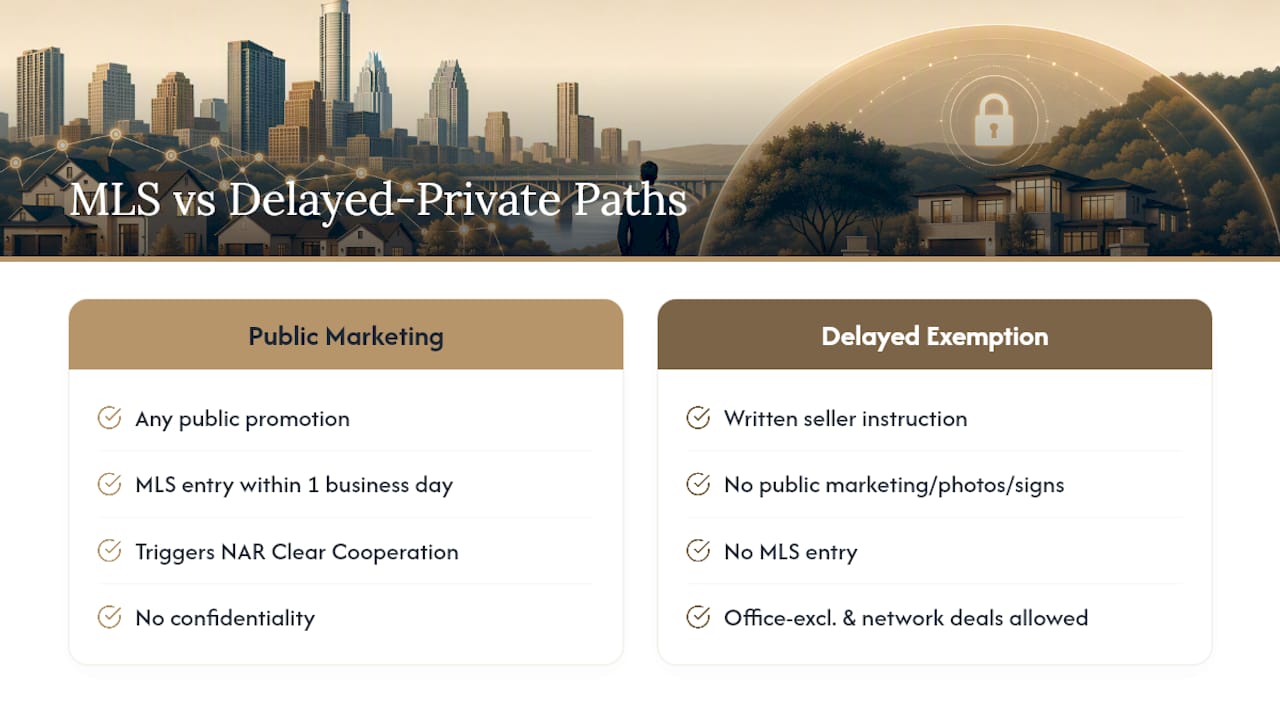
The single biggest regulatory factor here is the National Association of Realtors’ Clear Cooperation Policy, adopted in 2019. It requires that once a broker publicly markets a listing, that listing has to enter the MLS within one business day. The policy exists to stop brokers from quietly shopping listings to favored buyers while keeping other agents in the dark.
It didn’t eliminate private sales. It narrowed the path. NAR later added delayed-marketing exemptions that let a seller instruct their broker, in writing, to keep a listing off MLS entirely, no public marketing, no photos, no signage. That’s the legal mechanism behind most true pocket listings today. A broker can still work an office-exclusive or a personal-network deal as long as no public marketing occurs.
Local MLS mechanics in Austin follow this same framework. If your broker plans any public-facing promotion (a “coming soon” post, social media teaser, even a yard sign), the clock starts and the one-business-day rule applies. If your goal is genuine confidentiality, the conversation with your broker needs to happen before any marketing begins, not after. Ask explicitly whether they’re structuring your sale as a delayed-marketing exemption or a fully private, no-MLS transaction. Those are different legal postures with different exposure levels, and the difference matters more than most sellers realize until they’re already committed.
What Legal Obligations Apply to Private Real Estate Deals in Texas?
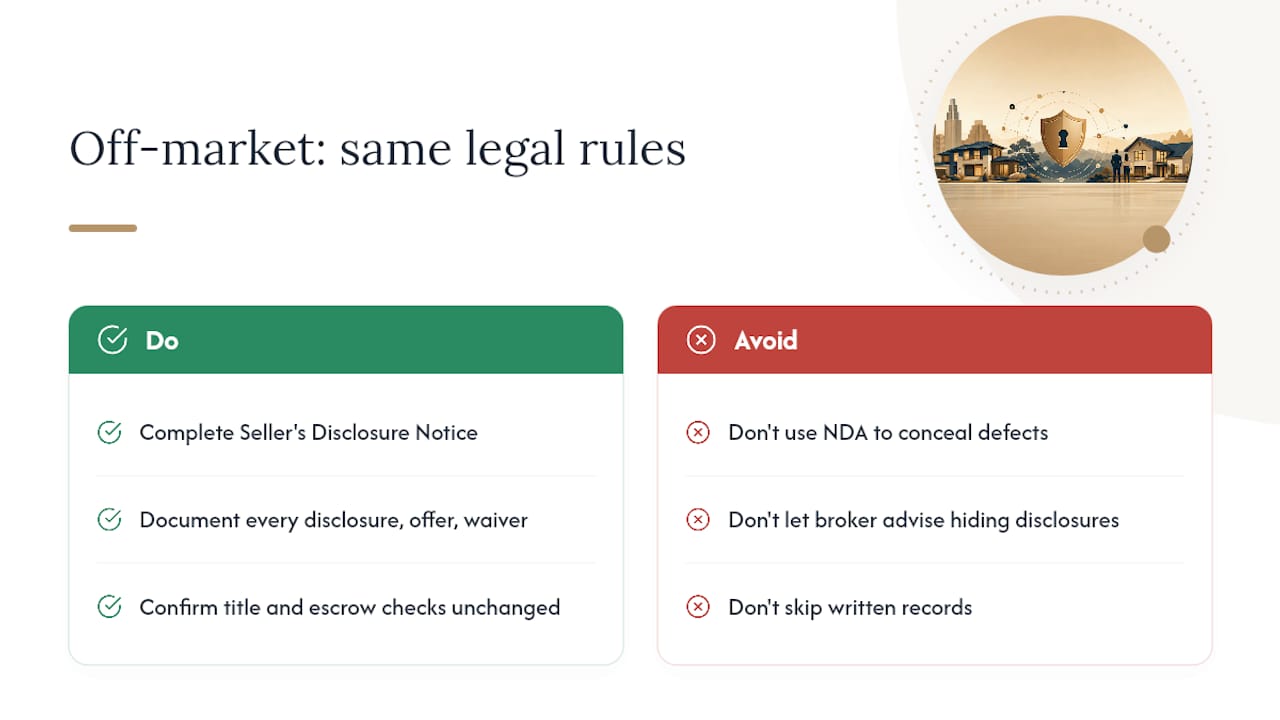
Going off-market doesn’t exempt anyone from Texas disclosure law. Sellers still have to complete a Seller’s Disclosure Notice under the Texas Property Code, covering known material defects, whether the property sits in a flood zone, and structural or mechanical issues. Skipping a public listing changes nothing about that obligation.
What does change is the paper trail. In a private transaction, there’s no listing history, no publicly logged price reductions, no digital record of how the marketing unfolded. That makes it more important, not less, that every disclosure, every counteroffer, and every contingency waiver gets documented in writing.
Confidentiality agreements used in off-market deals need careful drafting so they don’t accidentally conflict with disclosure requirements. A nondisclosure agreement can protect a seller’s identity and the fact that a sale is happening. It cannot be used to suppress a known defect or misrepresent the property’s condition. Any broker suggesting otherwise is creating legal exposure for both sides.
Texas title companies and escrow agents run the same verification process on a private deal as they would on a public one, title search, lien check, survey review. That consistency is a good thing. It’s the part of the transaction where “off-market” and “on-market” converge completely, and it’s worth confirming with your broker that nothing in that process gets shortened for the sake of speed.
What Risks Should Buyers and Sellers Watch For in Private Deals?
The biggest risk on the seller side is pricing blind. Without broad market exposure, you’re relying entirely on your broker’s comps and judgment. Sellers who insist on comparing more than one recent private and public sale for their specific submarket tend to avoid the “I sold too cheap” regret that surfaces months later when a nearby home closes for more.
On the buyer side, the risk runs the other direction: overpaying for access. The emotional pull of “getting in before anyone else” can push buyers past a rational number, especially when a broker frames the opportunity as scarce.
Both sides face a subtler risk: reduced negotiating leverage from limited competition. A seller with one interested buyer has no backup offer to point to. A buyer facing an unverified “other buyer is circling” claim has no way to confirm it’s true.
Legal liability doesn’t disappear either. Misrepresentation, undisclosed defects, and boundary disputes carry the same consequences whether the sale happened through MLS or through a quiet handshake between two brokers. If anything, the reduced paper trail in a private deal means disputes are harder to resolve after the fact, since there’s less contemporaneous documentation to point back to.
The mitigation for all of this is the same: written contingencies, a documented disclosure process, and a broker willing to slow down when a deal starts moving faster than the diligence can keep up with.
How Do You Verify a Property and Avoid Fraud in Off-Market Deals?
Fraud risk climbs when transparency drops, and off-market deals have less built-in transparency by design. That makes independent verification the buyer’s responsibility in a way it isn’t when a property has full MLS history and public tax records attached.
Start with the county appraisal district. Travis County’s records confirm ownership, tax history, and any liens, independent of anything a broker tells you. Cross-check the seller’s identity against those records before signing anything. A private deal where the person negotiating isn’t the actual title holder is a specific, recurring fraud pattern worth ruling out early.
Order a title search through a reputable Texas title company even before you’re deep into negotiations. It’s a small cost relative to the transaction size, and it surfaces liens or ownership disputes that a broker’s word alone can’t rule out. Insist on a licensed inspector’s report rather than relying on a broker’s description of “excellent condition.” Get an independent appraisal, particularly since off-market deals lack the comp trail that keeps public sales anchored to market reality.
Verify your broker’s license status through the Texas Real Estate Commission’s public records, and ask directly how they plan to structure confidentiality without compromising your legal protections.
Why Vetting Matters More Than Access Itself
Twenty years of brokering Austin’s luxury market has taught me one thing above all: the hardest part of off-market real estate isn’t finding a private listing. It’s verifying that the person offering it actually has standing to deliver it.
The private listings process is built around vetting inventory through direct relationships rather than secondhand tips, and requiring confidentiality agreements before any private preview goes forward. This protects sellers from exposure and buyers from wasting time on inventory that was never really available.
If you’re weighing whether a private sale or purchase makes sense for your situation, the conversation is worth having before you commit to either path.
— Mike
Ready to Access Austin’s Private Listings?
Most buyers hunting Austin’s luxury market are stuck choosing between public listings everyone else can see and vague promises of “connections” that never produce an actual address. We offer a third option: verified private inventory, sourced through extensive direct broker relationships across Austin’s top submarkets.
Getting started is straightforward. A private consultation comes first, where we walk through what you’re looking for (or what you need to sell discreetly) and outline confidentiality terms upfront. Buyers typically sign a representation agreement before we open access to private listings that never touch a public search. Sellers get a staged marketing plan built around their specific privacy needs, whether that means a fully confidential sale or a delayed-marketing approach.
If you want to see what’s currently available, browse our full property listings or reach out directly to start the private consultation. Focused specifically on Austin, our team knows the neighborhoods, the price tiers, and the brokers whose off-market claims actually hold up.
Sources
- Do pocket listings really boost sale prices, a new study tests it
- Bay Area off-market luxury listings — how $5M+ pocket listings actually trade + real channels for buyers and sellers
- Off-Market Luxury Property: Why It Works for Sellers and Buyers | Privé
- How to find and buy off-market properties
FAQ
What Does “Texas Non Disclosure Real Estate” Actually Mean?
In the Austin luxury market, it refers to off-market or private property listings, homes sold through broker networks and personal relationships rather than public MLS exposure.
Do Off-Market Homes Sell for More or Less Than Listed Properties?
A Dallas-Fort Worth study found off-market sales carried about a 1.7% price premium with faster closings, though that premium has shrunk since Clear Cooperation Policy took effect.
Is It Legal to Sell a Home Off-Market in Texas?
Yes. Brokers can use office-exclusive listings or NAR’s delayed-marketing exemptions to keep a property off MLS, as long as no public marketing occurs and standard Texas disclosure requirements are still met.
How Do I Find Off-Market Listings in Austin?
The most reliable path is a broker with verified private dealflow and access to brokerage internal pools and agent-to-agent networks. Mogavero Group maintains private listing access built on direct Austin broker relationships.
What Percentage of Texas Real Estate Sales Are Off-Market?
Texas ranks among the states with the highest share of off-market activity nationally, with off-market share increasing significantly at higher luxury price tiers.