2026 Buyers: 10 Walkable Austin Neighborhoods With Off Market Access
Ten walkable Austin neighborhoods for 2026 buyers, with WalkScore insights, a visit checklist, price tradeoffs, and off market tips.
2026 Buyers: 10 Walkable Austin Neighborhoods With Off Market Access
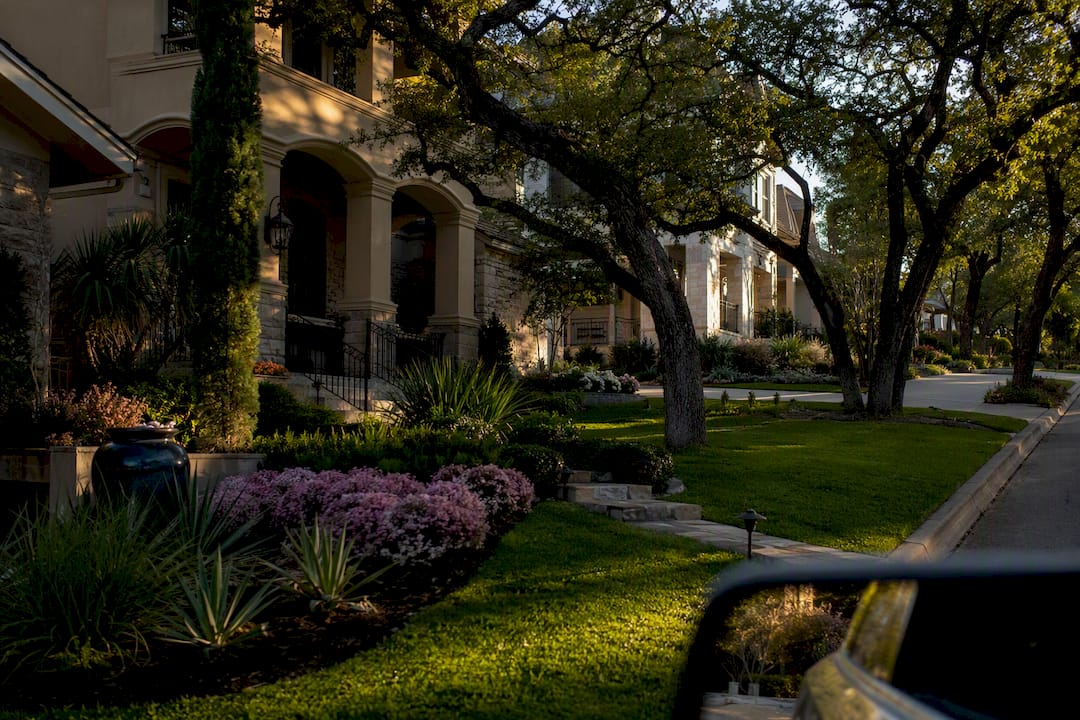
Downtown, West University/West Campus, East Austin, South Congress, Hyde Park, and Mueller are Austin’s strongest walkable neighborhoods right now, each scoring well above the metro average for daily-errand access. Expect a real price premium for that convenience, along with more street noise and denser living than the suburbs offer. Below, you’ll find what each area actually delivers on foot, how to judge walkability during a visit, and where the cost trade-offs land.
TL;DR:
- Walkable Austin neighborhoods like Downtown, West University, and East Austin generally command higher prices, with premiums often reflected in faster sales for comparable homes.
- The actual walkability of a specific street or block depends on factors like sidewalks, shade, traffic noise, and proximity to transit, requiring on-site evaluation beyond raw scores.
- Older neighborhoods may have uneven sidewalk quality and ADA compliance issues, making walkability assessments for daily routines essential before purchasing.
- Neighborhoods built with walkability in mind, such as Mueller, tend to have consistent infrastructure, while older areas like Clarksville rely on city investments to improve pedestrian access.
- Buyers can gain early access to high-quality, walkable inventory through agents offering private and off-market listings, especially in fast-moving markets.
Table of Contents
- Which Austin neighborhoods are actually walkable?
- How do you choose the right walkable block?
- What does walkability actually cost you in Austin?
- What Mogavero Group sees that raw walkability scores miss
- How accessible are Austin’s walkable neighborhoods really?
- What is Austin doing to improve walkability?
- Which neighborhood fits your stage of life?
- Let Mogavero Group Find Your Walkable Austin Address
- Sources
- FAQ
Which Austin neighborhoods are actually walkable?
Austin’s walkability drops off fast outside a handful of central pockets, and the neighborhoods that hold up are the ones with a genuine mix of housing, retail, and transit packed into a small radius. Redfin’s neighborhood data puts Downtown, West University, and the UT-area neighborhoods at the top of the list, with Walk Scores frequently landing in the 80 to 99 range for central blocks. Here’s how the leading candidates stack up.
- Downtown puts you within walking distance of Lady Bird Lake, the Second Street District, and dozens of restaurants and offices. A Walk Score entry for 200 Congress Ave shows the kind of near-perfect pedestrian access you get in the urban core. Best for young professionals who want zero commute and don’t mind high-rise living with premium rents and constant street activity.
- West University/West Campus sits next to the University of Texas and functions almost like a car-free micro-city, with grocery stores, coffee shops, and a light rail stop all within a few blocks. It fits students and young renters well, though the trade-off is dense student housing, late-night noise, and limited parking.
- East Austin mixes historic bungalows with new infill development, and residents can walk to coffee shops, taquerias, and East Sixth Street bars. Apartments flags East Austin as one of the city’s most consistently walkable areas outside the core. It suits young professionals and creatives, but gentrification has pushed prices up fast in pockets closest to Downtown.
- South Congress (SoCo) delivers boutique shopping, live music venues, and some of the best people-watching in the city, all within a walk of the South Congress Bridge. It fits buyers who want a lifestyle-forward address, though weekend foot traffic and tourist crowds mean it’s rarely quiet.
- Hyde Park is Austin’s original streetcar suburb, and it still shows: tree-lined sidewalks connect bungalow blocks to neighborhood cafes and Shipe Park. Families and long-term renters gravitate here for the quieter, moderately walkable feel, with fewer high-rises and a stronger sense of community than the core.
- Mueller is a master-planned community built around Aldrich Street, a dedicated pedestrian town center with shops, a farmers market, and regular community events, as detailed on the City of Austin’s Aldrich Street page. It’s the strongest option for families who want walkability without giving up newer construction and predictable HOA amenities.
- Zilker puts residents a short walk from Zilker Park, Barton Springs Pool, and the Lady Bird Lake hike-and-bike trail, making it a favorite for outdoor-access buyers, though inventory is limited and prices reflect the park-adjacent premium.
- Clarksville is a historic Freedmen’s Town just west of Downtown, with narrow, shaded streets and small-scale retail on West Sixth Street. It’s moderately walkable and appeals to buyers who want historic character over high-density urban living.
- North Loop has a funkier, more local feel, with vintage shops and independent restaurants along North Loop Boulevard, and it draws renters and young professionals priced out of Hyde Park who still want a walkable commercial strip.
- Barton Hills trades some walkability for green space, sitting near Barton Springs and Zilker with a more suburban layout, so it suits families who want proximity to trails and parks more than a walk-to-everything commercial strip.
How do you choose the right walkable block?
A high Walk Score tells you the neighborhood is walkable on paper. It doesn’t tell you whether the specific block you’re considering feels that way at 7 AM on a Tuesday or 11 PM on a Saturday. That gap is where most buyers get surprised after closing.
Run your evaluation against a short list of criteria: your daily-errand radius (grocery, pharmacy, coffee), proximity to a transit stop you’d actually use, shade coverage on the routes you’d walk most, block-level safety and lighting, housing type and price fit, and school zoning if that matters to your household. Then take these questions into a walk-through or ask your agent directly:
- Where do most residents on this block actually buy groceries, and how far is that walk in July heat?
- What time of day does this street get loudest, and what’s the source (bars, traffic, a nearby venue)?
- How far is the closest bus stop or rail station, and what’s the realistic wait time during peak hours?
- Are the sidewalks continuous, or do they disappear for a block or two along the route you’d walk daily?
- How much on-street parking competition exists, and does that spill into pedestrian space?
- What’s the flood or construction history on this specific block, not just the neighborhood?
- Is there tree canopy or covered walkway shade on the main pedestrian routes?
- How has foot traffic or noise changed here over the past two to three years?
Before you commit, walk the block twice: once during a weekday commute window and once on a weekend evening. Time your walk to the nearest grocery store and note how much of it has shade. Check whether the sidewalk is continuous or interrupted by driveways and gaps. Stand at the nearest transit stop and time an actual wait. For a broader framework on matching neighborhood features to your lifestyle, this guide on choosing an Austin neighborhood walks through the same priorities in more depth.
Pro Tip: Walk the block between 4 and 6 PM on a weekday. That window catches rush-hour traffic noise, after-school foot traffic, and early dinner crowds, which together reveal more about daily livability than any quiet Sunday morning stroll ever will.
What does walkability actually cost you in Austin?
Walkable, central neighborhoods carry a real price tag, and Opendoor’s neighborhood pricing data shows central pockets like Downtown and SoCo consistently commanding higher price points and faster sale velocity than comparable homes farther from the urban core. You’re paying for the walk, not just the square footage.
Walkability’s price signal: Central, highly walkable neighborhoods tend to sell faster and at a premium compared to similarly sized homes in car-dependent parts of the metro, according to Opendoor’s market data.
The trade-offs go beyond price. Expect smaller units, tighter parking, more ambient noise, and less private outdoor space the closer you get to a walkable core. Austin’s summer heat compounds this: a walk that feels reasonable in March can feel brutal in August without shade coverage along the route.
If the premium doesn’t fit your budget, look one ring out. Hyde Park, North Loop, and parts of East Austin offer moderate walkability at a lower price than Downtown or SoCo. Working with an agent who has off-market access and expertise can also surface walkable inventory before it hits public listing sites, which matters in a market where the best blocks move fast.
What Mogavero Group sees that raw walkability scores miss
A Walk Score treats every sidewalk the same. It can’t tell you that one side of a Hyde Park street gets full afternoon shade while the other bakes, or that a Mueller block near Aldrich Street empties out after a nearby event lets out. That kind of block-level nuance only shows up from walking inventory repeatedly and tracking how it changes season to season.
Buyers consistently underweight noise and overweight raw distance-to-amenities. A quarter-mile walk past a loud patio bar feels longer than a half-mile walk down a shaded, quiet street, and most Walk Score tools can’t capture that difference.
Mogavero Group uses targeted early alerts and curated private tours to get clients into walkable inventory, including off-market and private listings, before it’s publicly searchable.
How accessible are Austin’s walkable neighborhoods really?
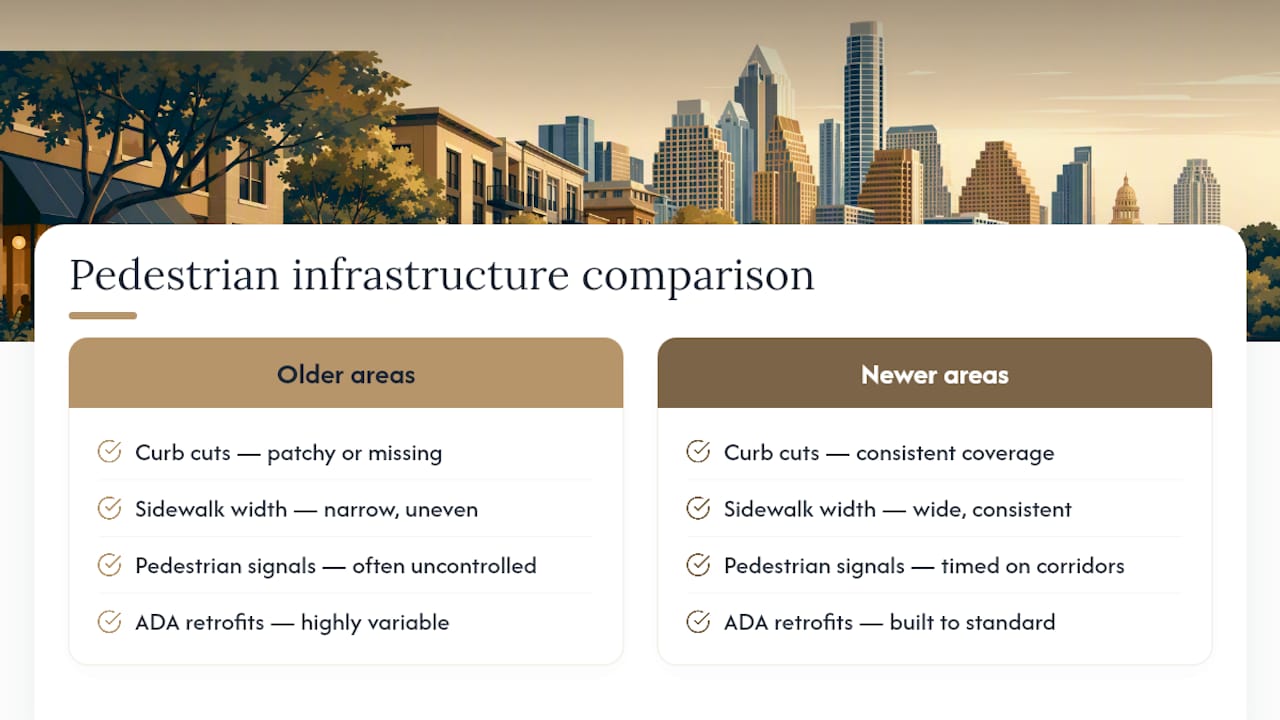
Sidewalk quality varies block by block even within the same neighborhood. Older areas like Clarksville and Hyde Park have narrower, sometimes uneven sidewalks from decades-old construction, while newer developments like Mueller build to current pedestrian standards with wider paths and consistent curb cuts.
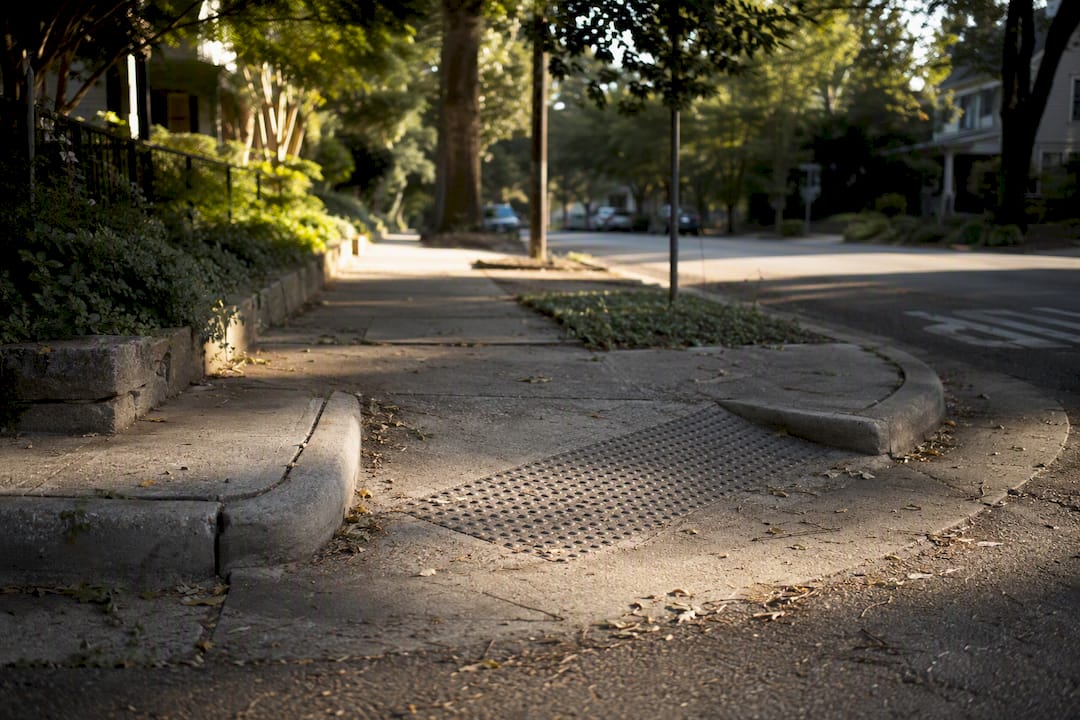
Curb cuts matter more than most buyers realize until they’re pushing a stroller, using a wheelchair, or hauling groceries on a rolling cart. Not every intersection in Austin’s older neighborhoods has one, and gaps in coverage can turn a short walk into a detour. Pedestrian signals also vary: busy corridors like Guadalupe Street near West Campus have timed crossing signals, but quieter residential streets often rely on unmarked or uncontrolled crossings.
If accessibility is a priority, walk the specific route you’d use daily rather than trusting a neighborhood-wide reputation. A block can carry a strong overall Walk Score while still having a missing curb cut at the one intersection you’d cross every morning. Ask specifically about ADA compliance on sidewalks near any home you’re considering, especially in pre-1990s construction where retrofits vary widely.
What is Austin doing to improve walkability?
The city has several active efforts aimed at closing pedestrian infrastructure gaps, and Mueller remains the clearest example of what intentional, walkable planning looks like when built from scratch. Aldrich Street was designed specifically as a pedestrian-first town center, with wide sidewalks, mixed retail, and regular community programming built into the plan rather than added later.
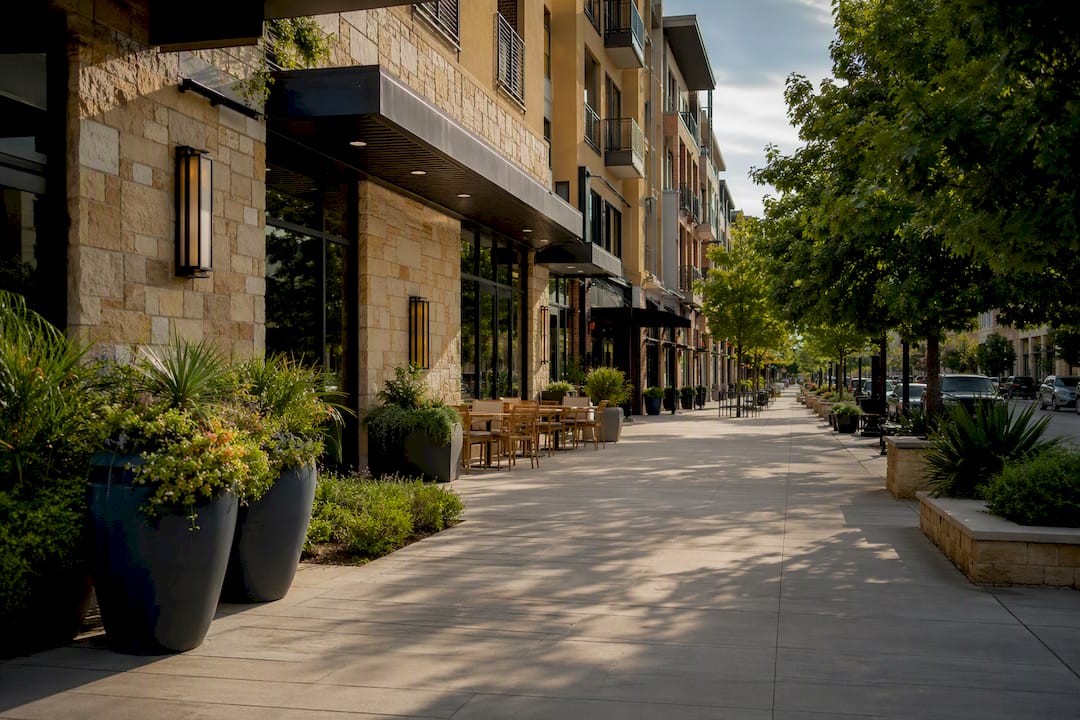
Beyond Mueller, Austin has invested in sidewalk expansion and urban trail connections through bond-funded infrastructure programs, though coverage remains uneven across older neighborhoods where retrofitting sidewalks into established rights-of-way is slower and more expensive than building them into new development. Transit corridors along Guadalupe Street and South Congress have also seen pedestrian signal upgrades tied to broader mobility planning.
The pattern worth watching: new and redeveloped neighborhoods increasingly build walkability in from day one, while older neighborhoods depend on incremental city investment to catch up. That gap explains why Mueller can promise consistent pedestrian infrastructure while a historic area like Clarksville still has stretches of inconsistent sidewalk coverage. For buyers weighing long-term walkability, it’s worth asking whether a neighborhood’s walkable reputation is a stable asset or a work in progress.
Which neighborhood fits your stage of life?
Young professionals do well starting in Downtown or East Austin, where nightlife and short commutes matter more than square footage. Families researching walkable communities in Austin should look hardest at Mueller and Hyde Park, both of which pair pedestrian access with more stable, long-term neighborhood character. Downsizers and buyers prioritizing outdoor access tend to land well in Zilker or Barton Hills, trading some commercial walkability for park proximity.
— Mike
Let Mogavero Group Find Your Walkable Austin Address
Mogavero Group spends its days inside these exact blocks, tracking which streets stay shaded through August, which Mueller phases are releasing next, and which East Austin listings never make it to public search. That block-level read is the advantage a general listing search can’t replicate.
Whether you’re weighing a West Campus condo against a Hyde Park bungalow, or you want first access to walkable inventory before it’s publicly listed, our team can build a curated tour around the exact trade-offs that matter to you. Browse current luxury Austin properties or reach out to get on the list for upcoming private listings in the neighborhoods covered above.
Sources
- Walk Score — 200 Congress Ave, Austin TX
- Best Walkable Neighborhoods in Austin — Redfin
- Apartments
- Austintexas
FAQ
What is the most walkable neighborhood in Austin?
Downtown consistently ranks highest, with Walk Scores near the top of the scale for central addresses like 200 Congress Ave.
Is South Congress (SoCo) walkable?
Yes. SoCo offers strong walkability to shops, restaurants, and music venues, though weekend crowds and tourist traffic make it busier than most residential-first neighborhoods.
Are walkable Austin neighborhoods more expensive?
Generally yes. Central, walkable neighborhoods tend to sell faster and at higher price points than comparable homes farther from the urban core, according to Opendoor’s pricing data.
Which Austin neighborhood is best for families who want walkability?
Mueller and Hyde Park both offer strong pedestrian access paired with family-friendly parks and schools, making them the more common starting points for relocating families.
Can an agent help me find walkable homes before they’re publicly listed?
Yes. Mogavero Group offers private and off-market listings that give buyers early access to walkable inventory in neighborhoods like East Austin and Mueller before it hits public search.