Off Market Austin Waterfront Neighborhoods With Private Dock Access
Compare Austin's lake neighborhoods to find private docks, off market listings, and a practical checklist for buying true waterfront homes.
Off Market Austin Waterfront Neighborhoods With Private Dock Access

Austin’s waterfront neighborhoods split into three clear clusters. Lake Austin suits boaters and buyers who want luxury estates with private docks close to downtown. Lake Travis and Lakeway fit families and recreation-focused buyers who want bigger lots and don’t mind the drive. Lady Bird Lake and the South Central Waterfront work for people who want trails, parks, and downtown walkability over true acreage. Market pricing and buying checks follow below.
TL;DR:
- Private dock ownership significantly boosts property value, making true waterfront lots with private slips much more expensive than those with only lake views.
- True waterfront listings with deeded dock rights and ample shoreline are rare on Lake Austin due to limited supply and high demand, often trading privately before hitting the market.
- Buyers should thoroughly verify dock easements, permits, and shoreline elevation certificates to avoid costly legal or insurance issues after purchase.
- Lake Austin and Lake Travis have distinct lifestyles, with the former favoring boaters and entertainers and the latter attracting families seeking space and recreation.
- Waterfront prices often depend more on dock rights and privacy than on total square footage, with off-market opportunities available through local specialists.
Table of Contents
- Which Austin Neighborhoods Actually Sit on the Water?
- What Daily Life Looks Like on the Water
- What Does Waterfront Property Cost in Austin?
- What Should You Check Before Buying Waterfront?
- How A Local Specialist Approaches A Waterfront Search
- Get Access to Austin’s Private Waterfront Listings
- Sources
- FAQ
Which Austin Neighborhoods Actually Sit on the Water?
Not every “lake view” listing means true waterfront. Here’s how the real waterfront neighborhoods in Austin break down, and who tends to end up choosing each one.
Lake Austin is the closest thing Austin has to old-money waterfront. This narrow, dam-controlled lake stays at a relatively constant level year-round, which is part of why it commands such a premium. Homes here range from multi-acre estates with private boat docks to condos with deeded slips, concentrated along Westlake Drive and in pockets like Rivercrest. Buyers here tend to be boaters and entertainers who want a dock at the end of their own yard, not a shared marina slip fifteen minutes away. This is the segment Mogaverogroup spends most of its time in, and you can see current Lake Austin waterfront listings to get a sense of what “true waterfront” looks like in practice.
Lake Travis and Lakeway flip the equation. You trade proximity to downtown for space, newer construction, and a more recreational pace. Lots run larger, HOAs often include marina access or community boat launches, and the trade-off is a 30 to 45 minute drive into Austin proper depending on traffic. Marble Falls, further west, pushes that trade-off even further for buyers chasing lower price points on the same lake system.
Lady Bird Lake and the South Central Waterfront are a different animal entirely. There’s no private dock culture here. Instead, you get walkability, hike and bike trail access, and a wave of planned redevelopment turning old industrial land into condos and mixed-use buildings within a mile of downtown.
A few lake-adjacent neighborhoods deserve a mention even though they aren’t technically waterfront:
- Steiner Ranch offers Lake Travis views and marina access without every lot touching the shoreline.
- Davenport Ranch sits close to Lake Austin with rolling hill views, though few homes have direct water access.
- Tarrytown and Highland Park trade true waterfront for walkable streets and proximity to both downtown and Lake Austin’s public parks.
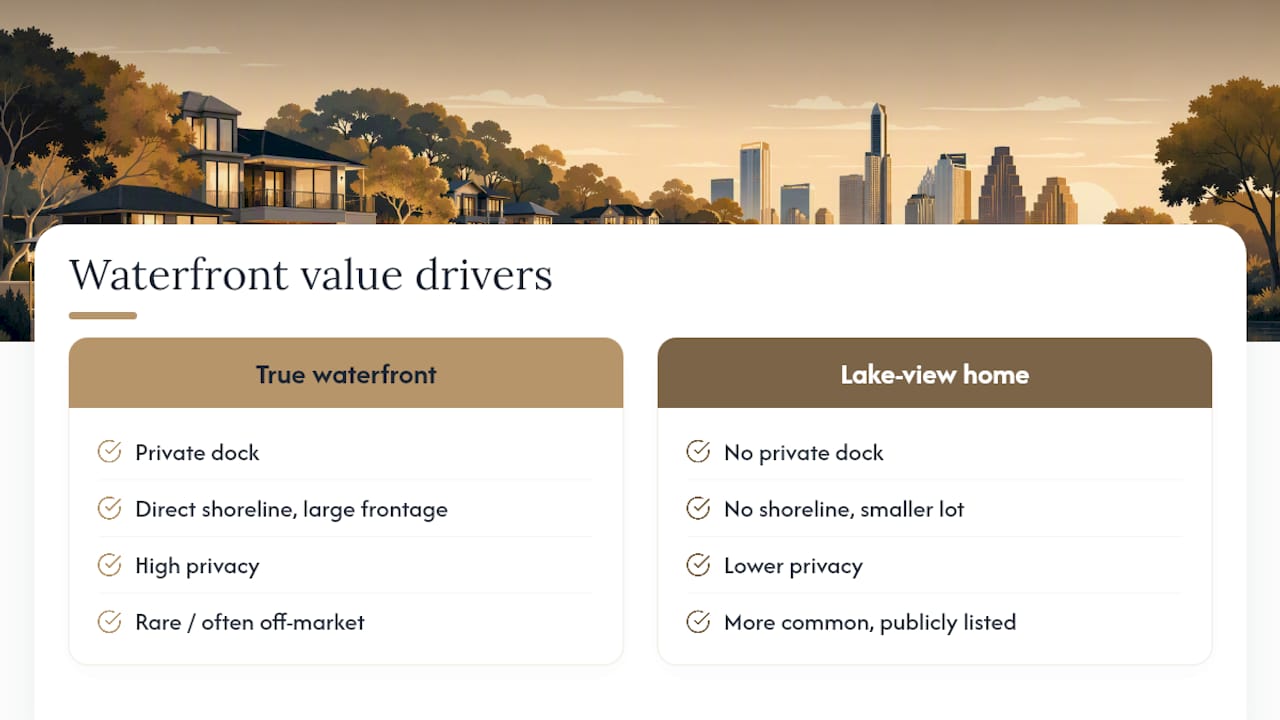
The distinction that matters most when you’re shortlisting: private dock ownership versus community or public access. That single factor moves price more than square footage in most of these areas.
What Daily Life Looks Like on the Water
Boating culture drives a lot of the waterfront lifestyle in Austin, and dock ownership dictates how you experience it. Owners with private docks on Lake Austin or Lake Travis can put a boat in the water on a Tuesday afternoon without planning around a public launch. Everyone else relies on marinas or public ramps, which get crowded on weekends from spring through fall.
The trail and park network matters just as much as the water itself. Mary Quinlan Park gives residents on Lady Bird Lake’s south shore public water access and green space, and it connects into the broader trail system that Austin’s parks department maintains around the lake. Mount Bonnell, overlooking Lake Austin, remains one of the most visited viewpoints in the city and a regular stop for residents showing off the neighborhood to guests.

Dining and social life cluster around a handful of institutions. Austin Country Club anchors the Lake Austin social scene, and lakeside restaurants along both lakes do steady business on summer evenings. Families weighing a move often care most about school zoning, since Eanes ISD serves much of the Lake Austin and Westlake area and factors heavily into resale value.
Pro Tip: Tour a waterfront property on a weekday and a weekend. Boat traffic, dock noise, and public launch congestion change completely depending on when you look.
What Does Waterfront Property Cost in Austin?
Waterfront pricing in Austin doesn’t move in a straight line with square footage. It moves with dock rights, lot frontage, and privacy. Live listing data for Austin waterfront homes shows a wide spread, from lakefront condos with shared slips into the millions for multi-acre Lake Austin estates with private docks, reflecting just how differently “waterfront” gets priced depending on what actually comes with the lot.
The premium math is simple: a true waterfront lot with a private dock and 150 feet of shoreline will consistently out price a comparable house two streets back with a “lake view” label, sometimes by a wide margin. Scarcity is the real driver since Lake Austin’s shoreline is fixed and mostly built out, so new true-waterfront inventory rarely appears.
Much of the highest-end Lake Austin inventory never hits public portals at all. Off-market and pre-construction opportunities move through private networks first, which is where firms with existing relationships have an advantage over a standard search.
Downtown, the South Central Waterfront Initiative is reshaping value on the Lady Bird Lake side. The plan covers a large area along the lake’s south bank and calls for expanded public green space along with a significant number of affordable housing units at full buildout. That kind of investment tends to lift adjacent condo and mixed-use values over time, even for buyers who aren’t waterfront themselves. Current interest rate and buyer power conditions are also shaping how aggressively buyers are moving on both lakes right now.
What Should You Check Before Buying Waterfront?
A waterfront listing photo hides a lot of paperwork. Work through these before you get attached to a property:
- Confirm dock ownership status. Is it deeded to the property, held under an easement, or a shared community slip? Each carries different maintenance obligations and transfer rights.
- Pull the FEMA flood map and elevation certificate. Shoreline elevation affects both insurability and premium cost, sometimes significantly.
- Read the HOA covenants on shoreline use. Some communities restrict dock size, boat lift type, or seawall repairs.
- Ask about permitting history for any dock or seawall. Unpermitted structures can become your problem at closing.
- Budget for ongoing maintenance. Docks, boat lifts, and erosion control aren’t one-time costs.
Lake levels themselves aren’t fixed by nature alone. LCRA manages Mansfield Dam, which controls water levels across the Highland Lakes chain, including both Lake Austin and Lake Travis. That operational control affects dock usability and shoreline conditions long after closing.
Pro Tip: Request the seller’s dock permit and any HOA shoreline addendum before your first showing, not after you’ve made an offer. On top of that, Texas transactions carry standard consumer protection notices required by TREC that every buyer should expect to see and understand.
How A Local Specialist Approaches A Waterfront Search
Waterfront deals in Austin rarely play out like a standard home search. Mike Mogavero has spent more than 20 years working the Austin luxury market, and Mogavero Group’s specialty sits squarely in off-market and pre-construction waterfront opportunities that never reach public listing sites.
The process usually starts before a property is publicly available: scouting relationships along Lake Austin and Westlake, then verifying dock rights, easements, and permit history before a client ever schedules a tour. That legwork matters more on waterfront property than almost any other category, since a beautiful lot with a disputed dock easement can unravel a deal at the title company. Coordinating inspections around lake-level fluctuations and seawall condition is part of the routine, not an afterthought.
— Mike
Get Access to Austin’s Private Waterfront Listings
Most of the best waterfront inventory on Lake Austin never makes it to a public search. Mogavero Group works those relationships directly, which means access to off-market and pre-construction waterfront properties before they’re listed anywhere else, plus concierge coordination on dock inspections, easement verification, and flood insurance questions before you’re deep into a contract.
If Lake Austin is your target, start with the Lake Austin neighborhood page to see current inventory and typical price ranges. Buyers open to other lakeside or lake-adjacent options can browse the full Austin properties collection, and those specifically hunting exclusive, unlisted inventory should ask about the private listings program. Reach out directly to schedule a consultation and get matched with waterfront opportunities before they go public.
Sources
For readers who want to dig into the planning and regulatory side of Austin’s waterfront:
Buyers comparing waterfront markets beyond Austin can also look at resources like Myrtle Beach real estate listings for a sense of how coastal and lake markets differ in pricing and inventory.
FAQ
Does Austin Have a Waterfront?
Yes. Austin’s waterfront runs across Lake Austin, Lake Travis, and Lady Bird Lake, each offering a different mix of private docks, public parks, and trail access.
What Is the Coolest Neighborhood in Austin?
It depends on what you’re after: Lake Austin draws buyers wanting boating and privacy, while the Lady Bird Lake and South Central Waterfront area appeals to people who want walkable, trail-adjacent urban living.
Where Does Matthew McConaughey Hang Out in Austin?
McConaughey is closely tied to Austin’s live music and film scene downtown, and the areas near Lady Bird Lake and the city’s waterfront trails are frequently mentioned as part of the city’s outdoor social culture.
Is $100,000 a Good Salary in Austin?
A moderate salary covers a comfortable standard of living in much of Austin, but it typically falls well short of what’s needed for true waterfront property on Lake Austin or Lake Travis, where entry prices sit well above the city’s general housing market.