Austin Homeowners: Tree Ordinance, 19 Inch Permits and $200/Inch Mitigation
A homeowner-first checklist for Austin's tree ordinance: when 19 inch trees need a permit, stop-work steps, how to file a TORA, and mitigation versus...
Austin Homeowners: Tree Ordinance, 19 Inch Permits and $200/Inch Mitigation
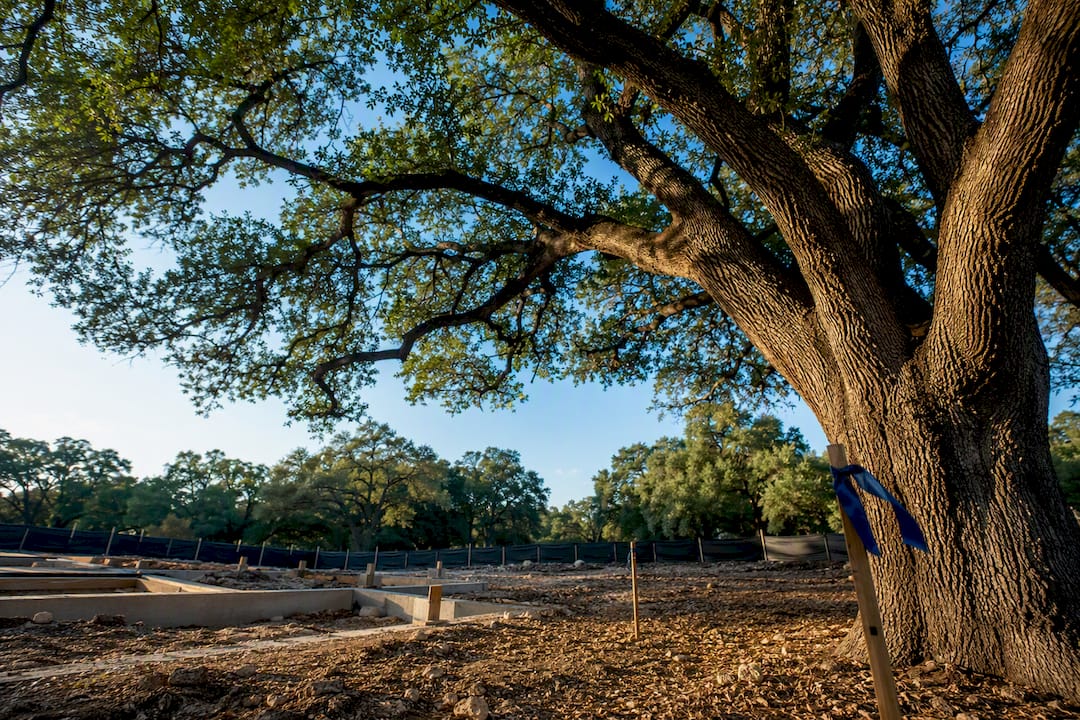
If a tree on your Austin property measures 19 inches or more in diameter at breast height, you generally need a permit before you cut it down, prune it heavily, or disturb its root zone. Commercial and multifamily sites face a stricter 8 inch threshold. Either way, the move is the same: stop work, measure the trunk, and open a Tree Ordinance Review Application through the city’s AB+C portal before a single branch comes down.
TL;DR:
- Trees, especially those over 19 inches DBH on residential lots or 8 inches on commercial sites, require a permit before removal, heavy pruning, or root zone disturbance.
- The critical triggers for permit application include removal, pruning over 25%, or any impact on the tree’s critical root zone, even without trunk contact.
- Proper measurement of DBH involves wrapping a tape at 4.5 feet, dividing the circumference by 3.14, and considering multiple trunks or slope angles.
- Mitigation for permitted removal depends on tree size and species, with Heritage trees requiring up to 300% replacement or payment into the urban forest fund.
- Filing a proper application involves registering in the city portal, submitting accurate measurements, photos, site sketches, and awaiting review, especially for Heritage or CRZ-impacting projects.
Table of Contents
- Quick Checklist: Stop-Work Actions and the Three Permit Triggers
- How to Measure DBH and Identify Heritage Species on Your Lot
- How to File a Tree Ordinance Review Application: Documents, Timelines, and Fees
- Critical Root Zone and Construction: What Counts as Impact
- Mitigation Rules and Payment in Lieu: What You’ll Owe
- Enforcement and Resolving Violations: Citations, ECVs, and Misdemeanor Exposure
- Preparing a Strong Application: A Pre-Plan Consultation Can Save Your Timeline
- Exemptions to the Tree Ordinance Beyond DDI Cases
- Updates or Recent Changes to the Austin Tree Ordinance
- Roles and Contact Information for Relevant City Departments
- Community Resources and Urban Forestry Programs in Austin
- Official City Pages and Documents to Bookmark
- Agent Perspective: How Tree Ordinance Issues Commonly Affect Listings
- How real estate agents support buyers and sellers facing tree-ordinance issues
- Sources
- FAQ
Quick Checklist: Stop-Work Actions and the Three Permit Triggers
Three things trigger the Austin tree ordinance, regardless of whether you’re a homeowner or a developer:
- Removal of a regulated tree, full stop.
- Pruning 25% or more of the canopy in a single event.
- Disturbance of the Critical Root Zone (CRZ), even if you never touch the trunk.
The size threshold that decides whether a tree counts as “regulated” depends on the property. Residential lots follow a 19 inch DBH threshold for Protected Trees. Commercial and multifamily parcels drop to 8 inches, which catches far more trees during site plan review. Certain species (oaks, pecans, elms, and a handful of others) hit Heritage status at 24 inches DBH and carry tougher protections than an ordinary Protected Tree of the same size.
If any of the three triggers apply to your situation, here’s the sequence to follow immediately:
- Measure the trunk at 4.5 feet above grade and write the number down.
- Photograph the tree from multiple angles, including the base and canopy.
- Flag the tree with tape or ribbon so contractors don’t mistake it for scrap.
- Pause any crew already on site until you know your status.
- Register an account in the city’s AB+C permitting portal and start your TORA.
Skipping step four is the most common mistake. Contractors paid by the day rarely wait for paperwork, and once a chainsaw touches a Protected Tree without a permit, the options for a clean resolution shrink fast.
How to Measure DBH and Identify Heritage Species on Your Lot
DBH stands for diameter at breast height, measured 4.5 feet up the trunk from the ground. That’s the number the city uses to decide whether a tree is regulated, and it’s the same number you’ll enter on your TORA.
Here’s the method that holds up under review:
- Wrap a flexible tape measure around the trunk at 4.5 feet.
- Record the circumference in inches, then divide by 3.14 (pi) to get diameter.
- For trees with multiple trunks below 4.5 feet, measure each trunk and follow the city’s combined-trunk formula rather than guessing.
- On sloped ground, measure from the uphill side, which is the standard the City Arborist applies.
A handful of species reach Heritage status at 24 inches DBH instead of the standard thresholds: live oak, pecan, bald cypress, Arizona ash, American elm, cedar elm, and a few others named in the Environmental Criteria Manual. Heritage status isn’t cosmetic. It changes mitigation math and makes removal significantly harder to justify.
Pro Tip: Measure every tree near planned construction, not just the one closest to the work zone. A tree 30 feet away can still have a Critical Root Zone that reaches your foundation footprint, and that’s the tree that trips people up.
If your lot has anything close to a Heritage tree or a cluster of large oaks, request a City Arborist site visit before you finalize plans. It costs you a phone call and saves you a redesign.
How to File a Tree Ordinance Review Application: Documents, Timelines, and Fees
A TORA is required any time you plan to remove a regulated tree, prune a large portion of its canopy, or disturb its Critical Root Zone. If your project already needs a building permit, the TORA typically rides alongside it. If you’re just taking down a tree with no construction attached, the TORA stands alone.
Filing one follows a consistent path:
- Register in the AB+C portal. This is the same system the city uses for building permits, so if you’ve pulled a permit before, you already have an account.
- Select Tree Ordinance Review as your application type and specify the nature of the work: removal, pruning, or root zone impact.
- Upload supporting documents. At minimum, expect to submit a site sketch showing tree locations relative to structures, photos of each affected tree, and DBH measurements. Larger projects need a certified tree survey; residential-only projects generally don’t require survey certification, per the Environmental Criteria Manual.
- Wait for City Arborist review. Staff check your application against preservation criteria in ECM Section 3, including whether reasonable alternatives to removal exist.
- Respond to information requests. The most common reason for delay is an incomplete sketch or a DBH measurement that doesn’t match photos.
Review timelines vary by workload and project complexity, and heritage trees or CRZ-heavy sites almost always take longer than a straightforward single-tree removal. Budget extra time if your project touches a Heritage species or sits inside a floodplain overlay, since those files get routed for additional review.
Critical Root Zone and Construction: What Counts as Impact
The Critical Root Zone is the area around a tree’s trunk where root damage translates directly into tree stress or death. The city calculates it as a radius tied to trunk diameter, and it governs what you can and can’t do near a tree during any construction project, not just tree work itself.
Austin’s rules split the CRZ into bands. No grading, trenching, or soil compaction is allowed inside the quarter-CRZ closest to the trunk. Work inside the half-CRZ is limited and usually requires specific mitigation techniques. Beyond that, standard construction practices generally apply, though the City Arborist blog notes that the city treats root disturbance and over-pruning as forms of removal, not just cutting down the trunk.
Actions that commonly get flagged as de facto removal include:
- Compacting soil with heavy equipment parked inside the CRZ.
- Cutting structural roots during trenching for utilities.
- Changing grade by adding or removing more than a few inches of soil over roots.
- Storing construction materials or vehicles over the root zone for extended periods.
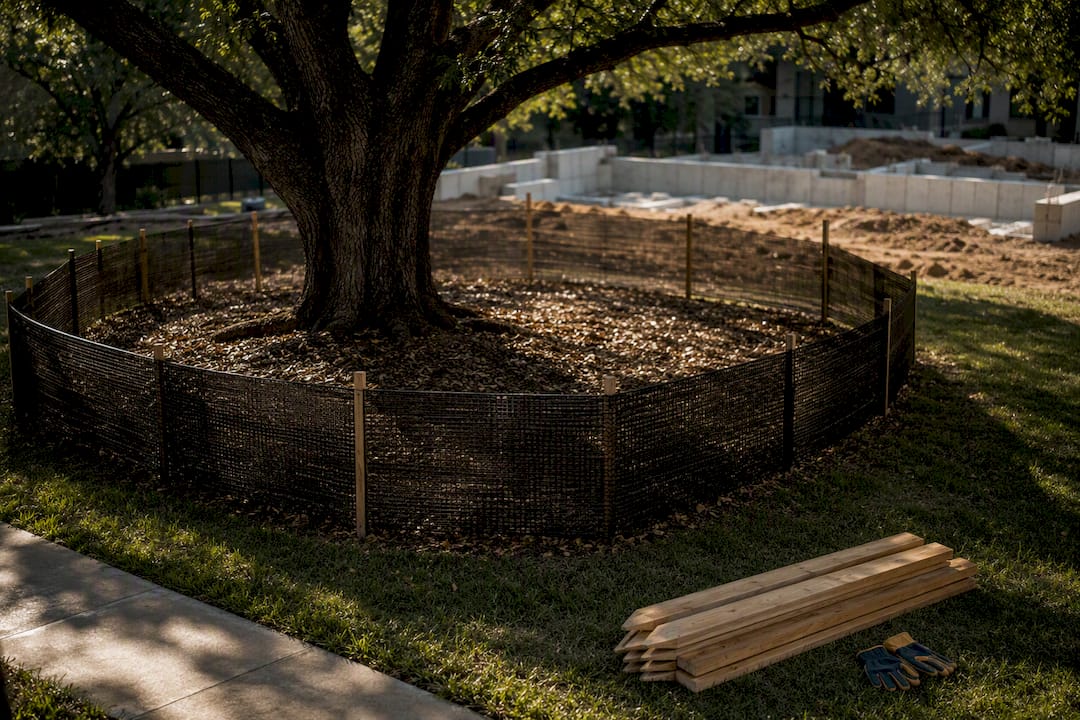
Approved protection measures look different depending on the project. Temporary fencing around the CRZ perimeter is standard. For foundations near a protected tree, engineers sometimes design piers with a suspended slab instead of a continuous footing, which avoids trenching through roots entirely. Root pruning, when unavoidable, should be done with clean cuts by hand tools rather than machinery tearing through roots.
Pro Tip: Install CRZ fencing before the first delivery truck arrives, not after grading starts. Once equipment has compacted soil inside the root zone, there’s no fence that undoes the damage, and the city can require mitigation even if the tree survives.
Mitigation Rules and Payment in Lieu: What You’ll Owe
If the city approves removal of a Protected Tree, mitigation kicks in immediately. Heritage trees carry a steeper penalty: 300% mitigation, meaning three inches of new canopy for every inch of Heritage tree lost.
The mitigation math in practice: Remove a 30 inch Protected oak that doesn’t qualify as Heritage, and you owe 30 inches of replacement planting, likely spread across several smaller trees since nurseries rarely sell single 30 inch specimens. Remove a 30 inch Heritage live oak, and that number jumps to 90 inches of replacement canopy.
Not every property has room for that much new planting, which is where the Urban Forest Replenishment Fund comes in. Instead of planting on-site, owners can pay into the UFRF at a published rate of $200 per inch of required mitigation. The fund uses that money for tree planting elsewhere in the city, and it’s often the practical choice on small urban lots where there’s simply no space for a dozen replacement trees.
A few factors can reduce what you owe:
- Trees in declining condition may receive reduced mitigation credit if documented by an arborist.
- Some species exemptions apply for invasive or undesirable trees under the Environmental Criteria Manual.
- The City Arborist has discretion to adjust mitigation requirements based on site constraints, though this isn’t automatic and requires a documented request.
Enforcement and Resolving Violations: Citations, ECVs, and Misdemeanor Exposure
Unauthorized tree removal in Austin can trigger two very different tracks. The administrative track results in an Enterprise Code Violation (ECV), which usually means required mitigation planting, a remedial care plan, and repeat inspections until the city confirms compliance. The criminal track is more serious: removing a Protected or Heritage tree without a permit can result in a Class C misdemeanor citation, separate from any mitigation the city requires.
Most cases start with a 311 complaint from a neighbor or a routine inspection during a building permit review. Once flagged, here’s what typically happens:
- The city issues a notice of violation with a deadline to respond.
- Owners can request a retroactive permit if the removal already happened, though approval isn’t guaranteed.
- Photo documentation, DBH records, and any arborist assessment made before removal significantly strengthen your position.
- Repeat violations or willful removal of Heritage trees tend to draw harsher penalties than a documented mistake.
Resolving issues early, before a citation escalates, almost always beats fighting it after the fact. A TORA filed late is still better than no TORA at all.
Preparing a Strong Application: A Pre-Plan Consultation Can Save Your Timeline
Compile your DBH measurements, dated photos, a site sketch, and any arborist assessment before you file. Buyers and sellers should also flag tree issues in disclosure paperwork early, since a pending TORA can affect closing timelines.
For lots with Heritage trees or tight setbacks, request a paid pre-plan Submittal Consultation with City Arborist staff before finalizing architectural plans. It’s a small upfront cost that regularly prevents redesigns after a permit gets denied.
Experienced agents coordinate directly with arborists and surveyors so permit timing doesn’t blow up a closing date, looping in vendors the moment a tree issue surfaces rather than after a buyer’s inspection flags it.
- Gather DBH notes and dated photos before your first design meeting.
- Loop in a certified arborist early if any tree on the lot looks borderline for Heritage status.
- Disclose known tree constraints to buyers or sellers before contract, not during due diligence.
Pro Tip: If you’re selling a property with mature oaks, get an arborist assessment done before listing. Buyers’ agents increasingly ask about tree status upfront, and having documentation ready avoids a renegotiation mid-contract.
Exemptions to the Tree Ordinance Beyond DDI Cases
Dead, Diseased, and Imminent Hazard removals get the most attention, but they’re not the only path around a permit requirement. A handful of other situations reduce or eliminate the standard process.
Trees on land actively used for agriculture may fall outside the ordinance depending on use and zoning, though this exemption is narrower than many property owners assume and doesn’t automatically apply just because a lot is large or rural-feeling. Certain invasive or undesirable species named in the Environmental Criteria Manual, such as hackberry or Chinaberry in some contexts, can qualify for simplified removal without the full mitigation obligation that applies to a native oak of the same size.
Utility companies operating under specific easement agreements sometimes have separate arrangements for vegetation management near power lines, distinct from a standard property owner’s permit path. And city-owned right-of-way trees follow their own maintenance rules rather than the private-property ordinance.
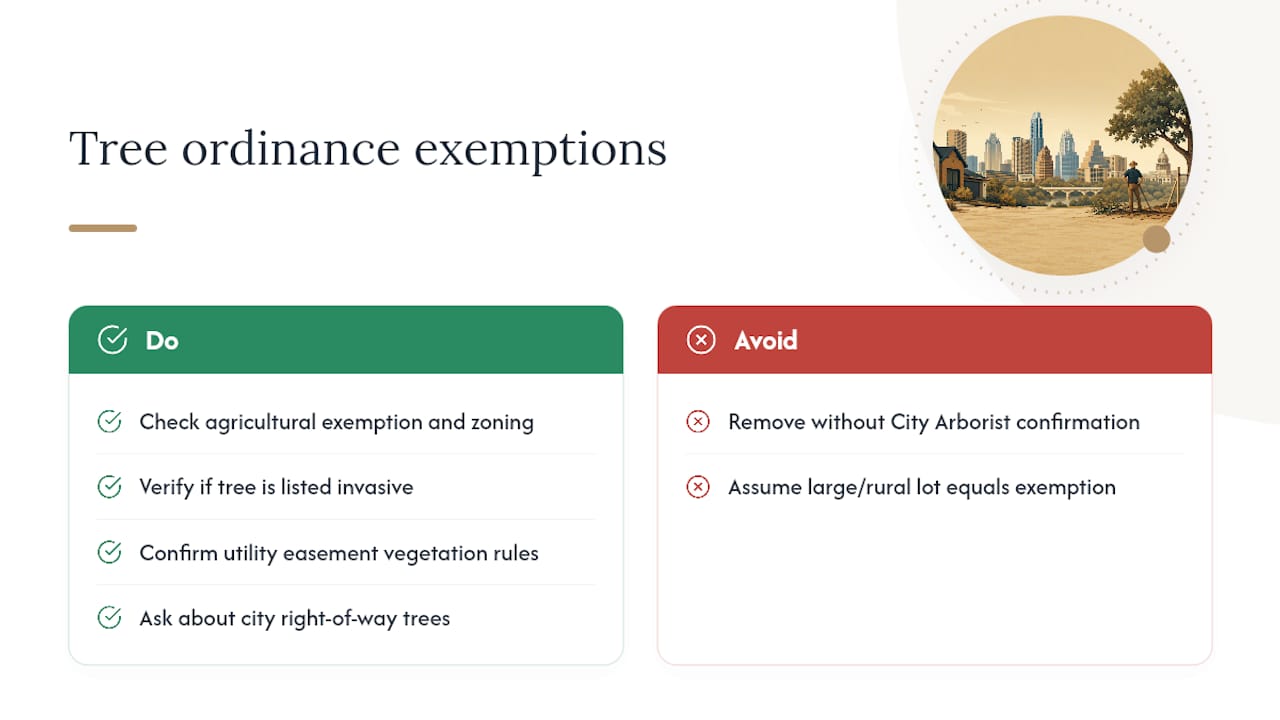
None of these exemptions are self-executing. Assuming your situation qualifies without confirming it with the City Arborist is exactly how owners end up facing an ECV for a tree they genuinely believed was exempt. If you think your project might qualify for something outside the standard permit path, ask before you cut. It’s a five-minute phone call against a potential misdemeanor citation.
Updates or Recent Changes to the Austin Tree Ordinance
Austin’s tree regulations live inside the Land Development Code, specifically LDC 25-8, alongside detailed technical standards in the Environmental Criteria Manual. Both documents get periodic revisions as the city adjusts preservation criteria, mitigation formulas, and survey requirements based on development pressure and canopy loss data.
Rather than memorizing a static rule set, treat this ordinance as a living document. The Environmental Criteria Manual Section 3 in particular gets amended when the city refines what counts as CRZ disturbance or updates engineering standards for construction near protected trees. The UFRF payment-in-lieu rate is also the kind of figure that can shift as the city reassesses replacement tree costs over time.
The practical takeaway: don’t rely on secondhand summaries, including this one, for the exact current fee schedule or technical threshold on a project with real money at stake. Confirm the current rate and requirement directly with the City Arborist program before filing, especially on Heritage tree projects where mitigation costs can run into five figures.
Roles and Contact Information for Relevant City Departments
The City Arborist Program, housed within Austin’s Development Services Department, is the primary authority on tree ordinance compliance. Arborist staff review TORA applications, conduct site visits, make DDI determinations, and have final say on mitigation adjustments.
For most property owners, the practical entry points are:
- Development Services Department, which houses the AB+C permitting portal where every TORA gets filed and tracked.
- City Arborist staff, reachable through the Development Services front desk for pre-plan consultations and site visit requests.
- 311, Austin’s general service line, which is also where neighbors report suspected unpermitted removals, so it’s worth knowing this is the same channel that can trigger an inspection on your own property.
Larger commercial and multifamily projects typically interact with the City Arborist through the site plan review process rather than a standalone TORA, since tree survey requirements get folded into the broader development review.
Community Resources and Urban Forestry Programs in Austin
Austin’s approach to tree preservation extends beyond permit enforcement into active canopy-building programs. The city periodically dedicates funding and volunteer coordination toward expanding tree cover in neighborhoods with thin canopy, often prioritizing areas that lost trees to development or storm damage.
Homeowners’ associations and neighborhood groups in tree-heavy areas like Lake Austin or Tarrytown frequently coordinate informally with the City Arborist’s office on preservation questions that affect multiple adjacent properties, particularly when a shared Heritage tree straddles a property line. If you’re dealing with a boundary tree dispute, that kind of coordination tends to produce a better outcome than each owner filing separately.
The Urban Forest Replenishment Fund itself functions as a community resource in a real sense: money collected through payment-in-lieu mitigation gets redirected into public tree planting, which means individual removal decisions on private lots indirectly fund canopy restoration elsewhere in the city. It’s worth understanding this cycle if you’re weighing on-site replanting against a UFRF payment, since both paths ultimately support the same broader goal of maintaining Austin’s tree cover.
Official City Pages and Documents to Bookmark
Bookmark these before you start any project involving a tree:
- City Arborist — permit overview and how to request a consultation.
- Trees on Residential Property — TORA requirements and residential thresholds.
- Trees on Commercial and Multifamily Property — 8 inch threshold and survey rules.
- Dead, Diseased and Imminent Hazard Trees — DDI determination process.
- Environmental Criteria Manual Section 3 — CRZ and preservation criteria detail.
Agent Perspective: How Tree Ordinance Issues Commonly Affect Listings
Tree permits routinely stall renovation timelines and resurface during closing negotiations when mitigation costs surface late. Experienced agents order a tree survey before listing a wooded lot, line up trusted arborists in advance, and disclose tree constraints early rather than letting a buyer’s inspector find them first.
— Mike
How real estate agents support buyers and sellers facing tree-ordinance issues
The City Arborist issues permits, not Mogavero Group, but the coordination around that process is where a transaction either stays on schedule or falls apart. Experienced agents work alongside arborists and surveyors from the earliest stages of a listing or purchase, sequencing permit-sensitive work to avoid permit delays impacting closing dates.

That means vendor referrals lined up in advance, disclosure paperwork that flags tree constraints transparently, and scheduling that accounts for City Arborist review windows rather than ignoring them until they become a problem. For lots with Heritage oaks or tight CRZ constraints, that kind of planning can help avoid renegotiations over mitigation costs late in the process.
If you’re buying or selling a property where mature trees are part of the value, or the complication, browse current Austin listings and request a consultation to talk through how tree-ordinance timing fits your specific transaction.
Sources
- City Arborist | Austin Development Services
- Trees on residential property | Austin Development Services
- Trees on commercial and multifamily property | Austin Development Services
- An Introduction to Austin’s Tree Regulations (ECM excerpt)
- Dead, diseased and imminent hazard trees | Austin Development Services
FAQ
Does Austin require a permit to remove a tree?
Yes, for any Protected Tree, generally 19 inches DBH or larger on residential property or 8 inches on commercial and multifamily sites. You’ll need to file a TORA before removal, heavy pruning, or root zone disturbance.
Can you legally trim a neighbor’s overhanging tree in Texas?
Texas law generally allows property owners to trim branches that cross onto their property line up to that boundary, but this common-law right doesn’t override Austin’s tree ordinance if the tree itself is a Protected or Heritage tree and the trim exceeds 25% of the canopy.
What trees are protected in Austin?
Trees at 19 inches DBH or larger on residential lots, and 8 inches or larger on commercial and multifamily property, qualify as Protected. Species like live oak, pecan, and bald cypress reach Heritage status, with stronger protections, at 24 inches DBH.
Can you cut down a tree in your own backyard in Austin?
You can remove a tree below the Protected Tree threshold without a permit. Once it hits 19 inches DBH (residential) or falls into the Heritage or DDI category, you need City Arborist approval first, even on your own property.