Austin Buyers: MUD vs PID in Texas, Verify PID Payoff Before You Offer
Austin buyers: how MUD taxes differ from PID assessments, when a PID can be prepaid, and which payoff numbers to get before you offer.
Austin Buyers: MUD vs PID in Texas, Verify PID Payoff Before You Offer

A MUD is a taxing district. The tax moves with your home’s appraised value forever, or at least until the bonds are retired decades from now. A PID is usually a fixed assessment tied to a specific improvement, and in many cases you can pay it off and walk away. Before you sign a contract, pull the county appraisal district record and get the district notice, then confirm the details with the Texas Commission on Environmental Quality for MUDs or the creating city or county for PIDs.
TL;DR:
- MUD taxes fluctuate with home market value and often remain high until bonds are fully paid, usually over 20 to 30 years, affecting long-term affordability.
- PIDs generally have fixed assessments that, in most cases, can be paid off early, but their type (capital or maintenance and operations) determines whether they can be fully retired or will continue as ongoing fees.
- Buyers should request district notices, bond summaries, and current assessment rolls before signing a contract to understand potential future costs and escrow treatment.
- If a property is within a MUD, the remaining bond debt transfers to the city upon annexation, and the tax rate can decline over the district’s lifespan; for PIDs, the assessment may be perpetual or for a defined term.
- Verifying district details early during negotiations prevents surprises at closing and ensures accurate budgeting for long-term property costs.
Table of Contents
- MUD vs PID Texas: A Side-by-Side Comparison
- What Is a MUD in Texas?
- What Is a PID in Texas?
- How MUD and PID Charges Affect Your Taxes, Escrow, and Mortgage
- How to Verify Whether a Property Sits in a MUD or PID
- Negotiating a MUD or PID Before Closing
- How Experienced Austin Agents Handle MUD and PID Checks
- Why the “Prepay Your Way Out” Advice Only Tells Half the Story
- Get Help Verifying District Documents Before You Offer
- Where to Verify MUD and PID Details
- Sources
- FAQ
MUD vs PID Texas: A Side-by-Side Comparison
The two structures look similar on a tax bill, but they behave completely differently once you dig into how they’re funded and how you get rid of them.
| Feature | MUD | PID |
|---|---|---|
| Who creates/governs | TCEQ petition or legislative act; elected district board | City or county ordinance under Local Government Code Chapter 372 |
| Funding vehicle | Bond-backed ad valorem property tax | Special assessment tied to a benefit formula |
| Payment behavior | Moves with assessed value | Fixed principal, set at formation |
| Prepayable | Generally no, tied to district debt | Often yes, per the ordinance or service plan |
| Typical uses | Water, sewer, drainage, roads | Landscaping, security, sidewalks, amenities |
| Tax deductibility | Usually deductible as real property tax | Usually not deductible, aside from allocated interest |
A Texas Real Estate Research Center analysis makes the core distinction plain: MUD taxes rise and fall with your home’s market value, while PID assessments are calculated once and often stay fixed until paid off. That single fact changes how you should think about long-term affordability. A MUD tax on a home that appreciates over time generally rises accordingly. A PID assessment set at $2,400 a year when the ordinance passed generally stays $2,400 a year, sometimes with modest inflation adjustments, until the term ends or someone pays it off.
Pro Tip: If you only have time to ask one question before writing an offer, ask for the PID payoff figure. If there’s no PID, ask for the MUD notice, current tax rate, and a copy of the bond summary instead.
What Is a MUD in Texas?
A Municipal Utility District is a political subdivision created under Texas Water Code Chapters 49 and 54, with authority to issue bonds and levy property taxes to pay for water, sewer, and drainage infrastructure. Developers typically petition TCEQ to form the district before a single house gets built, because raw land needs pipes, lift stations, and roads long before it needs residents.
Here’s the mechanism that surprises a lot of buyers: the developer fronts the infrastructure cost, then the MUD issues bonds to reimburse them. Homeowners repay those bonds through their annual MUD tax. If the district sits inside a city’s boundaries or its extraterritorial jurisdiction, the city typically has to consent to the district’s creation, which is why many Austin-area MUDs went through a strategic partnership agreement with the city before the first lot ever sold.
Governance runs through an elected board, usually five directors who live in or own property in the district. Early on, before many homes exist, that board might be the developer’s own staff and consultants. Voter-approval tax-rate thresholds differ by district maturity: an early-stage MUD can typically levy up to an 8% growth rate without triggering a rollback election, while a more built-out district faces a tighter 3.5% threshold, according to the Texas Municipal League. That gap exists because a young district has more debt to service relative to its tax base.
MUD bond lifecycles typically span multiple decades. As the debt gets paid down, the district’s total tax rate can decline, though a piece of it, the operations and maintenance portion, tends to stick around to fund ongoing utility costs. Buyers should know a few practical points about how this plays out:
- The MUD tax rate appears as its own line on the county tax statement, separate from city, county, and school district taxes.
- Rates are typically split between debt service (paying bonds) and operations and maintenance (running the utility system).
- If a city later annexes the MUD before bonds are fully paid off, state law requires the city to assume the remaining debt, a detail that shapes how cities negotiate annexation timing.
- Homeowners inside a MUD also pay standard usage-based water and sewer fees on top of the district tax, since the tax funds infrastructure, not consumption.
What Is a PID in Texas?
A Public Improvement District is formed under Local Government Code Chapter 372, giving cities and counties the power to levy special assessments on property owners within a defined boundary to pay for public improvements or ongoing services. The process starts with a petition, usually from a developer or a group of property owners, followed by a public hearing and a city council or county commissioners’ ordinance authorizing the assessment roll.
That assessment roll matters more than most closing documents you’ll see. It lists every parcel in the district, the benefit formula used to calculate its share, and the payment schedule. The creating authority, often the city council, has to approve and publish that roll annually, which is why a PID assessment can theoretically shift slightly year-to-year even when the underlying principal doesn’t change.
PIDs split into two functional types, and mixing them up leads to real confusion at the negotiating table:
- Capital PIDs finance one-time improvements, roads, drainage, parks, with a defined term and a payoff amount that shrinks as the principal gets retired, similar to a mortgage.
- M&O PIDs (maintenance and operations) fund ongoing services like landscaping, private security patrols, or sidewalk cleaning, and they don’t have a payoff because there’s no principal to retire, just an annual service cost.
Austin’s own PID policy shows the extent to which M&O districts can be used. The city has authorized M&O PIDs that fund public safety patrols, streetscape maintenance, and beautification in commercial corridors and some residential developments, according to Austin’s PID program page. A buyer looking at a home inside one of these districts should expect the assessment to function more like a permanent HOA-style fee than a debt you’ll ever fully retire.
How MUD and PID Charges Affect Your Taxes, Escrow, and Mortgage
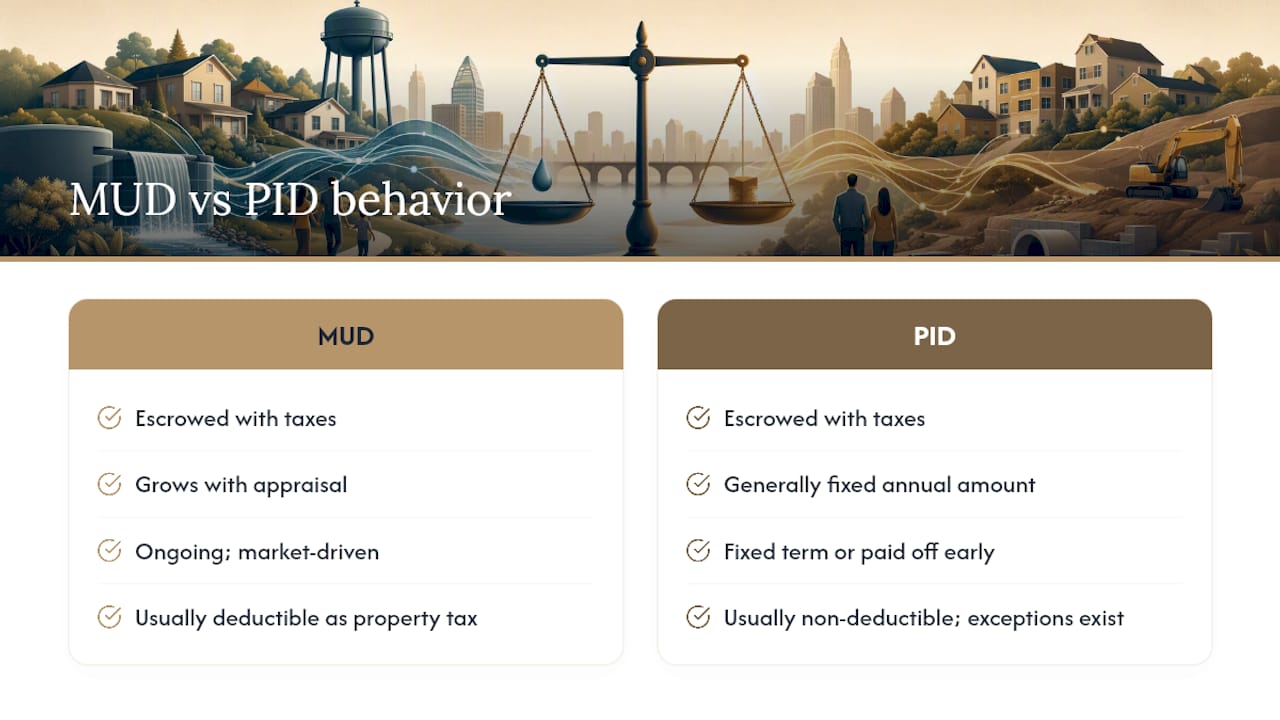
Both charges usually land on the same consolidated property tax bill you get from the county, and both typically get escrowed by your lender alongside your regular property taxes and insurance. That means a MUD tax or PID assessment doesn’t just affect your annual bill, it changes your monthly mortgage payment and your debt-to-income ratio the moment your loan officer runs the numbers.
The deductibility split is where a lot of buyers get tripped up. MUD ad valorem taxes are generally deductible as real property taxes on a federal return, the same as any other property tax line. PID assessments are typically treated differently: because they fund a specific improvement or service rather than general government functions, they’re usually not deductible, except for any portion allocated to interest or ongoing maintenance in some cases. This isn’t a small distinction if you’re budgeting your after-tax housing cost, and it’s worth a conversation with a CPA before you assume a PID line item works the same way a MUD tax does on your return.
Here’s a concrete way to see the difference in practice. For example, a home in a MUD-only district may have a MUD tax rate that adds several thousand dollars annually to the tax bill, with the amount rising if the home’s appraisal increases. Compare that to a PID assessment with a generally fixed annual amount for a set term to fund neighborhood landscaping. The MUD number grows with the market. The PID number generally doesn’t move until the term ends or someone pays it off early.
Loan officers should flag district charges early, not at the final underwriting stage, because escrow treatment can vary. Some lenders won’t escrow a PID assessment until they’ve seen the actual assessment roll and payoff terms, according to a Texas A&M AgriLife Extension breakdown of PID mechanics, while others require the buyer to carry it as a separate line item outside escrow depending on loan type. If you’re a buyer, ask for a written estimate that includes every district charge before you get too far into the process, not after you’ve locked a rate.
How to Verify Whether a Property Sits in a MUD or PID
Follow these steps in order, and do them before you get emotionally attached to a house.
- Search the county appraisal district’s parcel record. Every parcel’s tax roll lists the taxing entities attached to it, including any MUD or PID by name.
- Request the seller’s MUD notice or PID disclosure addendum before you sign anything. Texas law requires this notice before contract execution, not after.
- Pull the PID ordinance and current assessment roll from the city or county that created it, confirming the benefit formula and remaining balance for your specific parcel.
- Check the district’s website or bond summary for outstanding MUD debt, tax rate history, and the debt-service versus operations and maintenance split.
- Get a written escrow estimate from your lender that includes the MUD tax or PID assessment, so the number you see in underwriting matches what you’ll actually pay.
Timing matters more here than in almost any other part of a Texas closing. Under HB 1543, which took effect September 1, 2021, sellers must give PID notice before contract execution, mirroring the older MUD notice requirement. Miss that window, and the buyer generally gets the right to terminate the contract, sometimes with monetary remedies if the seller knew and didn’t disclose.
Pro Tip: To find a PID payoff number, don’t call the title company first. Call the city or county department that administers the PID directly, they hold the current assessment roll and can generate an exact payoff quote tied to your parcel, usually within a few business days.
A property survey can also help confirm you’re looking at the correct parcel boundaries when district maps don’t line up neatly with subdivision plats, which happens more often than you’d expect in newer developments.
Negotiating a MUD or PID Before Closing
Once you know a property carries a PID assessment, you have real leverage in negotiations, more than most buyers realize. A seller can pay off the assessment before closing, wiping the lien clean. Alternatively, the buyer can assume the remaining balance with full written disclosure, or the parties can agree to a price credit that offsets the assessment instead of a formal payoff. Some deals use an escrow holdback when the payoff amount isn’t finalized by closing day, releasing funds once the title company confirms the exact figure.
A PID assessment that isn’t paid off or credited at closing conveys with the title as a lien against the property. That’s worth repeating because buyers sometimes assume it disappears with a change of ownership. It doesn’t. Whoever owns the parcel owes the remaining balance, which is exactly why the payoff request matters so much during option period negotiations.
MUD taxes work differently, and this trips up buyers who assume every district charge can be negotiated away the same way. You generally cannot retire a MUD tax with a single-parcel payoff, because the tax funds district-wide bonded debt, not a per-property assessment. There’s no lien to release and no check to write that makes it go away. Instead, you model it into long-term affordability the same way you’d model property tax growth, and you factor in that the rate may fall as bonds retire over the district’s 20 to 30-year lifecycle.
Before closing, confirm your title and escrow file includes:
- The signed MUD notice or PID disclosure addendum, dated before contract execution
- A recorded payoff statement if a PID assessment was retired as part of the deal
- A current tax certificate showing all outstanding amounts owed to every taxing entity, MUD included
How Experienced Austin Agents Handle MUD and PID Checks
Agents who work Austin’s fast-growing suburbs treat district paperwork as a first-week task, not a closing-week scramble. That means requesting the MUD notice or PID disclosure addendum the moment a property enters serious consideration, pulling the assessment roll before writing an offer, and flagging any outstanding bond summary that could affect long-term tax growth.
This diligence should be built into the buyer representation process from the start. Rather than discovering a PID assessment during the option period, buyers working with an agent who models district charges into affordability from day one avoid the scramble that comes from a last-minute surprise on the closing disclosure. That includes coordinating directly with lenders to confirm how a specific loan program will escrow district charges, since treatment varies by lender and loan type.
When a PID payoff is on the table, having someone who knows how to request the exact figure from the city and negotiate it into the purchase agreement, rather than leaving it as a vague line item, changes the outcome of the deal. The firm’s private listing access also gives buyers a way to see off-market properties where district status and paperwork are already vetted before the home hits public search.
Why the “Prepay Your Way Out” Advice Only Tells Half the Story
Most explainers on this topic stop at “MUD taxes rise with value, PID assessments can be paid off,” and treat that as the whole answer. It’s accurate, but it undersells how much the type of PID changes the calculus. A capital PID with a 15-year payoff schedule behaves nothing like an M&O PID funding permanent security patrols. One has an exit. The other doesn’t, ever, unless the city dissolves the district.
The advice I’d push back on hardest: buyers who avoid MUDs entirely because “taxes go up forever” are often making the wrong tradeoff. A well-managed MUD with a mature bond schedule can have a lower effective rate than a fresh MUD carrying early-stage debt, and that rate often declines over time. Meanwhile, an M&O PID’s service costs can climb with inflation just as easily.
What actually matters is reading the bond schedule and the assessment roll, not the district’s label. Get those two documents before you get emotionally invested in a listing photo.
— Mike
Get Help Verifying District Documents Before You Offer
Chasing down a MUD notice, a PID assessment roll, and a lender’s escrow policy on your own eats into the option period you need for inspections and financing. District verification should be integrated into buyer representation from the first showing, so clients know what they’re signing before contract execution, not after.

If you’re evaluating a property that might sit in a MUD or PID, reach out for a review of the district paperwork before you submit an offer. That includes pulling the assessment roll, requesting a payoff figure if one applies, and confirming how your lender will treat the charge in escrow. Start with buyer representation and get a straight answer on what a property’s district status actually means for your monthly payment, not a guess you find out about at closing.
Where to Verify MUD and PID Details
- Texas Commission on Environmental Quality for MUD formation records and district search tools
- Texas Water Code Chapters 49 and 54 for MUD statutory authority
- Your county appraisal district’s parcel search for confirmed taxing entities on any address
- TREC’s consumer notice forms for statutory MUD and PID disclosure requirements
Sources
- Texas Water Code (Chapters relevant to MUDs)
- Texas Real Estate Research Center — Clear as mud
- Texas National Title — MUD, PUD, or PID?
FAQ
Who Pays MUD Taxes in Texas?
The property owner pays MUD taxes, billed and collected the same way as county and school district taxes on the consolidated annual tax statement. If you have a mortgage, your lender typically collects this through escrow along with your other property tax payments.
How Do I Know if My Property Is in a MUD District in Texas?
Search the county appraisal district’s parcel record for your address, which lists every taxing entity attached to the property, including any MUD by name. You can also confirm formation details directly through TCEQ’s district records.
Is MUD Tax Separate From Property Tax in Texas?
MUD tax appears as its own line item on your consolidated county tax bill, separate from city, county, and school district taxes, but it functions as a form of ad valorem property tax. It’s generally deductible the same way other real property taxes are, unlike most PID assessments.
What Is the PID Tax in Texas?
A PID assessment isn’t technically a tax. It’s a special assessment set by a city or county ordinance under Local Government Code Chapter 372 to fund specific improvements or ongoing services within a defined district. Capital PID assessments often have a fixed payoff amount, while M&O PID assessments fund recurring services with no principal to retire.