Capture Rainwater in Austin and Claim Up to $5,000 in Rebates
Practical Austin guide to sizing, costs, permits, and rebates: tank examples, cost ranges from $80 barrels to $30,000 potable systems, and how to claim up...
Capture Rainwater in Austin and Claim Up to $5,000 in Rebates
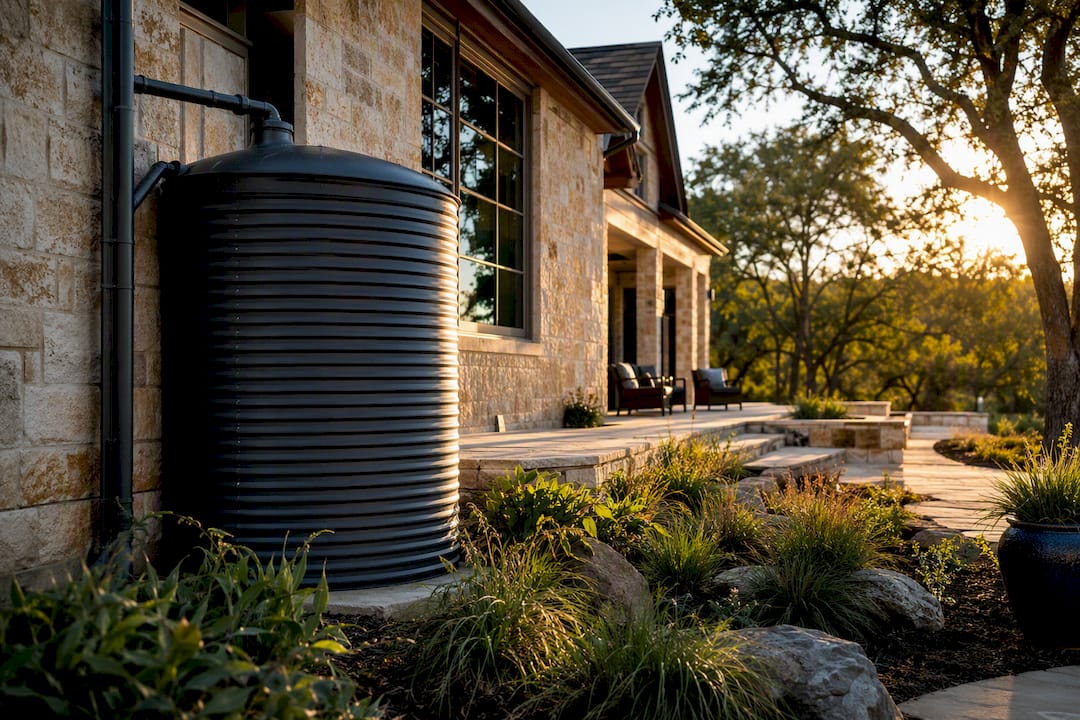
Yes, collecting rainwater is legal in Texas and in Austin, and the city pays you to do it. Austin Water offers rebates worth up to $5,000 for qualifying systems, and Watershed Protection reduces your monthly drainage charge if you capture stormwater on-site. The real first decision isn’t legal, it’s practical: are you collecting water for landscape irrigation and drainage relief, or do you want it as a household water source? That answer determines everything else, from tank size to permit requirements.
TL;DR:
- Austin homeowners can use rainwater harvesting to reduce stormwater charges, with rebates up to $5,000 for qualifying systems, especially for larger tanks.
- The typical system sizes for irrigation range from 1,000 to 3,000 gallons, while potable backup systems often require 5,000 gallons or more and extensive treatment.
- Costs vary from roughly $80 for a DIY rain barrel to over $10,000 for a full potable treatment system, with rebates and tax exemptions helping offset expenses.
- Permits are generally not required for small rain barrels but are necessary for larger, plumbed, or environmentally sensitive installations, especially in the Barton Springs Zone.
- Rainwater quality is suitable for landscape use without treatment, but drinking applications demand multi-stage filtration and regular testing for safety.
Table of Contents
- Which Rainwater Collection System Is Right for Your Austin Property?
- How Big a Tank Do You Actually Need?
- What Does a Rainwater Collection System Cost in Austin?
- Do You Need a Permit, and How Do You Qualify for Discounts?
- DIY or Hire a Pro: How to Vet a Rainwater Contractor
- How Do You Maintain a Rainwater System Once It’s Installed?
- How to Apply for Austin Rainwater Rebates: A Step-by-Step Plan
- What Should You Know About Austin’s Seasonal Rainfall Patterns?
- Is Collected Rainwater Safe? What About Water Quality Testing?
- How Does Rainwater Collection Support Austin’s Water Conservation Goals?
- What Can You Actually Use Collected Rainwater For?
- A Local Real Estate Perspective on Rainwater Systems and Property Value
- Where to Go for Official Rainwater Collection Information in Austin
- Sources
- FAQ
Which Rainwater Collection System Is Right for Your Austin Property?
Most Austin homeowners fall into one of four setups, and picking the wrong one wastes money fast.
Rain barrels are the entry point: 50 to 100 gallon plastic drums that catch downspout runoff for garden watering. They’re cheap, need no permit, and do almost nothing for drainage relief on a large roof.
Cisterns scale up to 300 gallons on the small end and several thousand on the large end, usually made of polyethylene, galvanized steel, or concrete. These handle irrigation, fill rain gardens, and start to meaningfully offset stormwater runoff during Austin’s heavier downpours.
Pressurized systems add a pump so water reaches hose bibs, drip irrigation, or even indoor fixtures at usable pressure. Non-pressurized setups rely on gravity, which limits them to ground-level uses like soaker hoses.
Potable systems treat collected water for drinking or full household use, requiring multi-stage filtration, UV disinfection, and far more oversight than a landscaping setup.
- Rain barrels: irrigation only, no permit, the lowest cost
- Cisterns: irrigation plus drainage/erosion control, some require permits above certain sizes
- Pressurized cisterns: irrigation and limited indoor non-potable use
- Potable systems: full water supply, require treatment and inspection
If erosion or a soggy yard is your main complaint, a cistern paired with a rain garden addresses that directly. If you want drought insurance, you’re looking at a much bigger investment.
How Big a Tank Do You Actually Need?
The sizing math isn’t complicated: roof area (square feet) multiplied by rainfall (inches) multiplied by 0.623 (gallons per square foot per inch of rain) multiplied by a runoff coefficient gives you gallons harvested. Asphalt shingles run a coefficient around 0.8 to 0.9; metal roofs run closer to 0.95 because less water clings to the surface.
Here’s a worked example for a typical Austin home:
- Roof footprint: 2,000 square feet
- Average monthly rainfall: roughly 2.5 inches (Austin’s annual average lands near 34 inches, spread unevenly across the year)
- Runoff coefficient: 0.85 for a standard shingle roof
- Calculation: 2,000 × 2.5 × 0.623 × 0.85 ≈ 2,650 gallons of potential monthly yield
Statistic Callout: A 2,000 square foot roof in an average Austin month can theoretically yield around 2,650 gallons, but Austin’s rainfall is famously erratic, some months deliver almost nothing while a single fall storm dumps several inches in one day.
That gap between theoretical yield and reliable yield is exactly why irrigation-only systems and potable-backup systems get sized so differently. For irrigation, you’re storing enough to bridge dry stretches between storms, so a 1,000 to 3,000 gallon cistern usually covers a typical residential landscape. For potable backup, you need enough buffer to cover weeks without rain, which pushes many households toward 5,000 gallons or more, plus redundant filtration since running dry isn’t just inconvenient, it’s a health risk. Run your own roof numbers through Texas A&M AgriLife’s rainwater calculators before committing to a tank size.
What Does a Rainwater Collection System Cost in Austin?
Budgets vary enormously depending on what you’re trying to accomplish, and the biggest cost jump isn’t tank size, it’s whether you need potable-grade treatment.
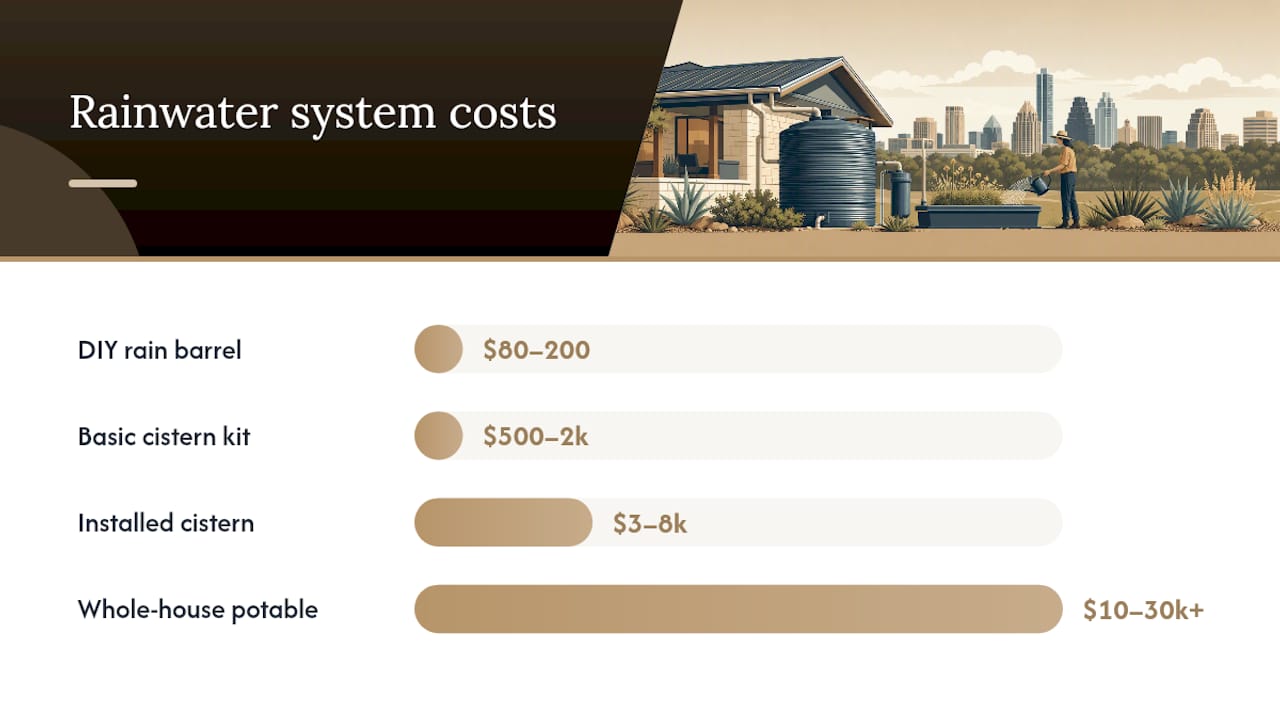
- DIY rain barrel setup: $80 to $200 per barrel, often assembled in an afternoon
- Basic cistern kit (500 to 1,000 gallons, gravity-fed): $500 to $2,000
- Installed cistern with pump and plumbing (1,000 to 3,000 gallons): $3,000 to $8,000
- Whole-house potable system with multi-stage filtration and UV: $10,000 to $30,000 or more
Statistic Callout: Texas exempts rainwater harvesting equipment from state sales tax, which shaves a meaningful chunk off larger installations where equipment costs run into the thousands.
The variables that swing your quote up or down: tank material (polyethylene is cheapest, concrete and galvanized steel cost more but last longer), filtration complexity, whether you need a pump at all, how much trenching or plumbing rerouting the site requires, and local labor rates. Permit fees add a modest line item, but they’re rarely the deciding cost factor.
Two things soften the final number. First, the state sales-tax exemption above. Second, Austin Water’s own rebate programs, up to $5,000 for a Rainwater Harvesting rebate based on storage capacity, or $0.50 per square foot (capped at $1,500) under the WaterWise Rainscape rebate for landscape conversions. Neither rebate is automatic. You apply, you document, and in some cases you get inspected before the check arrives.
Do You Need a Permit, and How Do You Qualify for Discounts?
Texas law actively supports rainwater harvesting at the state level, and the Texas Water Development Board confirms both the legal footing and the sales-tax exemption on equipment. Homeowners associations have limited authority to block systems outright under state guidance, though many HOAs still push for screening or placement rules, so check your deed restrictions before you install anything visible from the street.
Locally, Austin Watershed Protection runs the permit and inspection side of things. Small rain barrels typically skip permitting entirely. Larger cisterns, anything tied into structural plumbing, or systems in the environmentally sensitive Barton Springs Zone usually require a permit review, since runoff quality and quantity there get extra scrutiny.
- Rain barrels under roughly 100 gallons: generally no permit needed
- Larger cisterns or plumbed systems: permit review through Watershed Protection
- Systems in the Barton Springs Zone: additional environmental review likely
- Drainage-charge discount: requires an application and documentation of tank size and impervious-cover offset
The financial incentive worth chasing is the stormwater management drainage discount. A 1,000 gallon tank can reduce your monthly drainage charge by a few dollars, and discounts can offset a substantial portion of your impervious-cover fee depending on runoff capture. If you’re unsure how your property’s impervious cover factors into that fee, our breakdown of impervious cover calculations in Austin walks through the math.
Pro Tip: Photograph your tank, downspout connections, and any overflow routing before you bury or landscape around them. Inspectors and rebate reviewers both ask for this documentation, and retroactive photos are a hassle.
DIY or Hire a Pro: How to Vet a Rainwater Contractor
A rain barrel is a weekend project. Anything involving a pump, buried plumbing, or potable treatment calls for a professional, both for safety and because a botched install can void your rebate eligibility.
- Confirm the contractor holds a Texas plumbing license if the job touches household plumbing.
- Ask specifically about potable-system experience, not just general irrigation installs, since treatment design is a different skill set entirely.
- Ask who handles the permit application and inspection scheduling, some contractors include it, others leave it to you.
- Request a written maintenance plan, not just an installation invoice.
- Watch for red flags: vague quotes with no itemized parts list, no mention of local permit requirements, or pressure to skip the inspection step.
A contractor who can’t answer basic questions about Austin’s permit process probably hasn’t done many local installs.
How Do You Maintain a Rainwater System Once It’s Installed?
Neglected systems grow algae, clog filters, and eventually stop performing, which matters both for water quality and for keeping any drainage-discount registration valid.
- Monthly: clear gutter screens and inlet filters of leaves and debris
- Quarterly: check for cracks, sediment buildup, and pump function on pressurized systems
- Annually: inspect tank seals, flush sediment from the bottom, and service any UV or multi-stage filtration components
Potable systems carry stricter requirements. Sediment filters need checking every few months, and UV disinfection units need annual servicing to prevent bio-fouling, the buildup of bacterial slime that degrades water quality over time.
Pro Tip: Set a recurring calendar reminder tied to Austin’s rain seasons, spring and early fall, when debris load and pollen are highest. That’s when filters clog fastest.
Skipping maintenance doesn’t just risk contamination. It shortens tank life and can complicate future rebate or resale documentation if an inspector finds a neglected system.
How to Apply for Austin Rainwater Rebates: A Step-by-Step Plan
Getting the paperwork right the first time saves weeks of back-and-forth with the city.
- Define your goal: irrigation, drainage relief, or potable backup.
- Size your system using roof area and rainfall data.
- Check rebate eligibility on Austin Water’s program page before buying equipment.
- Confirm whether Watershed Protection requires a permit for your tank size or location.
- Get itemized quotes and schedule installation.
- Register the system for the drainage-charge discount and schedule any required inspection.
- Keep receipts, photos, and permit documents on file indefinitely.
| Step | What You Need | Common Pitfall |
|---|---|---|
| Rebate application | Proof of purchase, storage capacity documentation | Applying after installation without pre-approval |
| Permit check | System size, plumbing plans if applicable | Assuming small cisterns never need review |
| Drainage discount | Impervious-cover offset calculation, tank photos | Skipping registration entirely and missing the credit |
Most rebate denials come down to one thing: buying equipment before confirming eligibility.
What Should You Know About Austin’s Seasonal Rainfall Patterns?
Austin’s rainfall doesn’t arrive on a predictable schedule, and that unevenness shapes how you should size and manage a system. Spring, particularly May, tends to bring the heaviest rain of the year, sometimes several inches in a single week. Summer often turns dry and hot for months at a stretch, exactly when irrigation demand peaks. Fall can deliver a second smaller rain surge, and winter is generally mild but unpredictable.
This pattern means a system sized only for average monthly rainfall will disappoint you in July and overflow in May. Overflow isn’t just wasted water, a tank that spills constantly during spring storms isn’t doing much for drainage relief when it matters most, during the exact downpours that cause yard erosion and street flooding.
The practical fix is an overflow plan that redirects excess capacity toward a rain garden or permeable area rather than straight into a storm drain. That approach also supports the drainage-discount math, since it demonstrates active on-site management of peak runoff rather than passive storage that fills once and does nothing for the rest of the season.
Freeze risk is minor but real. A hard freeze a few times each winter can crack exposed pipes and pump housings if they’re not insulated or drained ahead of a cold front. Anyone installing a pressurized system should budget for basic freeze protection, it’s a small add-on cost compared to replacing a cracked pump in February.
Is Collected Rainwater Safe? What About Water Quality Testing?
Collected rainwater isn’t automatically safe for every use, and the risk level depends entirely on what you’re doing with it. For irrigation and landscape use, water quality concerns are minimal. Roof runoff picks up some dust, pollen, and bird droppings, but plants tolerate that easily.
Potable use is a different matter. Water intended for drinking or cooking needs multi-stage filtration and UV disinfection at minimum, since untreated roof runoff can carry bacteria, particularly after long dry spells when dust and animal waste accumulate on the catchment surface before a storm washes it into your tank. Testing for bacteria and, in older systems, checking for lead if roofing materials or old solder are a concern, is a reasonable annual practice for anyone relying on rainwater as a primary water source.
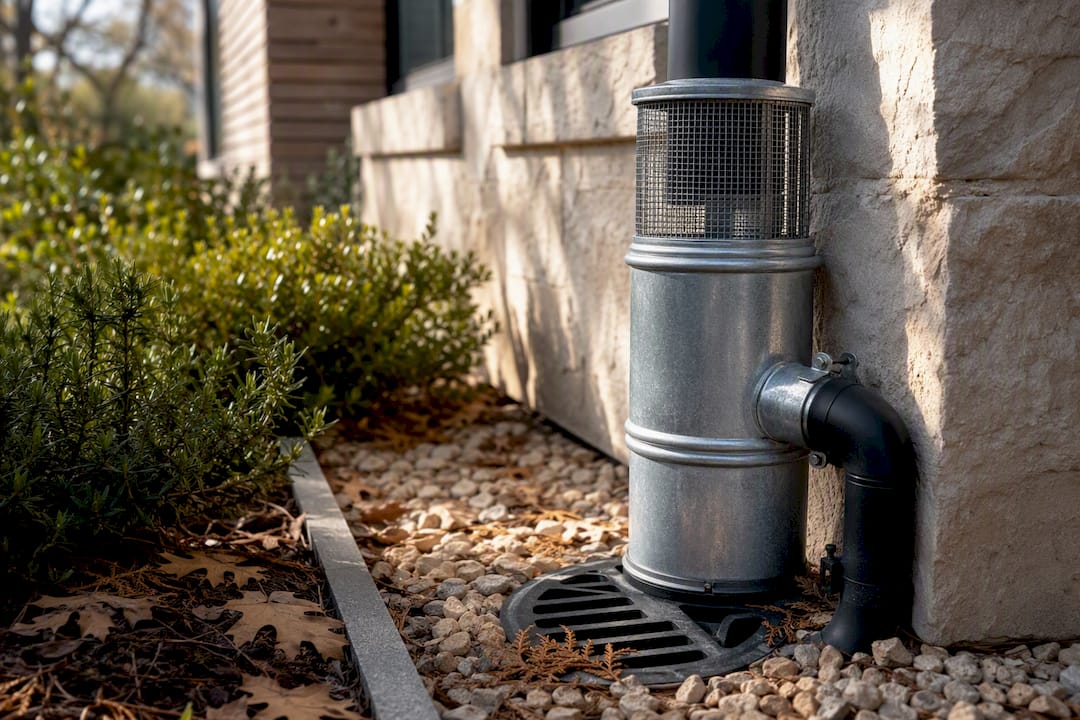
Austin’s environment adds a specific wrinkle: cedar and oak pollen season, generally late winter into spring, deposits heavy organic debris on roofs right before some of the year’s biggest rain events. A first-flush diverter, which routes the initial burst of dirty runoff away from the tank, meaningfully reduces the contaminant load reaching your storage before you even get to filtration.
If you’re using rainwater for anything you or your family will ingest, treat testing and treatment as non-negotiable steps, not optional upgrades.
How Does Rainwater Collection Support Austin’s Water Conservation Goals?
Every gallon captured and reused on-site is a gallon that doesn’t need to be pumped, treated, and delivered through the municipal system, and it’s also a gallon that doesn’t rush off your roof into a storm drain during the next downpour. Rainwater harvesting works as both a conservation tool and a stormwater management practice simultaneously, which is part of why the city incentivizes it rather than treating it as a niche hobby.
On the conservation side, using stored rainwater for irrigation reduces demand on treated municipal water, particularly valuable during Austin’s summer stretches when outdoor watering drives a large share of residential water use. On the stormwater side, rainwater harvesting functions as a recognized best-management practice for reducing runoff and erosion, which matters directly for a city built on karst limestone where excess runoff can degrade water quality in the Highland Lakes and Barton Springs watershed.
Scaled across a neighborhood, dozens of rain barrels and cisterns add up to a measurable dent in peak stormwater volume during heavy events, the exact moments when Austin’s aging drainage infrastructure gets stressed hardest. That’s the logic behind the city subsidizing individual installations rather than relying solely on large public infrastructure projects.
What Can You Actually Use Collected Rainwater For?
The honest answer is: it depends on your system type, and mixing these up is the most common mistake first-time buyers make.
Non-potable, non-pressurized setups cover garden and landscape irrigation, filling ornamental ponds, and washing outdoor equipment. This is the easiest and cheapest use case, requiring no treatment beyond basic screening to keep debris out.
Pressurized non-potable systems extend that to drip irrigation lines, outdoor hose bibs, and in some setups, toilet flushing, since flush water doesn’t require drinking-quality treatment. Some Austin homeowners integrate rainwater into gray water systems that also recycle shower and sink runoff for irrigation, though gray water plumbing involves its own separate code requirements worth checking with a licensed plumber.
Potable systems, treated to drinking-water standards, can supply an entire household, useful for rural properties or anyone building serious water independence. This is the rarest and most expensive category locally, since most Austin properties stay connected to municipal water and use rainwater as a supplement rather than a replacement.
For the large majority of Austin homeowners, irrigation and drainage relief deliver the best return relative to cost. Potable systems make sense mainly for larger acreage properties or households specifically pursuing off-grid resilience.
A Local Real Estate Perspective on Rainwater Systems and Property Value
Rainwater systems tell a story about a property beyond the water bill. On sloped or erosion-prone lots, a well-placed cistern paired with a rain garden visibly reduces runoff damage, and buyers who’ve dealt with a soggy yard elsewhere notice that immediately during a showing.
Not every buyer sees it the same way, though. Some view a large cistern as a smart, drought-ready feature. Others see it as one more system to maintain and ask pointed questions about upkeep history. Sellers do best documenting maintenance records and permit paperwork upfront rather than leaving buyers to guess. Drainage resilience is increasingly part of how Austin properties get evaluated, particularly on lots with known runoff or flood history.
— Mike
Where to Go for Official Rainwater Collection Information in Austin
Start with Austin Water’s rebate programs to apply for financial incentives, then check Watershed Protection’s permit guidance before installing anything beyond a basic barrel.
- Austin Water Rebates: apply for the Rainwater Harvesting or WaterWise Rainscape rebate
- Watershed Protection: confirm permit triggers and drainage-discount registration
- Texas Water Development Board: review state law and the sales-tax exemption
- Travis County: practical component checklists for basic system setup
- Texas A&M AgriLife calculators: run your own roof-specific sizing numbers
Sources
- Rainwater harvesting — Texas Water Development Board (TWDB)
- Rebates, Tools & Programs — Austin Water
FAQ
Is It Legal to Collect Rainwater in Austin, Texas?
Yes. Texas law explicitly supports rainwater harvesting statewide, and the Texas Water Development Board confirms both its legality and a sales-tax exemption on harvesting equipment.
Can an HOA Ban Rainwater Collection in Texas?
HOAs have limited authority to prohibit rainwater harvesting outright under state guidance, though they can typically impose reasonable placement or screening requirements, so check your community’s deed restrictions before installing a visible system.
How Much Does It Cost to Collect Rainwater?
Costs range from $80 to $200 for a basic DIY rain barrel up to $10,000 to $30,000 or more for a whole-house potable system with filtration and UV treatment, with installed cisterns typically falling between $3,000 and $8,000.
What States Legally Allow You to Collect Rainwater?
The overwhelming majority of states allow rainwater collection, and Texas actively encourages it through tax exemptions and city-level rebates rather than restricting it.
Do I Need a Permit for a Rain Barrel in Austin?
Small rain barrels under roughly 100 gallons generally don’t require a permit, but larger cisterns, plumbed systems, or installations in the Barton Springs Zone typically need review through Austin Watershed Protection.