Five Figure Lawsuits: 4 Steps to Check Austin Deed Restrictions
See why an Austin permit may not stop neighbor enforcement. Follow a 4 step Travis County and NWACA check to locate deed restrictions and avoid costly...
Five Figure Lawsuits: 4 Steps to Check Austin Deed Restrictions

Deed restrictions are private covenants attached to a property’s title, and they can limit what you build, park, or run on that land regardless of what current zoning allows. The City of Austin will process a permit that meets the Land Development Code even if a private covenant prohibits the work. Enforcement then falls to neighbors, homeowners associations, or developers named in the deed, not city inspectors. Before you buy, permit, or renovate, check Travis County records and neighborhood deed databases first.
TL;DR:
- Private deed restrictions are enforceable only by neighbors, HOAs, or developers through legal action, not by the city of Austin.
- A permit can be issued despite a restriction prohibiting the project, but neighbors can still sue to enforce or rescind it.
- Finding deed restrictions requires searches of Travis County records, neighborhood databases, and ordering a title report for accuracy.
- Enforcement costs are high and often limited to wealthier HOAs or organized groups, while individual neighbors may lack resources.
- Removing or amending restrictions depends on their specific language, enforcement history, and whether the neighborhood supports a legal or internal change.
Table of Contents
- What Are Deed Restrictions and How Do They Work in Austin?
- How Do Deed Restrictions Interact With Austin Zoning and Permits?
- How Do I Find Deed Restrictions on a Property in Texas?
- Who Enforces Deed Restrictions in Austin?
- Can You Remove Deed Restrictions in Texas?
- Which Local Databases Actually Have the Deed Restriction Documents?
- What Should Buyers and Owners Do Before They Sign or Renovate?
- An Agent’s View on Deed Restrictions and Buyer Protection
- How Mogavero Group Handles Deed-Restriction Risk for You
- Sources
- FAQ
What Are Deed Restrictions and How Do They Work in Austin?
A deed restriction is a private agreement recorded against a property’s title that limits how the land can be used. Lawyers call this “running with the land,” meaning the restriction transfers automatically to every future owner, whether they read the fine print at closing or not. You do not sign a new contract accepting it. You simply inherit it the moment you take title.
Austin properties carry a wide range of these covenants, often written decades ago by original subdivision developers. Common types include:
- Use restrictions (no short-term rentals, no commercial activity, single-family only)
- Density and lot-coverage limits that cap how much of a lot can be built on
- Building material and architectural requirements (roof pitch, exterior finishes, minimum square footage)
- Fence height, setback, and appearance rules
- Restrictions on outbuildings, RVs, or livestock
Texas law does not treat every recorded covenant as automatically valid. Under standards described by TexasLawHelp, restrictions are generally enforceable when they are reasonable and don’t violate public policy, but courts resolve ambiguous language against enforcement, favoring an owner’s free use of their property. Some clauses are void outright, including anything illegal or historically discriminatory. That’s also why well-drafted covenants from newer subdivisions often include their own amendment or expiration procedures. Older, vaguer ones frequently don’t, which is exactly what fuels Austin’s ongoing deed-restriction disputes.
How Do Deed Restrictions Interact With Austin Zoning and Permits?
The City of Austin and a private HOA are not the same enforcement body, and confusing the two costs homeowners real money. City Development Services reviews permit applications against zoning code and recorded plat notes, but it does not cross-check every private covenant sitting in a subdivision’s original deed records.
That distinction matters practically:
- The city can approve and issue a fully compliant permit even while a private restriction technically prohibits the project.
- Permit applications require applicants to acknowledge deed restrictions on the property, shifting disclosure responsibility onto the applicant.
- Plat notes occupy a middle ground. Because they’re recorded on the subdivision plat itself, city reviewers do check them, and a conflicting plat note can stall a permit at intake.
- Zoning reforms don’t erase private covenants. Recent citywide changes to entitlements, including HOME ordinance adjustments, changed what zoning allows in some areas without removing recorded deed restrictions already sitting in the chain of title.
Recent Austin cases confirm this split holds up in court. Reporting on neighborhoods like Brykerwoods and Elmwood Estates shows courts upholding decades-old restrictive covenants against development plans that were otherwise zoning-compliant. A permit in hand doesn’t mean your neighbors can’t sue.
How Do I Find Deed Restrictions on a Property in Texas?
Finding out whether a specific Austin address carries deed restrictions takes four steps, in this order:
- Search Travis County records. Start with the Travis County Clerk’s recorded documents and the Travis Central Appraisal District, which lists your subdivision’s legal name under the property’s legal description. That subdivision name is the key you’ll need for step two.
- Check neighborhood-specific databases. The NWACA deed-restrictions database organizes covenant documents by legal subdivision, and many MUD (Municipal Utility District) websites publish their own restriction PDFs section by section.
- Order a title report. A title company will pull recorded CCRs (Covenants, Conditions, and Restrictions) tied to the property and flag anything a casual county search might miss. If plat notes or lot-line questions are in play, pair that with a property survey.
- Talk to the HOA or neighborhood association. Board members and longtime residents often know about amendment history, unofficial enforcement patterns, or disputes that never made it into any public record.
Pro Tip: Don’t rely on the seller’s disclosure alone. Sellers often don’t know their own deed restrictions exist until an agent or title company digs them up, especially in subdivisions platted before 1980.
Who Enforces Deed Restrictions in Austin?
Enforcement rests entirely with private parties, since the city generally won’t step in unless it’s a named party to the covenant itself. In practice, that means a neighbor, a homeowners association, or in some cases the original developer’s successor has to file suit to make a restriction stick.
- Named lot owners within the subdivision typically have standing to sue for violations.
- HOAs with authority written into their governing documents can pursue enforcement on behalf of the community.
- Remedies usually include injunctions ordering a violation to stop or be undone, compliance orders, and occasionally attorney’s fees awarded to the prevailing party.
Defendants aren’t without options. Courts weigh waiver and abandonment defenses seriously. If a restriction hasn’t been enforced consistently, or if similar violations exist unchallenged throughout the neighborhood, judges often side with the property owner rather than the covenant.
Enforcement isn’t cheap, and that shapes who actually brings these suits. Litigation frequently runs well into five figures once discovery, expert witnesses, and appeals get involved, which means enforcement tends to concentrate in wealthier, well-organized HOAs that can afford to hire counsel. A single neighbor without HOA backing often can’t match those resources, even with a legitimate claim.
Can You Remove Deed Restrictions in Texas?
Yes, but the path depends entirely on how the restriction was written and how badly the neighborhood wants to keep it. Start with the covenant’s own amendment clause.
Where no clean amendment path exists, owners turn to legal challenges built around a few recurring theories:
- Abandonment, arguing the restriction hasn’t been enforced in years and the neighborhood’s character has already changed.
- Illegality or public policy conflicts, which can void a clause outright under Texas covenant law.
- Ambiguity, since Texas courts read unclear restriction language in favor of the property owner.
Litigation is slower and costlier than amendment, often stretching a year or more once you factor in discovery and any appeal, and success depends heavily on the specific language and enforcement history involved. An amendment vote, when the subdivision supports it, is almost always faster and cheaper than going to court.
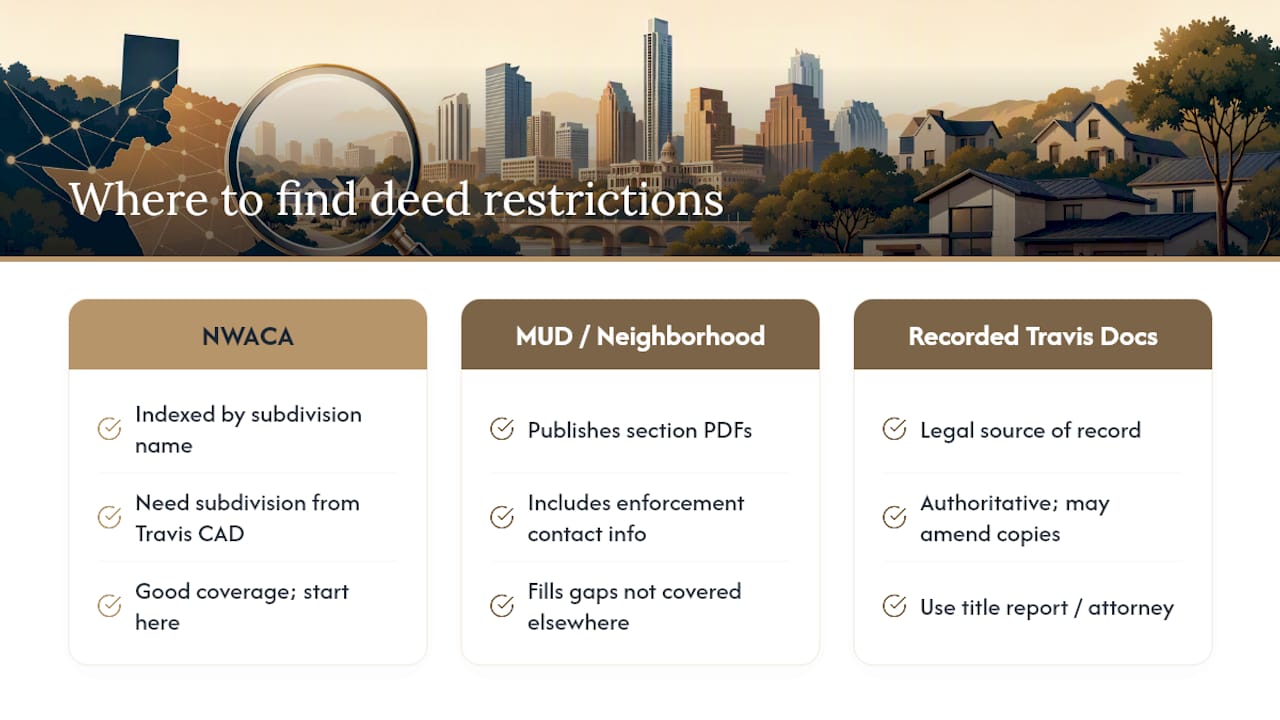
Which Local Databases Actually Have the Deed Restriction Documents?
Three resources cover most of Austin’s recorded restrictions, and knowing which one to check first saves real time.
Start with NWACA’s database, which organizes restriction documents by legal subdivision name rather than street address. You’ll need your subdivision name from Travis CAD before you can search it effectively, since NWACA doesn’t index by address.
MUD and individual neighborhood pages fill a different gap. North Austin MUD No. 1, for example, publishes its deed restrictions section by section as PDFs and runs an online complaint form for residents who suspect a violation, giving you both the document and the enforcement contact in one place.
Recorded Travis County documents remain the legal source of truth. Neighborhood-maintained copies are convenient, but they can be outdated or incomplete, especially after an amendment. When money is on the line, whether you’re closing on a purchase or planning a major renovation, a title report or a local real estate attorney is worth the cost to confirm what’s actually recorded versus what a neighborhood website happens to display.
What Should Buyers and Owners Do Before They Sign or Renovate?
Handle this in three stages, and don’t skip the middle one just because the seller seems trustworthy.
- Before you offer: Request the seller’s CCRs directly, run your own Travis County and NWACA search, and get the HOA’s contact information from the Austin Real Estate FAQs resource or the seller’s agent.
- During contract negotiation: Add a deed-restriction contingency, and require the seller to deliver recorded CCRs into escrow rather than promising to send them “later.”
- Before permitting or renovating: Share every CCR with your architect and contractor upfront, and confirm plat-note restrictions with the county before you spend money on drawings.
Pro Tip: If a project touches lot lines, easements, or shared fences, loop in a title attorney or an experienced agent before you break ground, not after a neighbor sends a demand letter.
An Agent’s View on Deed Restrictions and Buyer Protection
Deed-restriction checks aren’t a box to tick after a client falls in love with a house. They belong in the earliest days of a search, alongside title coordination and a first call to the neighborhood’s HOA or MUD contact. Skip that step and you find out about a restriction after an offer is already accepted, which is the worst possible time.
The pattern shows up often enough to matter: a buyer wants a guest house or a short-term rental unit, and a restriction buried in a 1970s-era covenant blocks it entirely, zoning approval or not. Catching that before closing changes the entire negotiation, sometimes the entire decision to buy.
— Mike
How Mogavero Group Handles Deed-Restriction Risk for You
Mogavero Group treats deed-restriction research as part of buyer representation from day one, not a surprise that surfaces during option period. That means Travis County record checks, NWACA and MUD outreach, and title coordination happen before you write an offer, not after.

If you’re weighing a purchase in a subdivision with older covenants, or you want access to private, off-market listings that come pre-vetted for exactly this kind of title complexity, that’s where local, hands-on representation earns its keep. Buyers eyeing Lake Austin or East Austin properties, in particular, often run into neighborhood-specific architectural covenants that a generic search won’t flag. Browse current Austin listings or reach out for a property review before you make an offer.
Sources
- Deed Restrictions and Development | Austin Development Services
- Nwaca
- Living With Deed Restrictions | TexasLawHelp
- Beyond Zoning: The Five-Layer Stack on Every Austin Property — Noetic
FAQ
How Do I Find Deed Restrictions on a Property in Texas?
Search Travis County Clerk records and the Central Appraisal District for your subdivision’s legal name, then check the NWACA database or your neighborhood’s MUD page for organized covenant documents. A title report confirms what’s actually recorded.
How Do I Know if My Property Has Deed Restrictions?
Order a title report, since deed restrictions attach to the property’s title and transfer to every new owner automatically. Your seller’s disclosure may not mention them if the seller never checked.
How Enforceable Are Deed Restrictions in Texas?
Restrictions are generally enforceable when reasonable and not contrary to public policy, but courts resolve ambiguous language against enforcement and can void illegal clauses outright.
Can You Get Rid of Deed Restrictions in Texas?
Sometimes, either through the amendment process written into the covenant itself (often requiring supermajority approval) or through litigation arguing abandonment, illegality, or ambiguity. Litigation is typically slower and more expensive than an internal amendment vote.
Does the City of Austin Enforce Deed Restrictions?
No. The City reviews permits against zoning code and plat notes but leaves private covenant enforcement to the parties named in the deed, such as neighbors or an HOA.